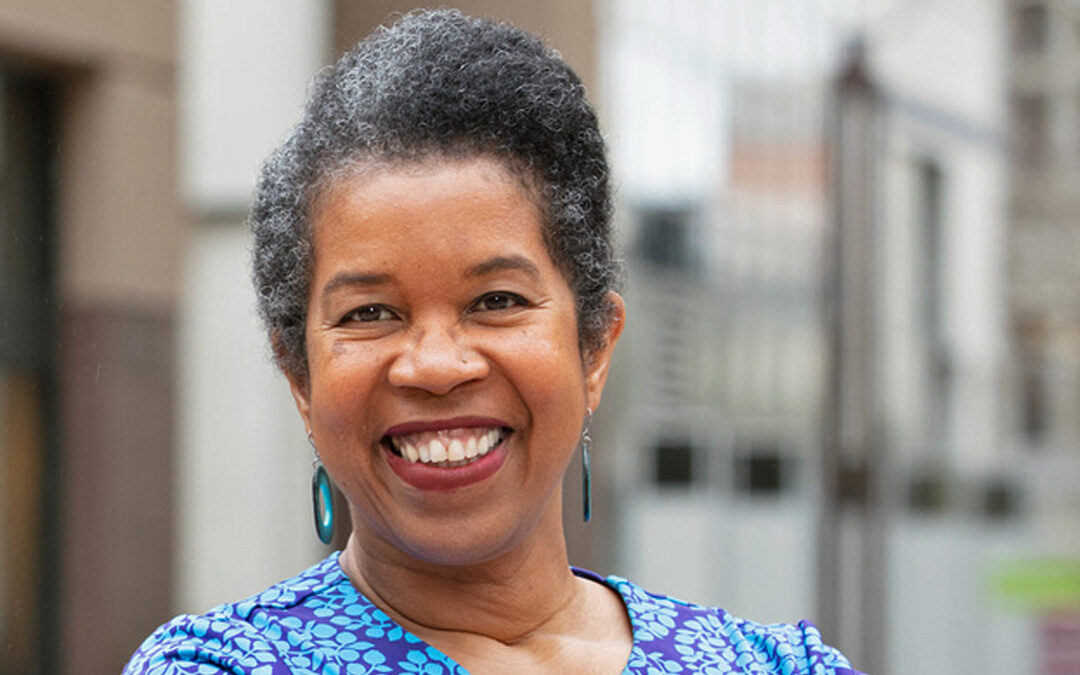
An Interview with Nikole Collins Puri, CEO of Techbridge Girls in Oakland, CA.
Sande: What do you know about leadership now that you wish you knew when you started in your role as an executive director?
Nikole Collins Puri: When I became a first time CEO of Techbridge Girls, there was a lot of work to do — creating a clear vision, strengthening the organization, fundraising, and developing a plan to scale.
Often I was so focused on “righting the ship” that I didn’t take the necessary time to bring our team and stakeholders along the way with me. What I learned is that yes, that work is important, but you also have to contextualize the work through the needs, fears, and expectations of your team and stakeholders.
As the leader, you’re delegating while trusting and empowering your team to be fully engaged with the vision so that they can deliver the work.
I’m learning to step back from the day-to-day work, make more space to nurture my creativity, and shift from doing the work to becoming a leader who guides, coaches, inspires, and uplifts the mission.
What has made me most effective is that I have showed up as a leader based on what is needed in that moment. I’ve gained the ability to adapt, be flexible and lean in. You can’t be a monolithic leader. You have to be an adaptable leader.
Sande: What one thing would you tell a new leader to do that would show they understood this idea that it’s about the people, that its’ about emotional intelligence?
Nikole: Active listening and vulnerability.
Active listening means realizing that you have to take the time to listen and understand what motivates your team, what concerns your team, what fears are within your team, what excites your team.
And yes, along may come a pandemic, which changes everything, as well as the everyday realities of working within a nonprofit, so you’ll have to bob and weave and be flexible.
Always being in that spirit of active listening is critical so that you can understand how to identify and lean into the leadership that is required in those moments of change.
And I say vulnerability with a caveat. Many people are told to be vulnerable, but as a Black woman leader, as a woman of color leader, society does not allow me to do that in full authenticity without potential repercussions or negative judgments.
So I think that as you build your currency with the organization and your board of directors – showing your competence, building relationships and trust with others– then you can start to allow that vulnerability to be expressed. Because in our society, your race and your gender is intricately connected to what you have to do to build that currency, and you can feel like you can lose everything you’ve built at any moment.
Sande: What’s important about leading change?
Nikole: You have to realize there is a pattern in the evolution of change. Folks go through a cycle where first there’s resistance, then acceptance to change, and finally there’s adoption of the change. And each of these phases can take time.
I didn’t realize the impact of not acknowledging and working through each phase of the cycle, especially the resistance phase. I think we take for granted that our team will eventually “catch up.”
As leaders, you see the long game, and you can have tunnel vision. But when we deny our teams’ feelings, we help perpetuate the resistance. So you have to acknowledge the resistance, while keeping consistency and constancy about the vision. That’s how you’ll ultimately get to acceptance and adoption.
Leading in change is knowing that it may have to go slower than you anticipated.
And going slower may mean letting go of that feeling of urgency. I think most leaders have this feeling of “we’ve got to get there, we got to achieve it, we’re passionate.” But you may need to take the time to break down the strategy into smaller bite sizes, whether that’s the work itself, or the emotional aspect of the change that’s creating tension.
So you may find that the vision that you had for that annual year goal may take two years, right?You have to ask yourself what is the impact to that slow down? You have to assess the risk.
When leading through change, you need active listening while asking yourself hard questions about the level of urgency around that change.
And finally, you’ll need to be very intentional and consistent with the messaging about why you’re making the change and how it connects back to the larger vision.
Sande: What does it mean to ask for help in your role, and what does help look like?
Nikole: First and foremost, being a leader does not mean that you have all the answers. And I think once you recognize that, you realize that you don’t have to be the smartest person in the room, you don’t have to be the go-to for the decision, and you don’t have to be the brains that comes up with the idea to move everything forward.
Once you realize that, you can get excited about asking for help because help doesn’t feel like a deficiency of something that you can’t do, but an asset that is adding onto something that you already know how to do or provide a space for growth and learning.
Asking for help is a strength versus a deficiency.
I rely on a “kitchen cabinet.” These are individuals that have been in this role before, and/or individuals that have certain types of experiences that I know I’m about to have.
So for example, when I acquired an organization while at Techbridge Girls, I didn’t know where to start. I asked some of our sister funds in the women’s funding movement that had acquired other organizations, “Who funds this stuff? Are there any case studies around it?”
Relying on a network of people that have a very broad range of skills and experiences is crucial.
You want to make sure that you have a network that is broad and expansive enough so that whenever you don’t know something, you can connect with someone who does know.
As a leader, you should authentically always be building relationships. You should be giving of yourself to others, just as you want others to give of themselves to you. That way, when you need to make that phone call, the person on the other end of the line doesn’t feel like, “oh, you just called me out of the blue.” Rather, they feel like “my friend is calling, or my colleague is calling, or my sister in this space is calling me to connect, or to ask for help. And I want to be there for her.”
Sande: How does racial justice play into your leadership practices?
Nikole: As an organization, we’re gaining greater awareness about how white supremacy culture perpetuates in our own cultures, in our own being, and how we need to navigate it. I’ve learned that white supremacist culture is almost the conditioned default for many of us.
As a woman of color leading an organization, I nowfeel like I have the language to explain my dance between the navigation of dominance and transforming it at the same time. We have language for describing the mindsets, practices and expectations of white dominant culture that do not enable us, but instead often oppress us in our authenticity. And we’re able to use that language more explicitly versus implicitly.
Language gives you a way to express something which you may know intuitively, but now you’re able to speak openly about it, with others.
I’ve built up my understanding of white supremacy culture enough to understand and acknowledge that in navigating to where I am now. I can’t deny that leaning into aspects of dominant culture has helped me in leadership positions throughout my career. But now, I have the ability to write a new story defining leadership and elevate the uniqueness and authenticity of leadership through the eyes of a Black woman.
Now that I have the language, I feel like I can be more empowering to show the staff how we are combating white dominant culture.
Sande: Anything else that you want to say? Any final words?
Nikole: I would just say give yourself a pat on the back as a leader.
It’s okay to do that. It’s okay to beef yourself up. I’m saying this because as a woman of color in leadership, I want to see us celebrated for our brilliance and approach to leadership. It doesn’t mean you’re not humble. It’s about giving yourself your flowers because you are owed it and you deserve it. And we often feel like that’s not reserved for us. We don’t need it. We don’t do this work to get patted on the back. But, it is important for our spirits.
And when you give yourself grace in that way, you do it not only in your accomplishments, but also in your shortcomings.
Also,be sure to take care of yourself – give yourself space to do that.
Go get that massage you wanted. Make sure you take that extra long stroll – not just the 30 minute walk because you need to get it in because it’s your health – but taking that extra 15 minutes of that time, where you can just wander away and wander off in thought and space and presence.
As I reflect on my own development as a leader, I’m very conscious that I didn’t grow up with the idea that leadership was something I could do. My goal was to get an education, make a good living, and work while being kind and fair to others. Leadership was something that other people did.
But as I’ve thought about my leadership journey, I can see how important it’s been to do the work of IMAGINING myself a leader so that I might take actions that exemplify, demonstrate and fulfill my values and my vision.
Let me tell you, this journey’s not done! And if there’s one thing I’ve learned in my work leading and coaching others, it is that I’m not alone.
I coach women who may be new to leadership roles, or who are expanding their imaginations so that they can see themselves stepping into these roles, so I decided to start a series of interviews with women leaders whom I admire.
I know that I find it helpful to hear the various perspectives and insights from these dynamic women and I want to share those conversations with you. I’ll be asking questions such as:
What do they know now that they wish they had known when they took on leadership roles?
What does it mean to ask for help?
How are they managing in times of great change?
How do they bring racial justice into their leadership?
“You have to realize there is a pattern in the evolution of change. Folks go through a cycle where first there’s resistance, then acceptance to change, and finally there’s adoption of the change. And each of these phases can take time.
I didn’t realize the impact of not acknowledging and working through each phase of the cycle, especially the resistance phase. I think we take for granted that our team will eventually ‘catch up.’
I’ve written about how writing saved my life, and now, on my five year anniversary of deciding to learn to draw, I want to share how drawing has completely altered the way I see the world, do my work, and live my life.
1. The drawing practice continuously opens my mind to new ways of thinking and seeing.
Learning to draw changed my way of seeing. At the same time, this process of learning to see never ends. Just today, I was taking a drawing class taught by Anita Lehmann where I was learning how to think about light and shadow when I draw. As a result, I found myself looking out the window at the trees and houses, staring curiously at the shadows. I hadn’t thought about the length of the shadows as the sun moves, or how bringing shadows into my drawing helps to unify the objects.
2. Learning to draw taught me to appreciate the many steps that a project may require.
And by project, I’m thinking about the work that goes into designing a course, or the work of creating a new intranet. These are multi-step processes that require time, research, feedback from other people, and much iteration. I used to dislike multi-step processes. I was impatient and preferred doing work that I could accomplishes in one go.
One of the ways that drawing and painting have helped me develop appreciation for multi-step projects is through the practice of layering.
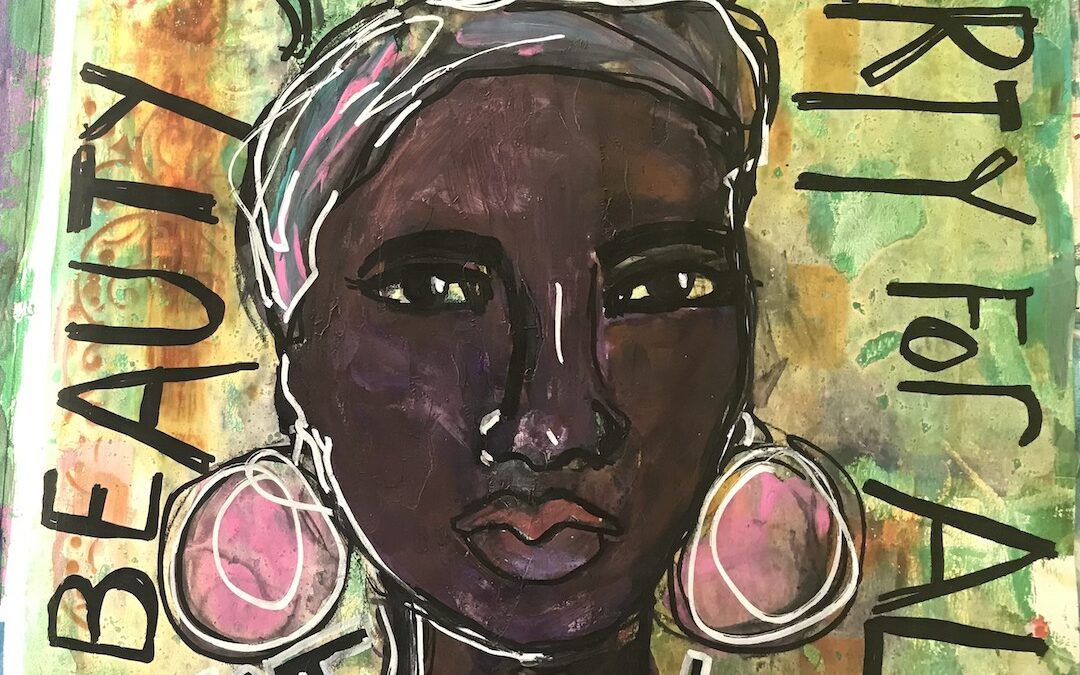
I started learning to make backgrounds – either with watercolor or through painting on a Gelli plate and then pulling the prints. That was layer one. Layer two might be random marks or collage made from painted or found papers. Layer three might be a face or flowers that I draw, followed by paint to cover up some of the background so that my drawings really stand out. And then, when I stop, pause, and look at the painting, I might notice it asking for a word or a series of words.
This practice of layering helps me to see that something beautiful isn’t created all at one time. I do a layer, stop, move to something else, then come back and add another layer. The complexity and interest of the piece evolves over time.
I see that with my work too. When I’m working on a long-term project, I know that there are going to be multiple steps before it’s done. Sometimes, when I feel impatient, I ask myself how I can approach a project like I approach my art – in layers.
I’ll get something down on the page, or call a meeting, and then go back and make the necessary additions, changes and corrections, all while appreciating the iterative nature of getting a big project done as similar to making a multi-layered piece of art.
3. Learning to draw taught me to reduce judgement and evaluation of the final product and focus instead on the process.
Drawing is a dynamic process of discovery. I enjoy the meditative state I can enter when I just focus on what I see in front of me, allowing my hand and pen to create lines on the page by slowly following the contours of what I see. I’ve learned to spend time looking, and get lost in what I’m drawing, rather than glancing repeatedly down at the page and judging what emerges.
Drawing and painting is an amazing process of watching something appear where there was a blank page and then exploring the interplay between what appears and the thoughts and connections still emerging.
Learning to draw has built my visual competence and that has had far-reaching effects in every area of my life.
I started out with just an interest in deepening my visual thinking and gaining an ability to replicate what I see. In the process I’ve discovered a passion that touches and makes more meaningful and beautiful every area of my life.
What is that thing that you’ve been wanting to try, but tell yourself you can’t, because you don’t have time, or you’re too old, or you’ll never be good at it so what’s the point?
I’m here to tell you (and show you) that it’s never too late to learn something new.
Five years ago I decided to learn to draw. You can read about that decision, why I started and how I learned, in this blog post here.
What I want to share today, as I celebrate my five year “learning something that I didn’t think I could” anniversary, is how I overcame the “you can’t do this” voice. Even if you’re not interested in learning to draw, these five steps will help you to start on that thing (you know what it is) that you’ve been wanting to do, but have been telling yourself you can’t.
1. Believe you can. Be curious to see your uniqueness.
One of the things that motivated me was showing my stepson that adults can learn something new. That it’s never too late to take classes, to be a beginner, to be confused, to stumble. Don’t let yourself be stopped by the fact that you won’t be good at something right away…or maybe ever.
In my case, with drawing, there is always going to be someone who draws better, who makes art that looks incredible and that I can feel envious of. But what’s the point of comparing and indulging in that line of thinking? Those thoughts stop me from creating. The way that I draw, paint and combine images and colors is unique to me.
What kept me going, and what keeps me learning, growing, and practicing, was realizing that comparing my art to others made me feel hollow and took away the enjoyment. And instead, I learned to be curious to see my unique way of doing things.
2. Focus on what you enjoy. Make enjoyment your goal.
Once I started learning to draw, I realized that I enjoyed the process of drawing, and that enjoyment for pure enjoyment sake was good and worthy of my time and effort. I loved the way I felt when I explored colors – so many different blues: cerulean blue, ultramarine, pthalo blue, indigo; and reds: magenta, quinacridone rose, vermilion, spectrum red, opera pink. . .wow!!!
So I kept going. Because no matter what the page looked like compared to others, the process felt good. And before I started there was a blank page, and now, it was filled.
I’d make stencils representing silhouettes of people, then make mono prints that depicted worlds in my imagination and told stories that I could describe by adding text. I savored the process of witnessing images and patterns appear on my page, then exploring the interplay between what I’d drawn and the ideas it conjured in my mind.
This dynamic process of discovery led me on, from class to class and month by month. Don’t wait to be good at whatever it is you want to start. Just focus on your enjoyment, and let the process of discovery take you to new places.
3. Follow your interests and curiosities.
While I set goals, I also allow my interests and curiosities to lead me.
For example, if you’d told me 7 months ago that I would be really into visual journaling, I would have pooh poohed the idea. But I allowed myself to follow this interest, even taking multiple classes in visual journaling with teachers like Eric Scott and Lissa Jensen – and the result is I’ve gained greater understanding of composition and my own artistic aesthetic. Visual journaling has been a path for me to continue to discover my voice and style.
4. Set up feedback loops.
When I think about how I’ve been able to persist in learning to draw and paint, I also think about feedback loops. There are lots of opportunities to set small goals and see yourself making progress toward those goals. I think of those feedback loops in a very literal way – information that is feeding and nourishing my interest and confidence in my capacity to continue to improve and operate as a visual artist.
So in the case of learning to draw – there were a number of feedback loops along the way as I saw my capacity changing. For example, one week, I didn’t know how to draw a face, and then with some information about how faces are structured and practice, I could draw a face. One month I wasn’t able to draw a face that looked anything like the person, and then with more inputs about how to see and replicate proportions more exactly, I was able to draw a face that actually looked like the person I was drawing.
There’s also feedback in terms of how I approach certain tasks in my job as a communications director. For example, three years ago, I saw designing powerpoint presentations as an annoying chore. And after drawing and painting a bit, honing my visual skills and confidence, I took a different look at powerpoints and started thinking about them as ways to provide information and experience to folks in a visually compelling way. Now I enjoy finding, or creating, images for my powerpoints and slowly developing my skill to make visually engaging presentations.
Learning to draw has built my visual competence and that has far-reaching effects in every area of my life, not least of which it is has impact in my communications life.
5. Make a commitment.
I also made a commitment in terms of time – when I set out on this journey of learning to draw, I made a commitment to give it five years before quitting, five years to see if this is what I loved and to learn what it meant to me. So this anniversary is all the more important because it’s a milestone and I know for sure that I’m re-upping my commitment. Here’s to at least five more years of art making and discovery!
What are you interested in learning? What are you excited to try and delve deeply into? What is that thing that you have always been curious about, but told yourself you were too old, or it was too late to start?
Go ahead. Do that thing. It’s never too late to learn something new.
It’s easy to judge ourselves for what we didn’t do the past year.
Lots of folks are talking about how much weight they’ve gained during the pandemic. It’s true that staying at home disrupted our usual exercise routines and cut off access to many of the practices we may have depended on for self-care. I’ve gained weight too over the past year, but instead of jumping on a diet, I’m turning first to regular exercise that is centered on moving my spine.
Over the years, I’ve learned, and relearned, that two of the most important practices I can have are mindful breathing and moving my spine.
Before the pandemic, twice a week, I went to Dr. Liz Dobbins, a doctor of chiropractic medicine who would work with my spine to release stress and tension stored in my spine and body. I did this (Network Spinal Analysis) for about two years starting at the end of 2017.
(According to a report from U.C. Irvine’s Department of Anatomy and Neurobiology, Network Spinal Analysis is a system of assessing and contributing to spinal and neural integrity, as well as health and wellness. Practitioners employ gentle force applications to the spine assisting the body’s self-regulation of the tension in the neurological system. The body naturally develops strategies for dissipation of stored tension/energy, thus enhancing self-regulation of tension and spinal interference. Download the findings here.)
I’d lay on a table and Dr. Liz would lightly touch my spine, and put me in various positions, while encouraging me to breathe in, and breathe out, consciously feeling the energy move through my body. It sounds woo woo when I say it, but I know that it made a difference to my energy levels and my attitude. After all, the spine houses the spinal cord, which is part of our central nervous system.
The first time that I lay on that table, I was SO ANGRY about the way that things were going at work and when she finished with me – just 20 minutes or so, I felt lighter, more open, and more joyful. It was truly amazing.
Although I haven’t been to Dr. Liz in a year (though now that I’m vaccinated, I’ll be going soon!), a couple months ago, I restarted my exercise program called Essentrics, created by Miranda Esmonde-White.
Every morning, I get up and do bends, stretches and reaches to strengthen my spine, improve my posture and exercise every muscle in my body. (I used to dance and the exercises remind me of the dance movements I did in my modern and ballet classes.) Within just a few weeks of doing Essentrics every morning,
I can feel myself sitting up straighter, enjoying greater flexibility and strength in my core. The movements feel delicious to do.
If you’re curious about Essentrics you can learn more about it through this Aging Backwards video featuring Miranda Esmonde-White and people of various ages who practice Essentrics. Scroll through to 22:34 to see detail about the importance of a flexible spine to good posture and health.
Even the simplest body movements can change our mood, generate energy and help us get unstuck. What can you do to move your body today?