The last few months, I’ve been taking classes that combine poetry and visuals. I’ve been learning about poetry comics, concrete poetry, erasure poems (aka black-out poems), and most recently, visual haiku. The classes are through The Writer’s Center, and are taught by Marianne Murphy.
Over the past two years, I’ve felt the part of me that loves to write entering into a bit of a battle with the part of me that’s discovered a love for making marks and shapes, playing with colors and creating images.
Intellectually, I know that there are many ways to combine words and images, and I’ve experimented with many of them: info-graphics, sketch-notes, visual journals, comics, diagrams, mind maps, powerpoints. But visual poems have really clicked for me. They feel like coming home.
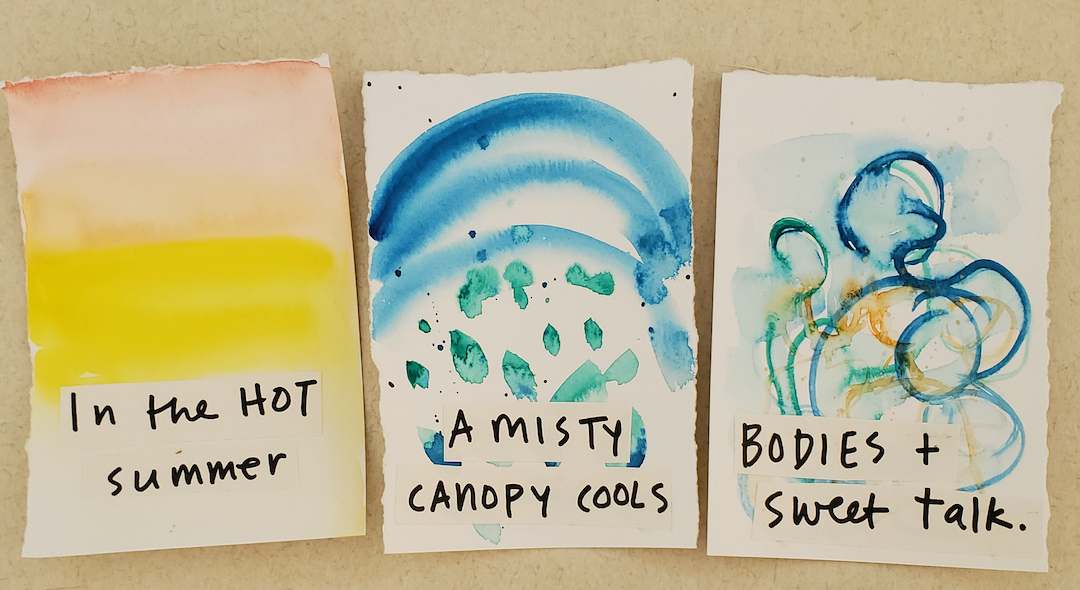
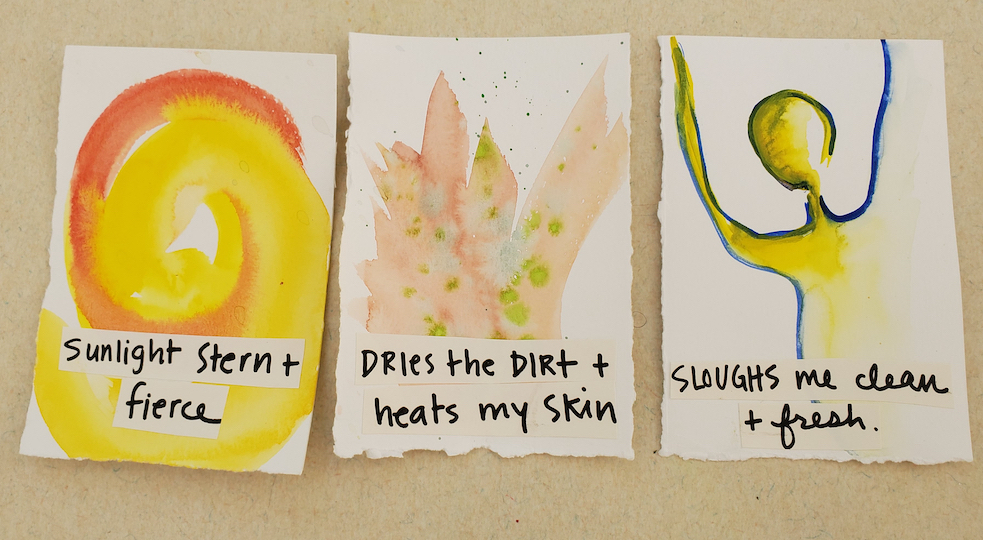
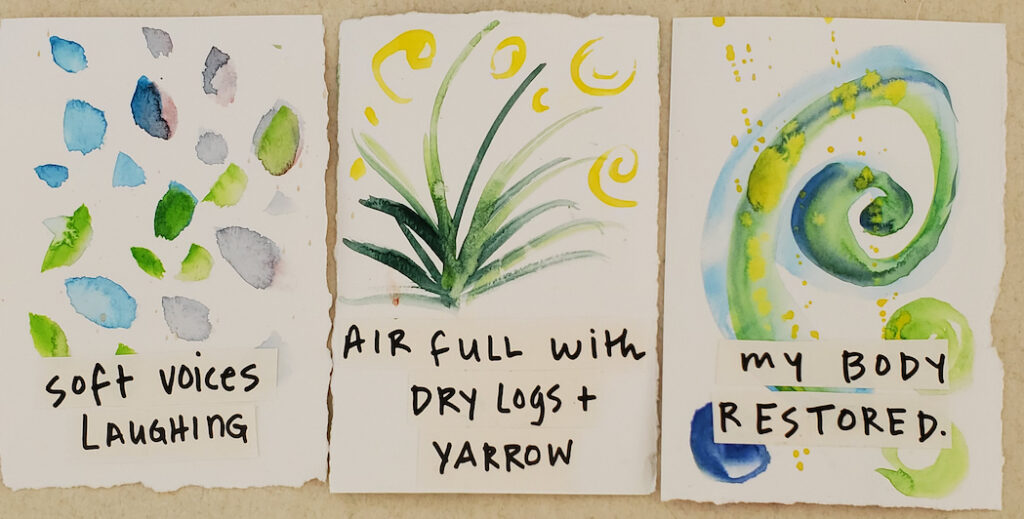
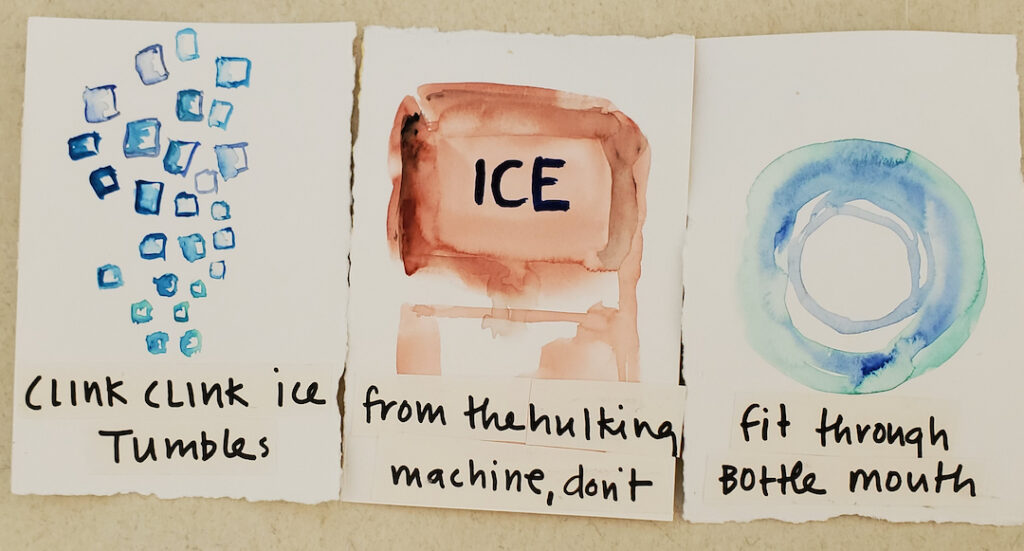
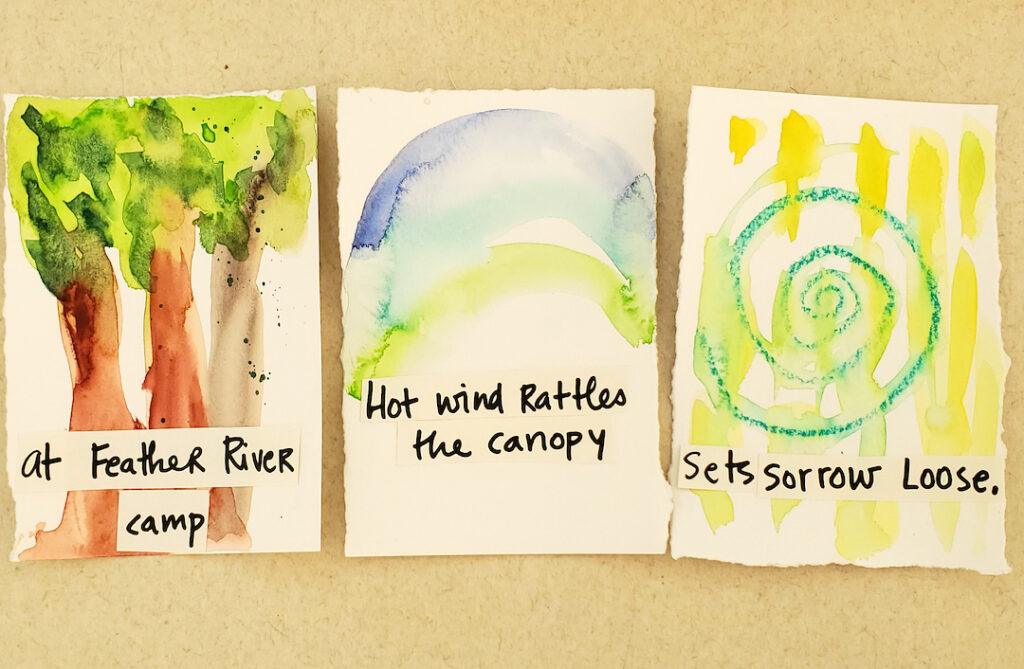
These images are from our assignment to write haiku. We were to answer questions about where we were, what we saw, smelled, heard, and what was beneath and above us.
Then, consider our emotions – what were we feeling at the time. We also were advised to consider the season we were in, because haiku often refer to the season. Once we wrote the haiku, we were to take each line and create an image.
These are some of the haiku I created while enjoying my time at Oakland Feather River Camp, a camp created in 1924 to be a refuge for the children and families of Oakland.
This was my third year there – my sweetheart and his son have been going for 19 plus years. It is a family tradition. And sadly, the fires that are burning in Plumas County are threatening this oasis.
People often ask me how they should think about the differences between mentoring, coaching and advising.
Mentoring is when someone who’s been where you are, helps you on your path.
For example, you’re a first-time communications director or CEO, and you reach out to people who’ve walked that path so that they can help you understand what that looks like.
A mentor is someone who’s willing to shine a light on the path that you’re walking and help you understand where the landmines and the opportunities are. In my interview with Nikole-Collins Puri, CEO of Techbridge Girls, she refers to the importance of having people that she can turn to who have been where she is.
A lot of us are hungry for mentors, and can find it hard to find them. I love the advice that Janet Mock gave during her 2019 Communications Network presentation.
She said, don’t try to find a mentor, just think about what you’re trying to figure out, and reach out to the person who can help you figure it out. Reach out and ask a specific question with specific parameters so that they don’t feel like they are signing up for something that is overwhelming.
Which leads me to advising.
Advising is when someone who has experience, in an area that you don’t have experience in, tells you how you navigate a situation.
You’re borrowing this person’s expertise and point of view, sharing your problem and hearing how they would handle the problem. An advisor might even say, “here’s what you should do . . . “
A coach doesn’t tell you what to do.
A coach partners with you in a thought-provoking and creative process that inspires you to maximize your personal and professional potential.
A coach focuses on what you are, and are NOT saying, while using a variety of practices to support you in gaining greater insight into your values, strengths and vision. A coach helps you to transform knowledge, learning and insight into action.
What I’ve noticed in my practice, is that ultimately, a coach helps you to gain a greater sense of confidence in who you are, and what you have the capacity to do. You can learn more about the International Coaching Federation core competencies here.
So how do you choose?
I think what’s most important is to consider that it’s not an either/or. Within a given day, you may need to call upon the experience of a mentor, the information provided by an advisor, and the empowering conditions facilitated by a coach.
What matters most is taking the time to ask yourself, what do I need now?
As a coach I see what happens when people acknowledge their anger, frustration and sadness, and allow themselves to explore what’s beneath those emotions.
When my clients can go into the emotions, when they’re curious, they have insights that open possibilities.
When I first read the literature on emotional intelligence, however, I felt a bit uneasy. I like the idea of self-awareness, but the idea of self-management raised questions for me. Who was determining what the emotional “standards” were, and from what perspective?
Some of the language made me feel I was being told to contain myself in a way that didn’t honor my culture, background, and ways of experiencing and expressing emotions.
So I was thrilled when I heard an interview with Karla McLaren, a social science researcher and author who has dedicated much of her life to understanding emotions – not to control them, but to use them as part of our intelligence. You can check out the interview: Making Friends with Anxiety and Other Emotionshere.
She encourages us to befriend our emotions, listen to what they’re trying to tell us, and learn how to channel them. I love that she uses the term channel, rather than control.
Karla has divided 17 emotions into four families, and for each of these families and the emotions within it, she provides questions that you can ask of the emotions, so you can begin to dig in and understand them.
Anger, which has to do with boundaries, rules and behaviors. The questions that you can ask when you feel anger include: What do I value? What must be protected and restored?
Sadness, which has to do with stopping, letting go, and recovering. The questions that you can ask when you feel emotions in the sadness family, include: What must be released? What must be rejuvenated?
Fear, which has to do with instincts, intuition, orienting and action. The questions that you can ask when you feel emotions in the fear family include: What actions should be taken? What truly needs to get done?
and happiness, which helps you look to the future with contentment and joy. Rather than questions, she offers statements of gratitude, which include: Thank you for this wonderful moment!
Karla uses the term emotional genius, and offers four key concepts:
1. Refrain from looking at emotions as good or bad. If we judge an emotion, such as anger as bad, then we can’t figure out what the emotion is telling us.
2. Learn to identify emotions at different intensity levels. Is your anger soft, medium, intense?
Karla provides an incredible range of words to describe the various intensities. For example in anger there are words for soft anger such as annoyed, sarcastic, displeased, for medium anger such as angry, incensed, affronted, and strong anger such as aggressive, seething, outraged.
3. Learn to identify mixed emotions, for example anxiety and rage can often be mixed.
4. Learn to channel the emotions so you that you can use their insights.
I love this model of emotional genius because it doesn’t judge the emotions or simply try to repress the ones that are inconvenient. Nor does it say that you should go around expressing each and every emotion without regard for the needs and values of others.
Rather, it supports us gaining awareness and insight so that we can channel our emotions in a way that honors who we are and what we’re seeking to be and do.
Our emotions are constantly being manipulated when we read the news, watch films, spend time on social media. We’re just not aware or taking the time to notice what emotions are being activated and why.
To be empowered and engaged in realizing our vision and our values, while making a positive difference for those we love, we must understand how to engage with our emotions, rather than run from them.
Over the last few weeks, I’ve noticed that my clients have been talking to me about feeling burned out and drained. I’ve also noticed myself delivering on a schedule this month that has included a lot of writing, presenting and moving forward big projects without much pause or rest.
Listening to and reflecting on my clients’ experiences as well as my own has me thinking about what causes us to burn out, and how we restore our energies, sometimes termed resourcing ourselves, when we’re feeling drained.
What drains you? What energizes you? Are you resting, resting deeply? How do you resource yourself when you’re tired?
Some of the ways that we can resource internally are:
Conscious breathing
Visualization – imagine being in a place you love
Noticing your feet against the floor.
Jumping up and down, moving around the room, dancing.
Doodling what’s going on inside you.
Writing what’s going on inside you.
Some of the ways we can resource ourselves externally are:
Spend time in nature
Listen to music
Infuse the room with an essential oil such as lavender or geranium
Eat something
Drink a glass of water
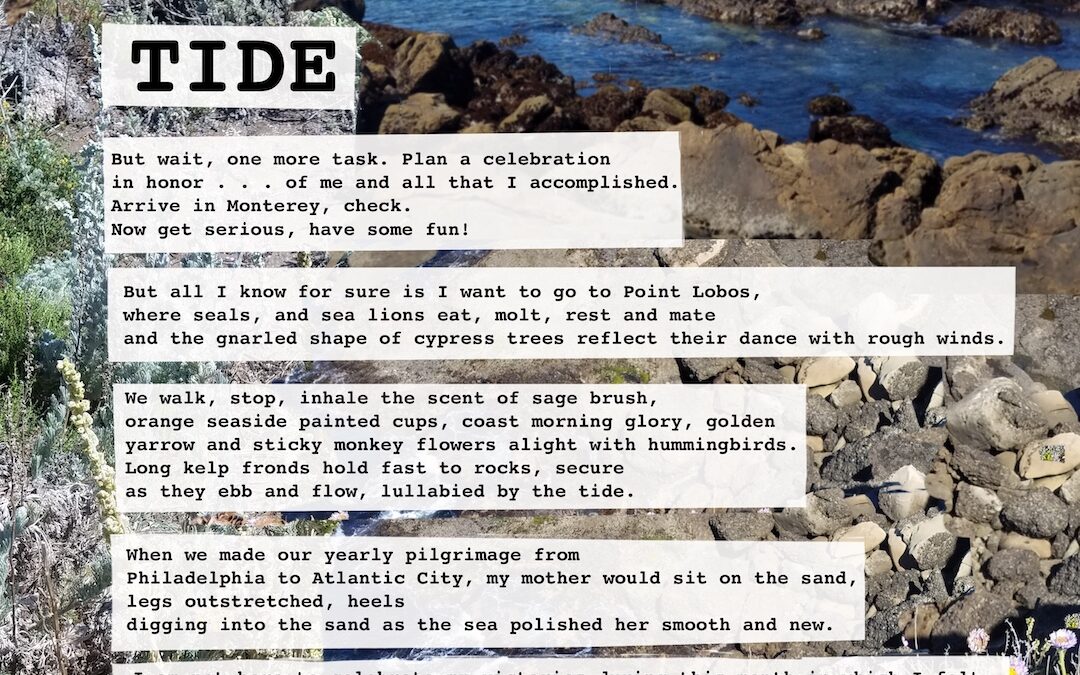
After an incredibly busy month, my sweetheart and I went to Monterey. I thought that my goal was to celebrate achieving my goals this month, but while in Point Lobos, I realized how deeply I needed to rest and receive the nurturing energy of the ocean, and to reconnect with my own rhythms, my own tides.
The trip reminded me that one of the reasons I start feeling burnt out and drained is because I don’t pause enough and rest. I don’t tune into my own ebb and flow even as I’m striving to get things done.
The tide still rises even when it ebbs and flow. So can I.
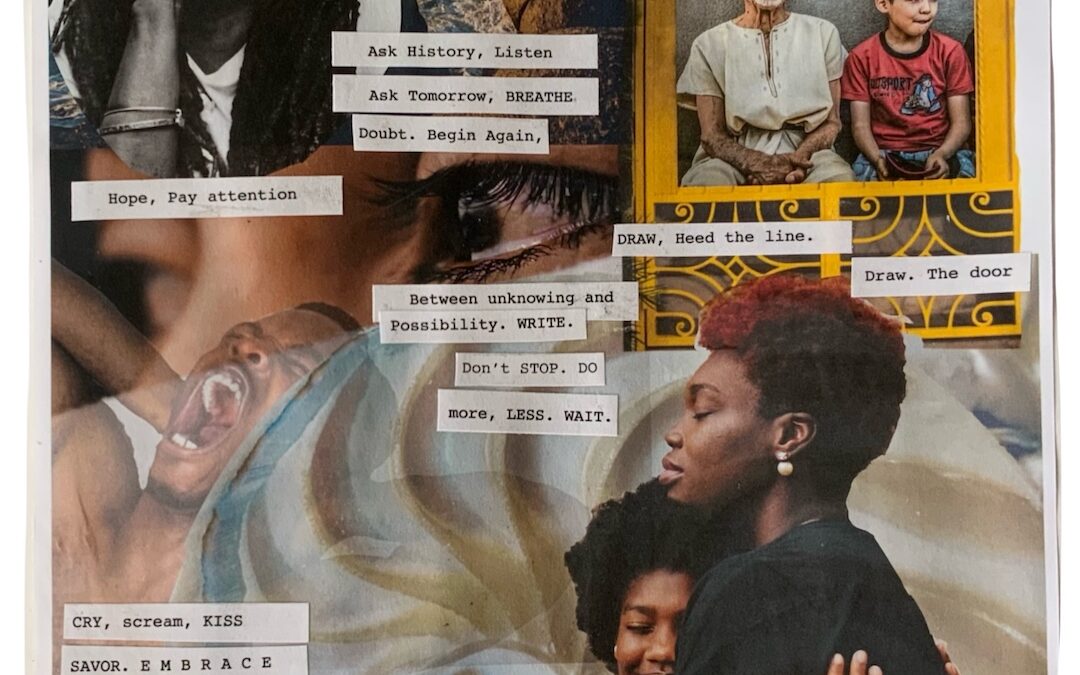
I wrote this poem to provide myself with a reminder, a mantra of sorts, when I was feeling discouraged after listening to news stories about ways that voting rights have been, and continue to be, undermined. Writing the poem restored me.
A few weeks later, I was in a class with one of my teachers, Leslie Avant-Brown of Blooming Willow Coaching, in which she talked about power. What takes our power? And what charges us?
In that class, I realized I can listen to news and absorb what’s being said in a way that drains my power, or I can take what’s being said, and use it as fuel.
In rereading the words of the poem, and adding images to them, I see how my words seek to recharge me, and remind me that I still have strength, and that my strength can be fortified if I do these things:
Turn to history to learn how others have faced the challenges that we face today,
donate to causes and people who are doing work to address the issues that I care about,
listen to young people who have ideas for different ways of thinking and doing, and
draw, write and listen to my own unknowing.
The photos in this collage were made by the following photographers: Eye for Ebony, Dan Stark, Nourdine Diouane, Luis Galvez, Giulia May and Mwangi Gatheca – all on Unsplash.