Five Steps to Help You Begin and Keep You Going.
What is that thing that you’ve been wanting to try, but tell yourself you can’t, because you don’t have time, or you’re too old, or you’ll never be good at it so what’s the point?
I’m here to tell you (and show you) that it’s never too late to learn something new.
Five years ago I decided to learn to draw. You can read about that decision, why I started and how I learned, in this blog post here.
What I want to share today, as I celebrate my five year “learning something that I didn’t think I could” anniversary, is how I overcame the “you can’t do this” voice. Even if you’re not interested in learning to draw, these five steps will help you to start on that thing (you know what it is) that you’ve been wanting to do, but have been telling yourself you can’t.
1. Believe you can. Be curious to see your uniqueness.
One of the things that motivated me was showing my stepson that adults can learn something new. That it’s never too late to take classes, to be a beginner, to be confused, to stumble. Don’t let yourself be stopped by the fact that you won’t be good at something right away…or maybe ever.
In my case, with drawing, there is always going to be someone who draws better, who makes art that looks incredible and that I can feel envious of. But what’s the point of comparing and indulging in that line of thinking? Those thoughts stop me from creating. The way that I draw, paint and combine images and colors is unique to me.
What kept me going, and what keeps me learning, growing, and practicing, was realizing that comparing my art to others made me feel hollow and took away the enjoyment. And instead, I learned to be curious to see my unique way of doing things.
2. Focus on what you enjoy. Make enjoyment your goal.
Once I started learning to draw, I realized that I enjoyed the process of drawing, and that enjoyment for pure enjoyment sake was good and worthy of my time and effort. I loved the way I felt when I explored colors – so many different blues: cerulean blue, ultramarine, pthalo blue, indigo; and reds: magenta, quinacridone rose, vermilion, spectrum red, opera pink. . .wow!!!
So I kept going. Because no matter what the page looked like compared to others, the process felt good. And before I started there was a blank page, and now, it was filled.
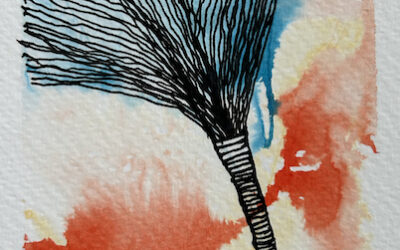
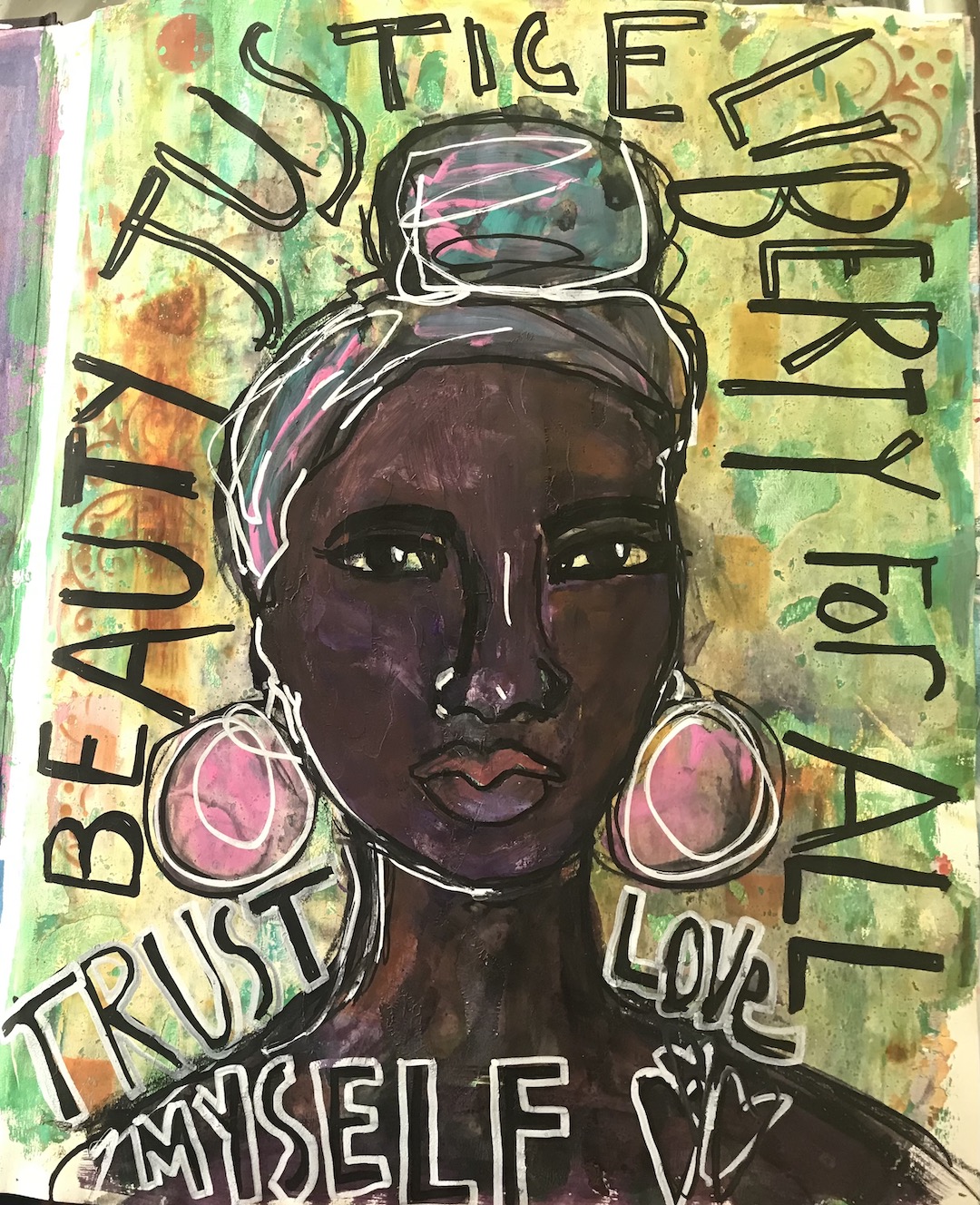
I’d make stencils representing silhouettes of people, then make mono prints that depicted worlds in my imagination and told stories that I could describe by adding text. I savored the process of witnessing images and patterns appear on my page, then exploring the interplay between what I’d drawn and the ideas it conjured in my mind.
This dynamic process of discovery led me on, from class to class and month by month. Don’t wait to be good at whatever it is you want to start. Just focus on your enjoyment, and let the process of discovery take you to new places.
3. Follow your interests and curiosities.
While I set goals, I also allow my interests and curiosities to lead me.
For example, if you’d told me 7 months ago that I would be really into visual journaling, I would have pooh poohed the idea. But I allowed myself to follow this interest, even taking multiple classes in visual journaling with teachers like Eric Scott and Lissa Jensen – and the result is I’ve gained greater understanding of composition and my own artistic aesthetic. Visual journaling has been a path for me to continue to discover my voice and style.
4. Set up feedback loops.
When I think about how I’ve been able to persist in learning to draw and paint, I also think about feedback loops. There are lots of opportunities to set small goals and see yourself making progress toward those goals. I think of those feedback loops in a very literal way – information that is feeding and nourishing my interest and confidence in my capacity to continue to improve and operate as a visual artist.
So in the case of learning to draw – there were a number of feedback loops along the way as I saw my capacity changing. For example, one week, I didn’t know how to draw a face, and then with some information about how faces are structured and practice, I could draw a face. One month I wasn’t able to draw a face that looked anything like the person, and then with more inputs about how to see and replicate proportions more exactly, I was able to draw a face that actually looked like the person I was drawing.
There’s also feedback in terms of how I approach certain tasks in my job as a communications director. For example, three years ago, I saw designing powerpoint presentations as an annoying chore. And after drawing and painting a bit, honing my visual skills and confidence, I took a different look at powerpoints and started thinking about them as ways to provide information and experience to folks in a visually compelling way. Now I enjoy finding, or creating, images for my powerpoints and slowly developing my skill to make visually engaging presentations.
Learning to draw has built my visual competence and that has far-reaching effects in every area of my life, not least of which it is has impact in my communications life.
5. Make a commitment.
I also made a commitment in terms of time – when I set out on this journey of learning to draw, I made a commitment to give it five years before quitting, five years to see if this is what I loved and to learn what it meant to me. So this anniversary is all the more important because it’s a milestone and I know for sure that I’m re-upping my commitment. Here’s to at least five more years of art making and discovery!
What are you interested in learning? What are you excited to try and delve deeply into? What is that thing that you have always been curious about, but told yourself you were too old, or it was too late to start?
Go ahead. Do that thing. It’s never too late to learn something new.