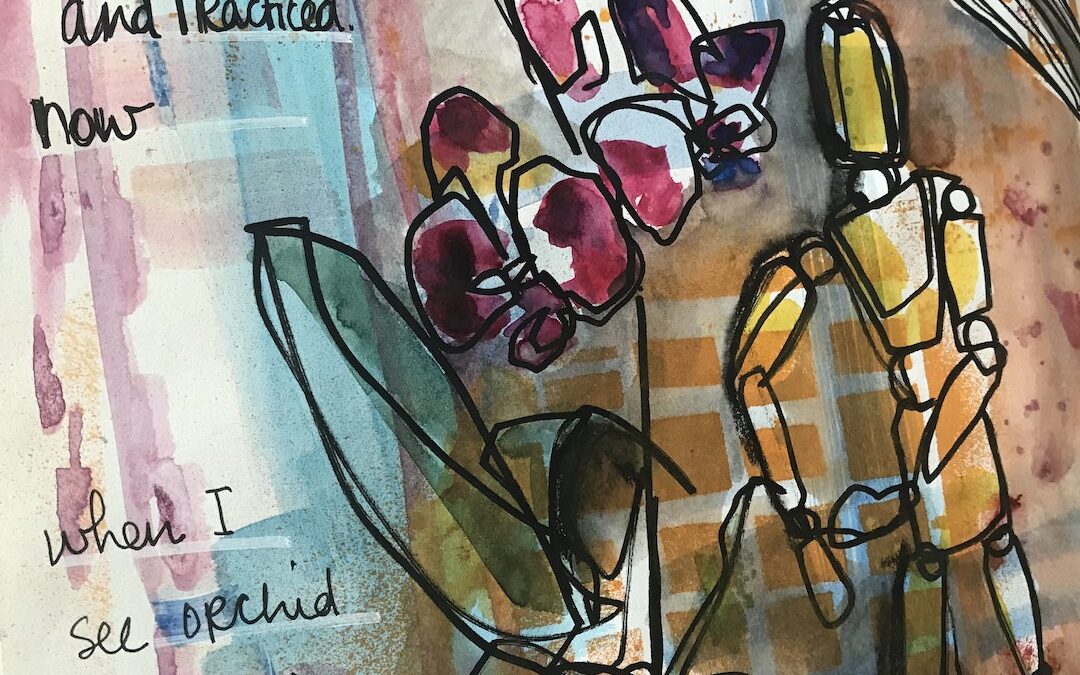
Drawing orchids used to be hard. I remember when I first tried to draw an orchid. A thank you card for a friend who had taken us into his green house to see his collection of orchids.
Drawing the orchid was HARD. I looked at photo after photo and saw so much complexity.
I practiced and practiced until I was finally satisfied with what I drew. Now, two years later, when I draw orchids, I see orchid for a moment, and then my VIEW SHIFTS. I see curves and lines, empty space and angles.
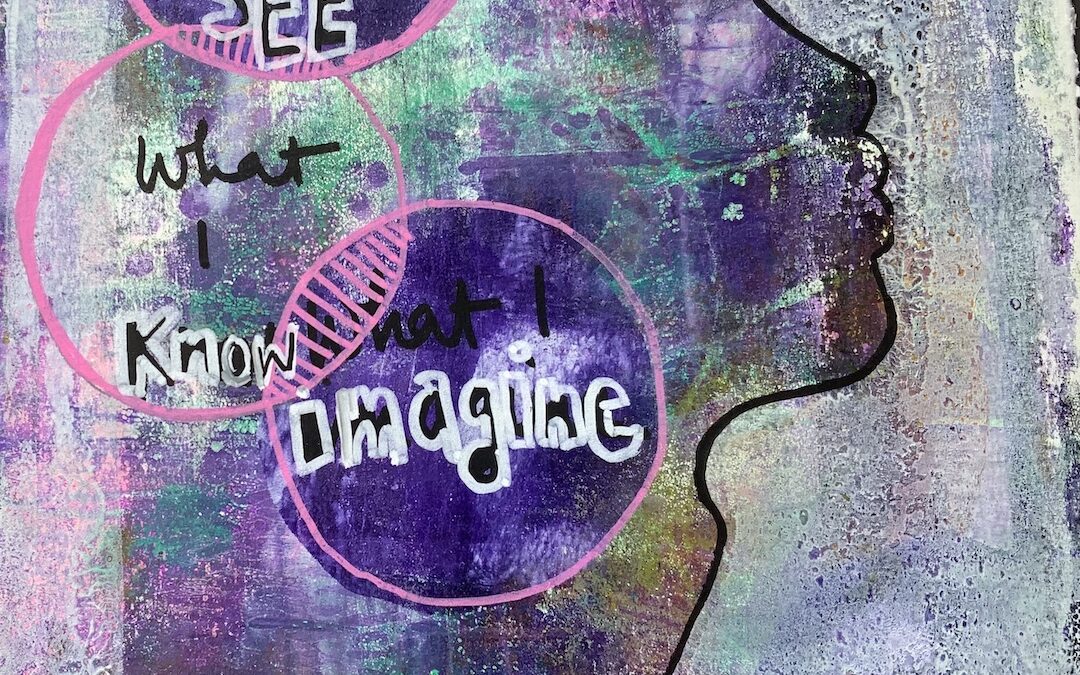
I don’t see “ORCHID” while I draw and so it’s easy to draw the orchid because it doesn’t become an orchid again – until it has transferred to my page. And then I shift back to seeing the whole as “ORCHID”.
It is a wondrous capability I have developed: to shift from seeing the named whole to the abstract parts.
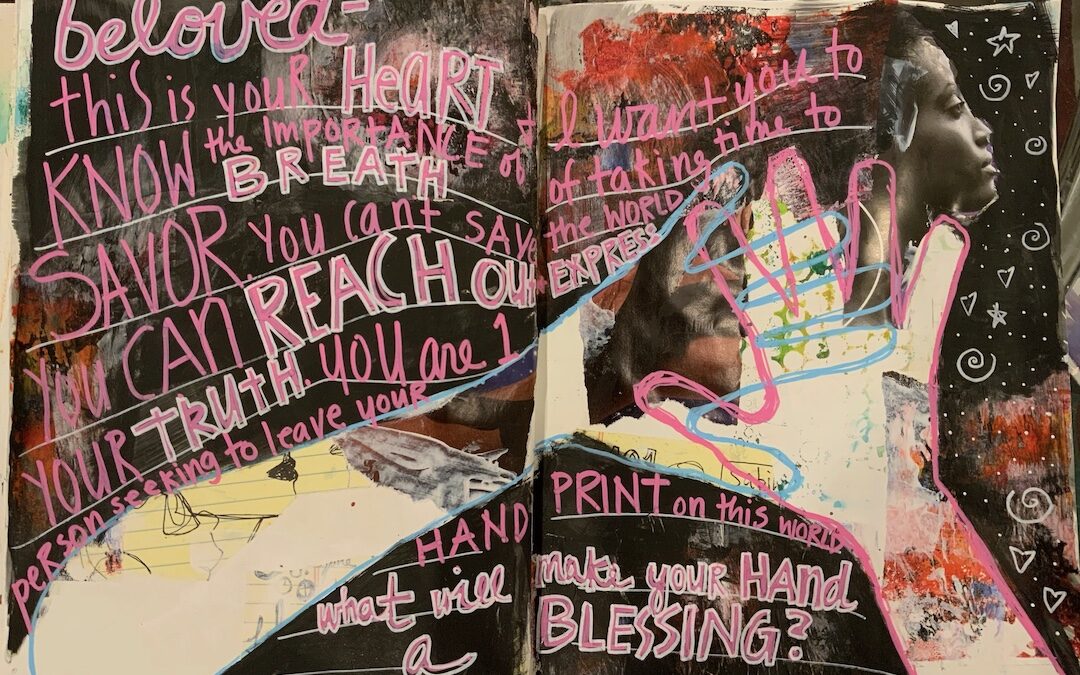
How to use your breath to connect with your body and help you focus.
Before each session with a client, I ask that we take a moment to center ourselves. I’ll often do three breaths – composed of an inhale through the nose to the count of three, followed by an exhale through the mouth to the count of six. This simple breathing exercise feels good, and helps shifts the energy.
Try it now. Inhale through your nose for a count of three, and exhale through your mouth for a count of six. Repeat a few times.
Breathing this way is something that you can do to help you reconnect with your body and shift your focus from what was going on before, to what is going on right now.
If you’re feeling scattered and all over the place, pause and take a few minutes to do this breathing exercise. This small pause will help you create a sense of calm and peacefulness. Then you’ll be ready to explore what is in front of you and focus on what is required of you.
I think of this breath-filled pause a bit like drawing a circle on the ground, then stepping into it, abracadabra. You are ready to work your magic.
As a leadership coach, one of the challenges I see my clients struggling with is how to articulate themselves clearly. We all want our thoughts and ideas to be understood and to have our voices listened to.
I help my clients work on aligning their values and their voice, a key factor to making sure that we are expressing our authentic selves, while seeking to be heard and have greater impact in the world.
One way to align your values and your voice is to take some time to pause and reflect on the voice and tone you want to bring to your topic. Once you have identified this voice, then you will have a north star that will support you as you write and speak.
These are some of the questions I explore with my clients as we’re identifying their voice. I invite you to take time to write your responses to these questions to aid you in strengthening the alignment between what you express and how you express it.
What is the voice that you want to come through in your speaking or writing about this topic?
Formal, informal? Warm, distant? A voice that questions, that answers, or that opens a new conversation? A voice that is curious? A voice that is intimate? Or something else entirely?
What values do you want to come across in your voice?
For example: do you want to convey your respect for community, or beauty, or creativity? When thinking about values, think also about your needs. What need are you expressing in your writing? Needs connect directly to values.
This is a word cloud of universal needs and values to help you think about and identify what values resonate with you. You can also do this exercise for values identification and clarification.
When you articulate your values in your writing, you can articulate your point of view.
Voice, values and point of view engage the reader more than so called objective stances.
Voice is composed on the page through the language and expressions that we use, whether or not we use first person, second person or third person, whether or not we sound like we’re talking to a friend over a cup of tea or standing at a podium delivering a talk to hundreds of people.
What emotions do you want to evoke in your listener?
Curiosity, surprise, wonderment, a sense of connection, a desire to learn more, a sense of awakening? Something else?
Rhetoric teaches that it is important to think about ethos (who you are as the speaker), logos (the intellectual concepts you are putting forth), pathos (the emotion you are seeking to elicit) and kairos (the timing, the now – why are you writing this in this moment – what has set your ideas flowing at this time?).
Think about what you like to read or listen to. What kind of voice do you most enjoy?
What qualities does that voice have? In what context is that voice most effective?
As you explore these questions, allow yourself to be curious. It may be that as you think about your audiences, you will feel a pull to use different qualities of voice. Write that down as well. The shift in voice may or may not serve, that is something to explore as you identify it.
When colleagues challenge our ideas and ways of doing things, it’s easy to get defensive.
I know that there have been painful times when I felt that a colleague didn’t trust me because of the questions they asked. When I feel that way, it becomes harder to stay clear, feel confident and build trust with the folks I’m working with.
I’ve learned a very helpful tool that I use now, thanks to a colleague’s advice to “put your thinking on the table.” There are a couple of variations: “show your thinking” or “make your thinking visible.”
Put your thinking on the table.
I’ve really leaned into this practice of putting my thinking on the table – and it’s a practice that takes effort and patience, especially when I’m feeling misunderstood. I’ve found that sharing the details of my process, “here’s what I think we should do, and here is what got me to this point,” gets me to SLOW DOWN and take my colleagues on a journey with me.
Making my thinking visible allows me to bring my colleagues into my world of associations, assumptions, and experiences. Seeing this as a practice means that I take my own way of making sense more seriously and don’t think, “Why don’t they already see that?” Instead, I think, the way that I’m seeing it is unique because it stems from my identity, knowledge, role and experience.
Making my thinking visible allows me to OWN my perceptions and my experiences through naming, claiming and sharing what’s brought me here to this viewpoint and proposal.
So try it out. The next time someone questions why you want to do something a certain way, take a deep breath, and offer to walk them through your thinking.