Learning How to Draw
Making marks, playing with color, arranging shapes, doodling, drawing and making art has helped me to claim my vision, my voice, my full self.
I have always made marks on the page. I am a writer, after all.
But I started learning to draw in 2016.
The impetus? One day, I was watching my boyfriend, Lloyd, an artist, draw some yoga poses for an assignment that he’d taken on. I noticed that he was looking up the yoga poses online, and then using the poses to guide what he drew. What are you doing? I asked. He told me he was researching the poses, learning what they look like, and then drawing his versions of them.
I was puzzled. What? Artists don’t already have the images they draw in their heads? What? Artists do research too? Of course, it made sense. As a writer, I know that research is an important part of my work. But the work that visual artists do had always seemed like magic to me.
After Lloyd explained how he used references to draw, I took myself to a café, googled the om symbol – a image that I love – and practiced drawing it. By the end of the hour, I could draw the om symbol. Wow, if I can do that, what else can I do? Then I googled art classes and signed up for one at Studio One Art Center in Oakland.
I enjoyed my class at Studio One, but when it was over, I wanted another. I had a book by Mona Brookes called Drawing with Children: A Creative Method for Adult Beginners, and knew that she had an art school in Berkeley. I called and left a message. She called me and explained her method.
I was struck by how she deconstructed the instruction process. Students don’t start out drawing 3-d objects and still lifes the way so many art schools do. If you don’t have confidence in your ability to draw at all, that’s too much of a leap. Instead, as a student, you start with drawing lines and shapes from 2-d images.
Step by step you build your capacity and confidence to make lines, shapes and connect them into recognizable images.
I signed up right away and studied at the Monart School of the Arts for a year – first with 8 – 10 year olds, and later with teenagers.
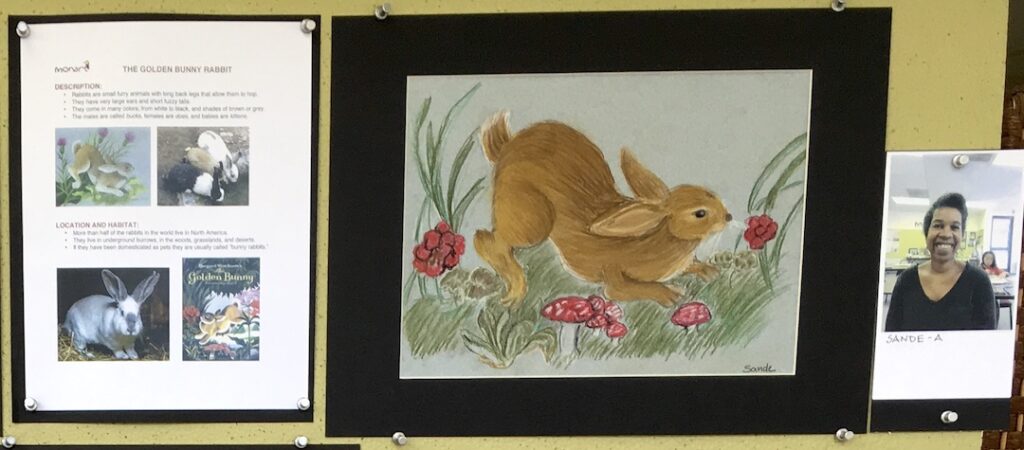
In one of my early classes, we were drawing a picture of a man playing a lute. I was proceeding along quite nicely, having drawn the outline in pencil, then inked in the drawing, and now was starting to color. Well, I got to a certain point in his pants and I made a mistake. UGH! I raised my hand and asked for white-out. Katherine, the instructor, came over and said – oh no, white-out would show through when you color in the rest.
You’ll have to make the mistake part of the design. And guess what I did, while considering how making the mistake part of the design is something I could do more of in the rest of my life.
I was always the only adult student during the Monart classes. Reflecting on the experience of those weekly classes, especially with the younger children, I can now more fully appreciate what an important part of my artistic development these experiences were.
As I watched the younger children produce their drawings during the step-by-step instructions, I saw us, all of us, drawing an image, such as a peacock, or the man with the lute, in our individual ways, maybe lines shaky, proportions a bit wonky, and yet each so beautiful and so delightful. And yes, mine was delightful too. This was mind-opening.

I took classes and practiced every day. After Monart, I continued – Berkley Art Studio, and California College of the Arts, then online classes through Creative Bug, Skillshare, Sketchbook Skool, and Carla Sonheim’s school. And that’s just to name a few.. To this day, I continue to learn and grow through taking classes, following teachers and artists online.
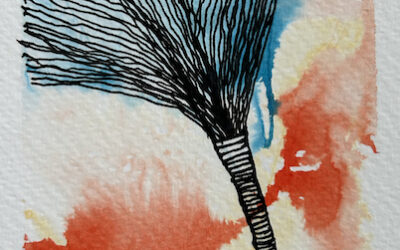
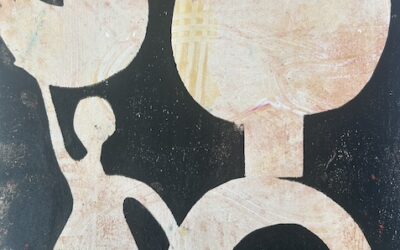
Along this path, I’ve practiced markmaking, zentangling, drawing faces, bodies, animals, flowers, buildings, learning how to use ink, brushes, watercolor, gouache, acrylics and icons.
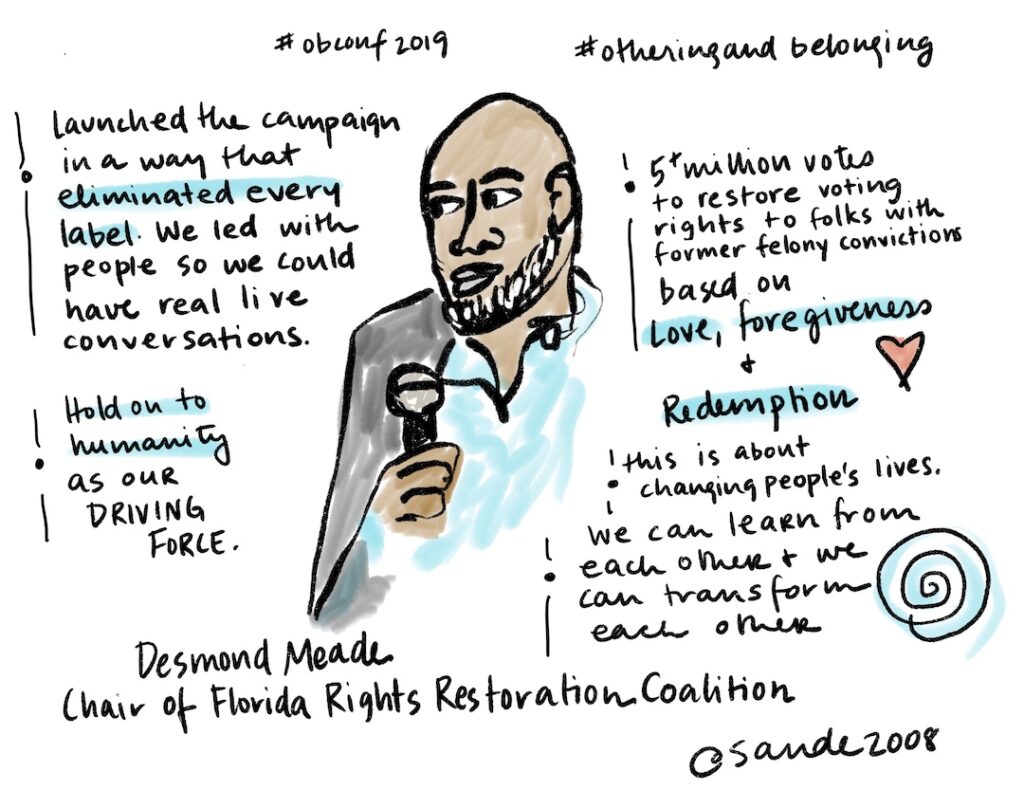
Because I wanted to be able to draw my thoughts as well as what was in front of me, I studied visual thinking and graphic facilitation and practiced diagrams, sketchnotes, mental models and visual templates. I drew from observing what I saw in front of me, and I drew from my imagination, curious to see what would emerge on the page.
I PRACTICED – one hour, two hours, sometimes more than that, every single day. No day was complete if I hadn’t drawn something.
Within weeks of committing myself to learning how to draw, I was in heaven – delighted, thrilled, ecstatic. I was in heaven because I realized I could color in and around and between the lines, no matter how perfect or imperfect my lines. I realized this because I was reading one of Lynda Barry’s books and I saw that she colored in her imperfect drawings, and the drawings were delightful. I realized that until this moment, I held a belief that you could only color in your drawings if they were perfect, that coloring was dessert.
I have learned that for me, coloring is part of the MAIN COURSE.
I was able to practice so much, draw so much, because I delighted in what I drew. I enjoyed the process, and I savored making marks and images.
Throughout this process I learned that drawing helped me to see myself more clearly and realize more about what mattered to me.
I could draw something absurd, and make myself smile, or draw something disturbing and make myself frown, wonder and reflect. I could connect one idea to another through making marks, playing with color, arranging shapes, doodling, drawing and making art.
Are you intrigued? Do you wonder if you can draw? Of course you can. If you can write, you can draw.
Here are some resources that I recommend to get you started. There are many, many resources. I am suggesting these because they are kind and encouraging, but over the next few months, I’ll share much more.
Mona Brookes, the founder of Monarts, has written two books. I recommend them both – but especially Drawing with Children, if you are a beginner.
Drawing with Children: A Creative Method for Adult Beginners, Too.
Drawing for Older Children & Teens: A Creative Method for Adult Beginners, Too
Becoming Me: A Work in Progress: Color, journal and brainstorm your way to a creative life, by Andrea Pippins. Written by artist, illustrator Andrea Pippins, this is an inspiring workbook journal that has great drawing tips. Wonderful for getting your hand moving – markmaking and coloring.
You Can Draw in 30 Days: The Fun, Easy Way to Learn to Draw in One Month or Less, by Mark Kistler. I loved doing the exercises in this book. I learned a ton through Mark’s encouraging step-by-step exercises. This guy is a zany cartoonist who loves teaching folks to draw in 3-d.
Doodling for Writers, by Rebecca Fish Ewan. This new book by cartoonist and memoirist Rebecca Fish Ewan takes writers by the hand and helps us practice lines, doodles, mental maps, diagrams and more to help us have more fun writing and moving the world.
The Drawing Mind by artist, educator Deborah Putnoi does a great job of expanding our ideas of what it means to draw. This is a great workbook that will have you following your marks, lines, and shapes into infinite worlds and possibilities.