One of my favorite ways to gather my thoughts is to make a mind map.
What is a mind map?
It’s a visual representation of your thoughts. Mind maps are radial. They spread out over your page, circles and rectangles connected by lines, a mapping of the connections between ideas. Unlike lists, which are linear, mind maps are non-sequential. They look like inky representations of tree branches connected to nodes.
When I’m stuck, I’ll often draw a mind map by placing my topic in a circle in the center of the page, then writing words around the main topic. I usually put those ideas in circles too, then take each word and brainstorm from there, drawing lines to connect ideas.
So how do you make a mind map?
There are plenty of resources out there to show you how, and at the end of this post, I’ll provide some links. One of the most passionate advocates for mind maps is Tony Buzan, and he provides very prescriptive guidance for making a mind map, which can be quite helpful. Some folks call mind maps clustering, like Gabriele Ricco whose book Writing the Natural Way is quite helpful, and there are other folks who call them tree diagrams. You can go as deep as you’d like.
I like to start out by writing in the middle of the page, the central idea that’s on my mind, and then I write down an idea that connects to it, draw a circle around that idea, and then think about what connects to the new idea, and put that next.
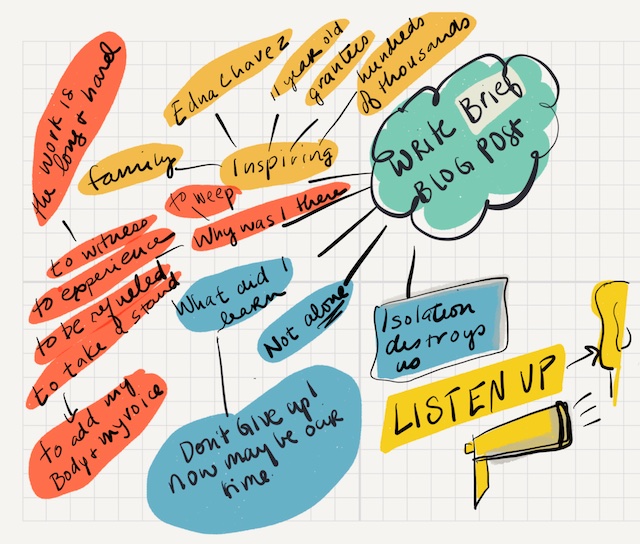
This is a mind map I drew when my head and heart were full of ideas and feelings after the March for Our Lives in March 2018.
I find that mind maps help me to organize my feelings as much as my thoughts.
After the March for Our Lives, I was full up. The speeches, the young people speaking out, the mass of people, the signage, the energy as more than 800,000 people came together to call for policy shifts that would bring an end to mass shootings. It was a lot, and I needed to pull it together to draft copy to share.
I made the mind map that you see here, and as I wrote and drew circles (I used color to distinguish clusters), I felt a sense of relief and then I felt a click. I know what I want to say. I know how I want to organize it, and the copy flowed from me.
So what about you? What’s filling you up that you want to see on the page? Take some paper – I’ll often use 11X17 paper, or I’ll do it on my ipad, make a circle in the center of the page for your main idea, and just let the ideas flow. Use color, doodle, and be open the connections that may arise between nodules. Then start again.
Here are some mind mapping resources for further exploration:
This is a good 8-minute video on Mind Mapping from Doug Neill, who is a fantastic resource for visual thinking.
Tony Buzan is widely credited as the creator of mind maps, and offers very specific guidance on how to maximize your use of mind maps. Here’s a link to the Tony Buzan Learning Resource Centre where you can learn more.
And here’s an article on clustering, which is similar to mindmapping, and a process created by writer and writer instructor Gabriele Rico: