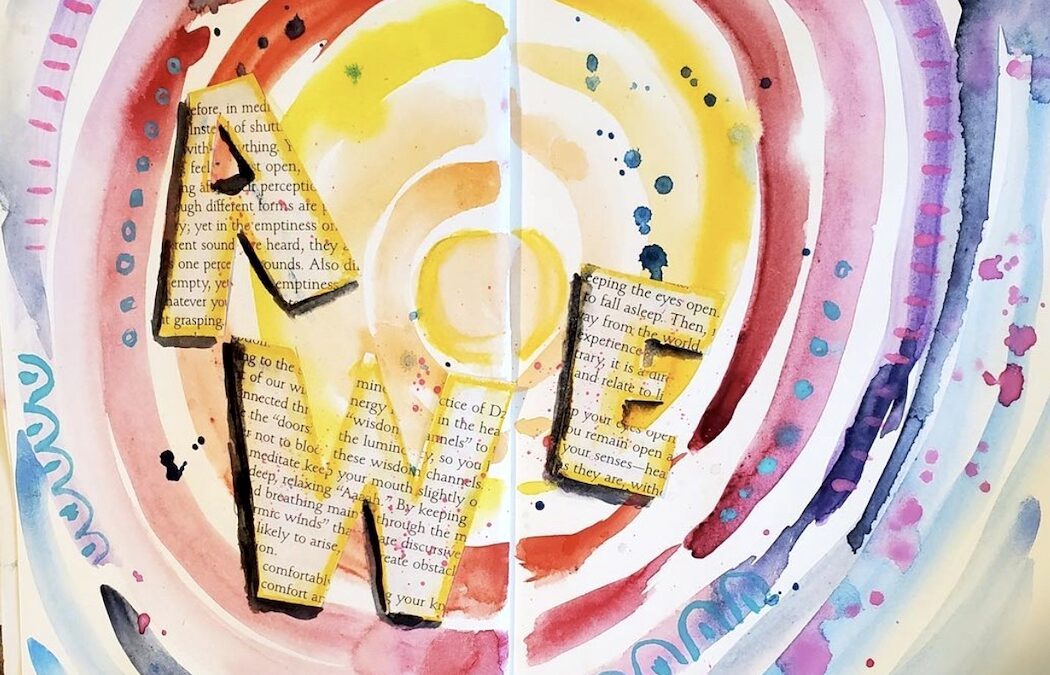
I was chatting with a dear friend and asked if he had any suggestions for my next 21 day challenge. He wanted to know if I’d heard of Dacher Keltner – a professor of psychology at UC Berkeley who researches and writes about the mental, physical and social benefits of awe.
“The feeling of awe helps us connect to others, helps us share, helps us feel like we are a part of other people. … It is an engine of exploration and discovery, and it opens up our minds and helps us look for things, discover things and see big patterns in life. … A lot of the things we love the most in life that are part of our culture are inspired by awe.”
Our lives depend on our staying powerfully, deeply, collectively engaged.
I am so angry with the Supreme Court decision overturning Roe v. Wade. It’s hard to come up with words to address the intensity of this moment that we’re in.
It is clear that we have a Supreme Court that has no respect for us – especially those of us who are Black and Brown, who are LGBTQI, who are impoverished, who are women. This decision is institutionalized hatred, the result of decades of intentional work to disenfranchise a majority of this country and disrespect our rights and our bodies.
I am overwhelmed with grief. I feel betrayed on so many levels and don’t know how to find sweetness – except in slowing down and breathing, and learning more about the roots of how we got here so that I can see what threads we might grab to disentangle where we are.
What can we do? How do we move from despair to action?
These are some of the things that I’m reaching for to help move me through this moment. Some of the actions are internal and some are external.
1 ) First of all, the importance of listening to, and feeling our emotions. I go back to this list of questions. I am reminded that anger has to do with boundaries, rules and behaviors. The questions that we can ask when we feel anger include: What do I value? What must be protected and restored?
2) Resmaa Menakem author of My Grandmother’s Hands: Racialized Trauma and the Pathway to Mending Our Hearts and Bodies had an interview with Krista Tippett in which he talks about white body supremacy – why it’s more important than ever to get real about the ways that race and racism is held in the body, not just the intellect, if we want to make a new way of being.
Rereading Menakem’s interview, I am reminded of the vagus nerve, a set of nerves that links your brain with your entire body and is responsible for various internal functions such as digestion, heart rate and immune response and even mood.
Menakem provides numerous exercises to help us settle our bodies so that we can literally strengthen our capacity to be uncomfortable, have difficult conversations and grapple with challenges that cause us profound distress.
3) So, prompted by Menakem’s work, I’m taking time to be kind to myself, to mind my body and notice how I’m breathing, to hum, one method of soothing the vagus nerve and settling the nervous system.
4) Jamelle Bouie writes about the nuts and bolts of what we need to do to address the court’s regressive rulings and reminds us that the court does NOT exist above the constitutional system. He says in a recent article:
“It is tempting, in the immediate wake of the court’s ruling in Dobbs v. Jackson Women’s Health, to say that there’s nothing to be done about the reactionary majority on the court. But that’s just not true. The Constitution provides a number of paths by which Congress can restrain and discipline a rogue court.
It can impeach and remove justices. It can increase or decrease the size of the court itself (at its inception, the Supreme Court had only six members). It can strip the court of its jurisdiction over certain issues or it can weaken its power of judicial review by requiring a super majority of justices to sign off on any decision that overturns a law. Congress can also rebuke the court with legislation that simply cancels the decision in question.”
5) And this poem by Mary Oliver, Don’t Hesitate, shared by a dear friend, starts off by saying,
“If you suddenly and unexpectedly feel joy, don’t hesitate. Give in to it. There are plenty of lives and whole towns destroyed or about to be.
We are not wise, and not very often kind. And much can never be redeemed. Still, life has some possibility left . Perhaps this is its way of fighting back.”
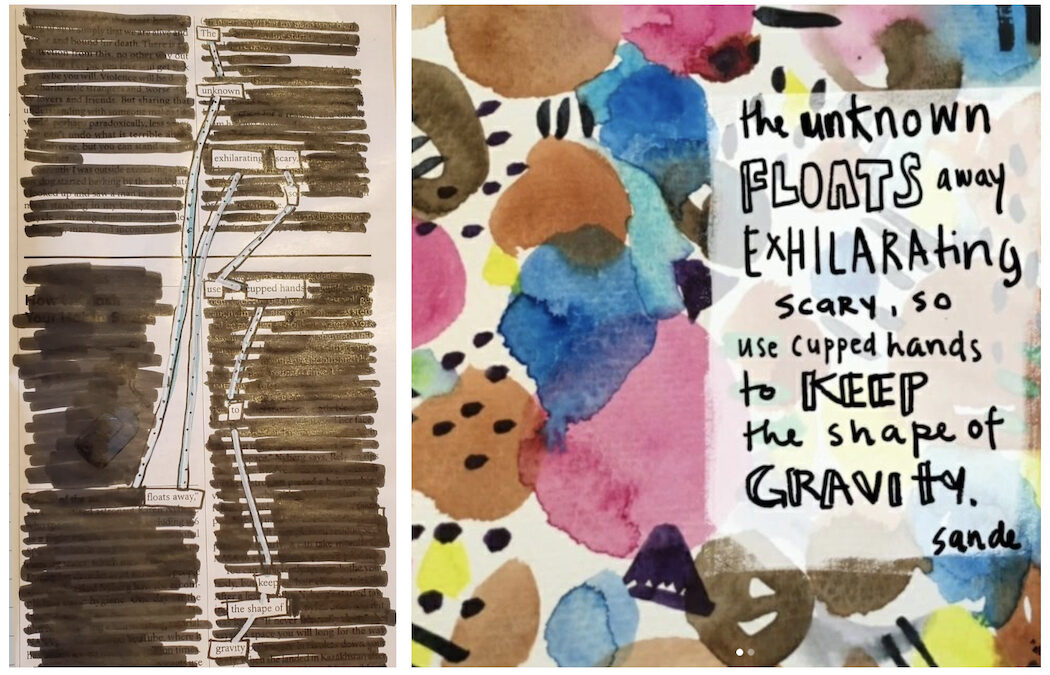
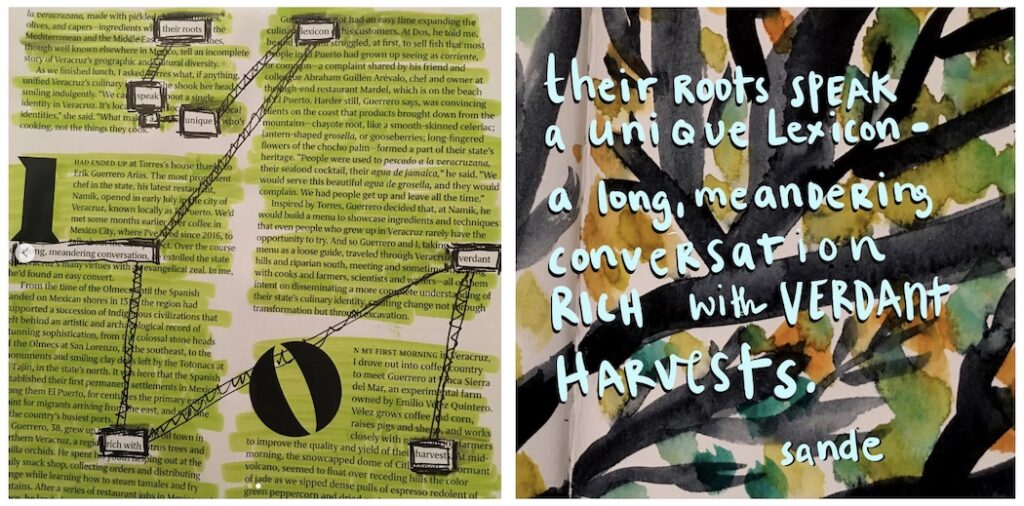
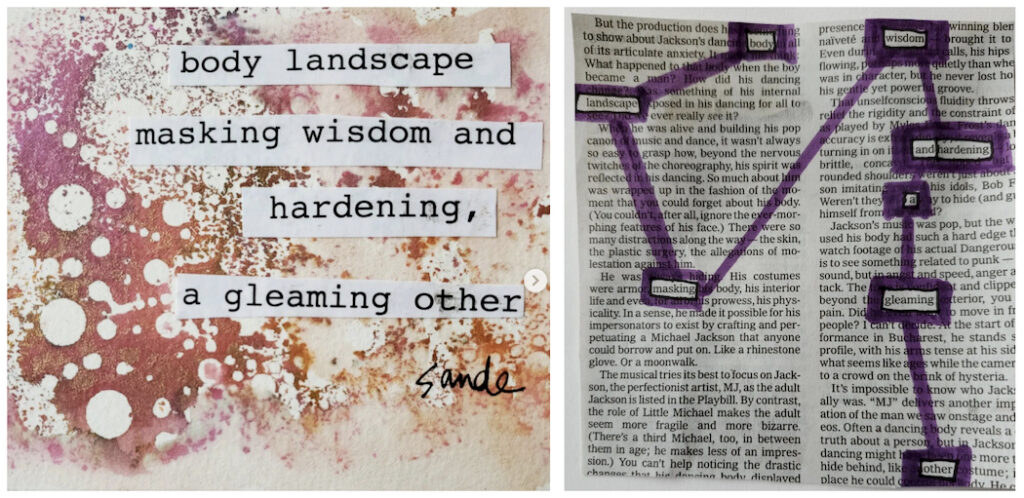
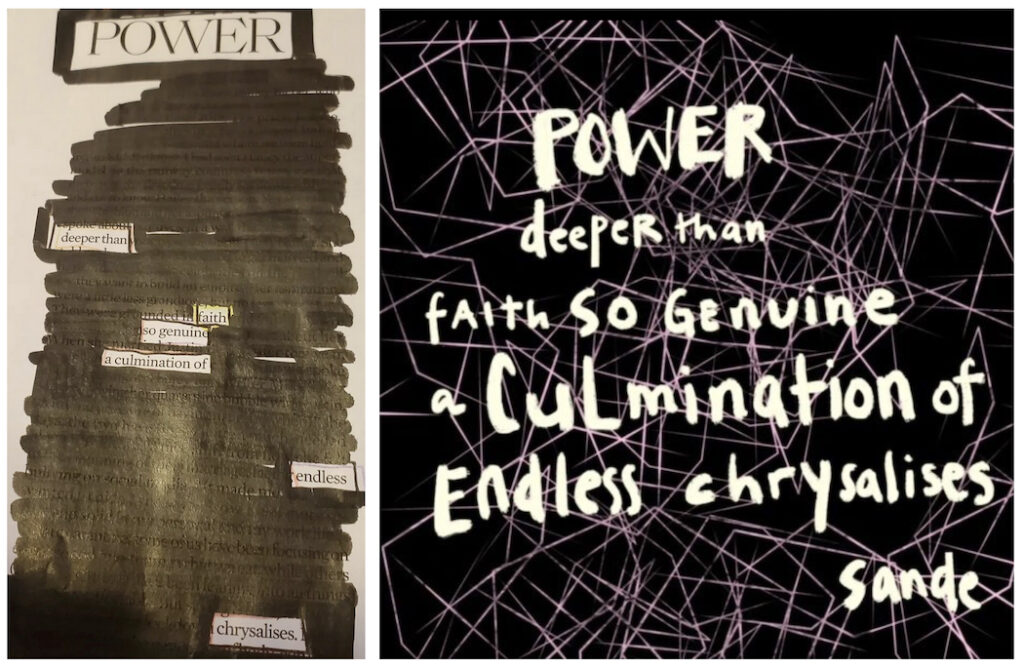
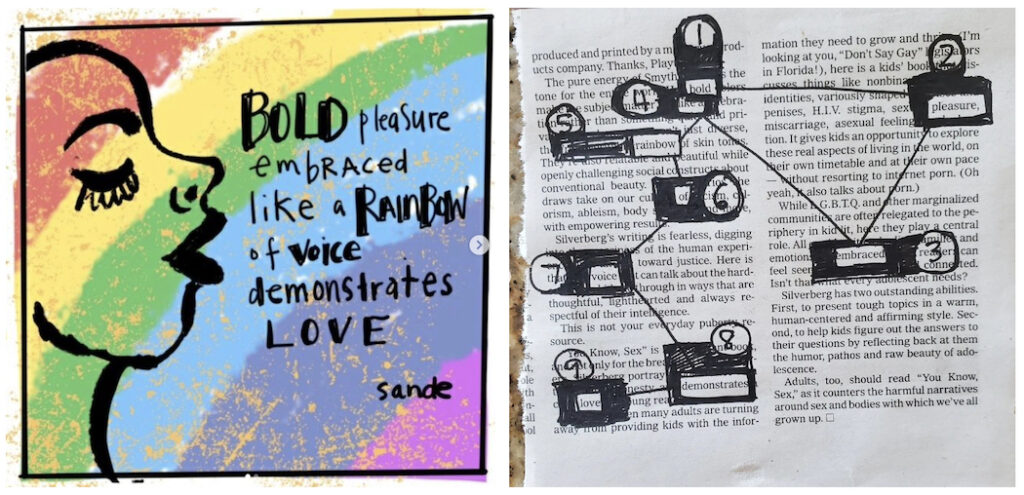
I’ve been wanting to give myself a 30-day challenge that will support both my writing and image-making and that doesn’t feel too overwhelming. I decided to do 30 days of black-out poetry with a simple image – and to spend no more than 30 minutes on it.
Black out poems are created when you take a text – could be from a book, a newspaper, or magazine, and you cross out the majority of words so that you end up with an entirely new text – which could be a couple sentences, a poem, any message that you find interesting. Austin Kleon is well-known for doing black-out poems. Check out his article about it here.
With these parameters I started. I found the process surprising and interesting, and really enjoyed allowing the imperfection and treasure hunting qualities of searching different texts for jewels.
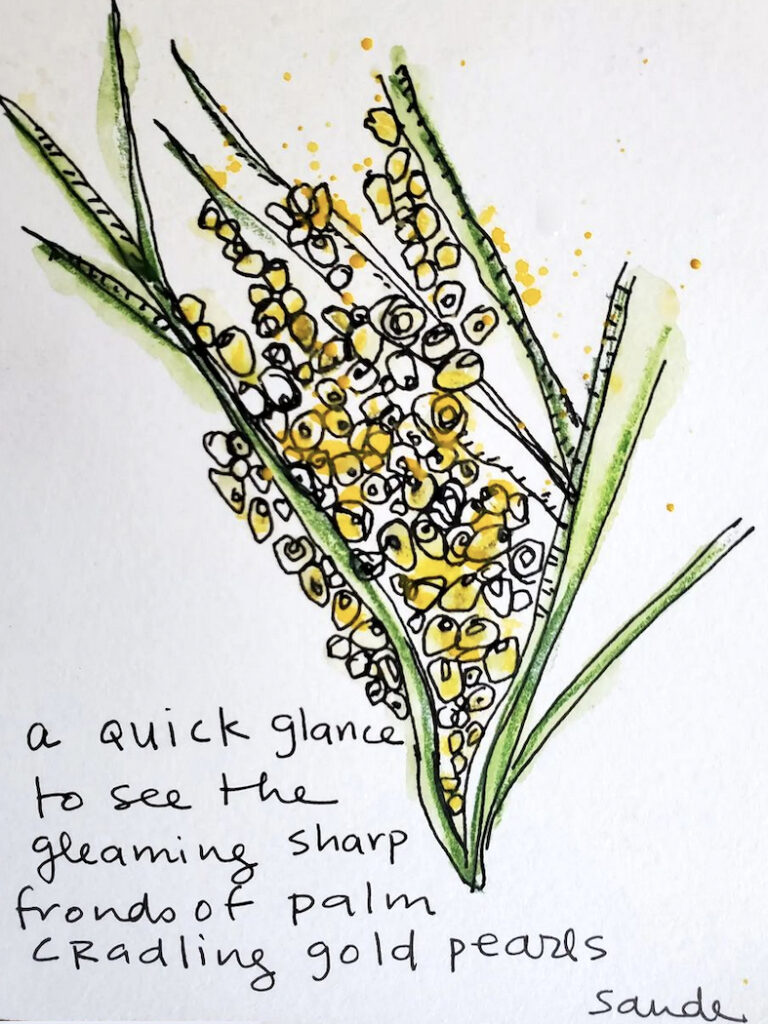
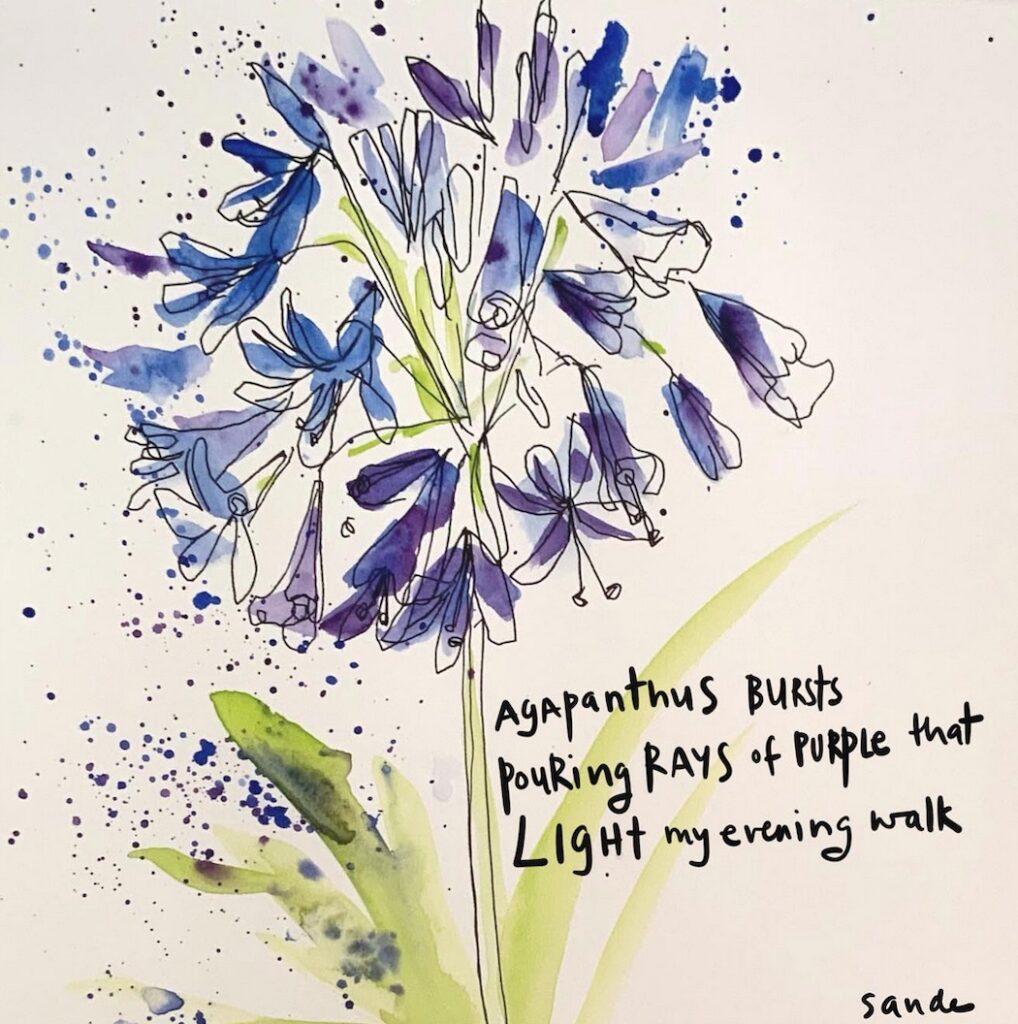
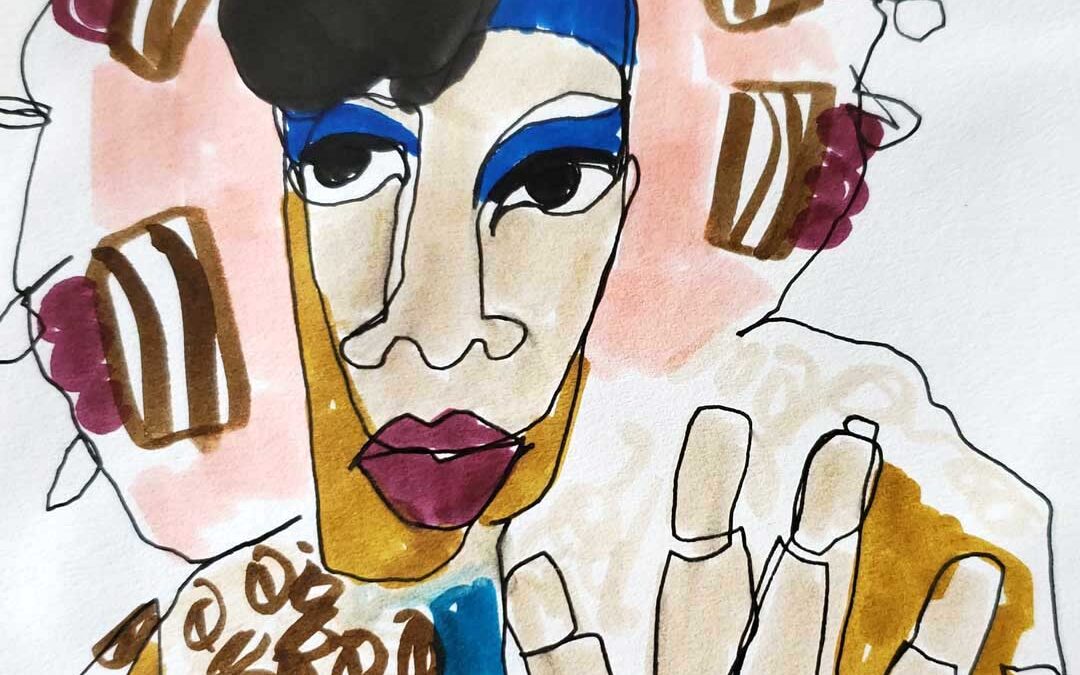
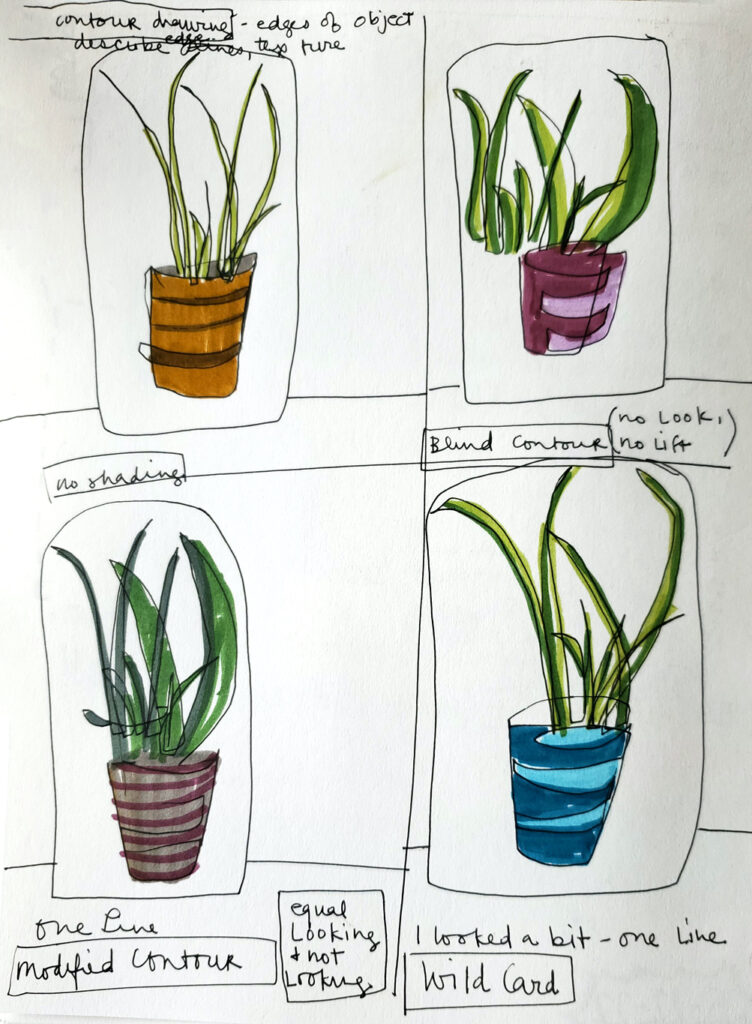
One of the most surprising ways to disarm the inner critic when it comes to drawing is to do blind contour drawing. That’s when you look at an object, like a cup or a plant or a face even, and you draw it WITHOUT looking at your page.
It’s unsettling, but oh so freeing, because when you look down at the odd image that has emerged on your page, you can say, well, I wasn’t looking at it, so there.
But here’s what is quite surprising: because you are LOOKING so carefully at what’s in front of you, while allowing your pen to trace what you’re seeing – on the page – you will often be quite surprised at how much like the object this blind contour image can be.
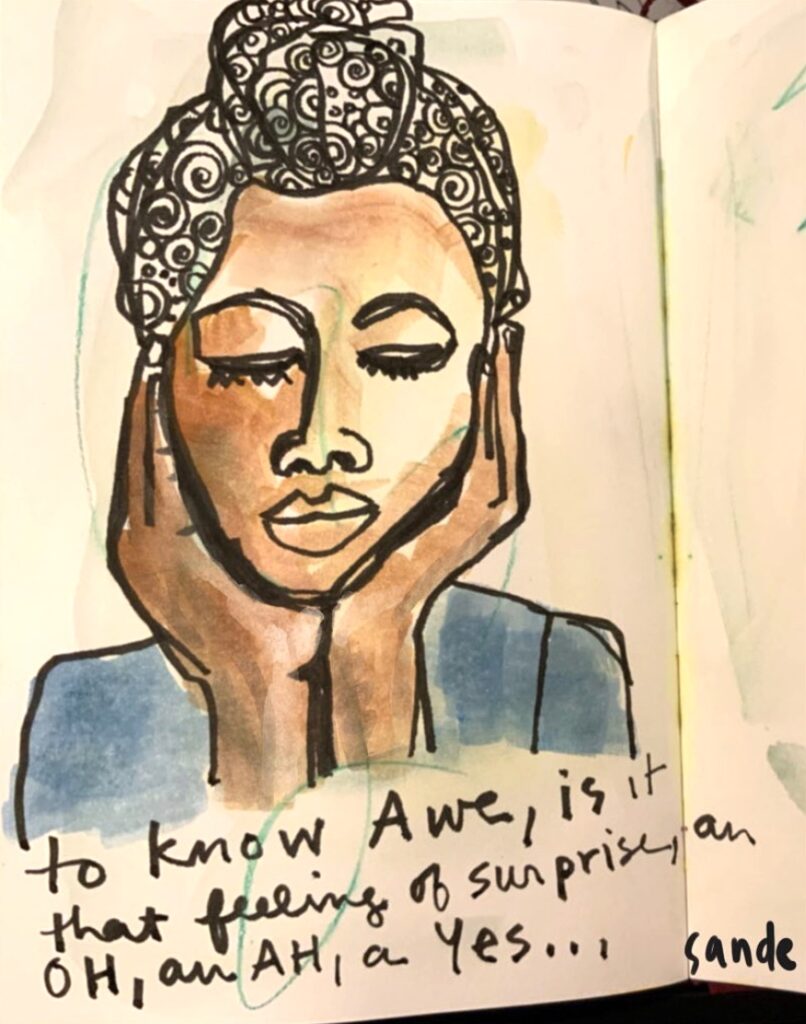
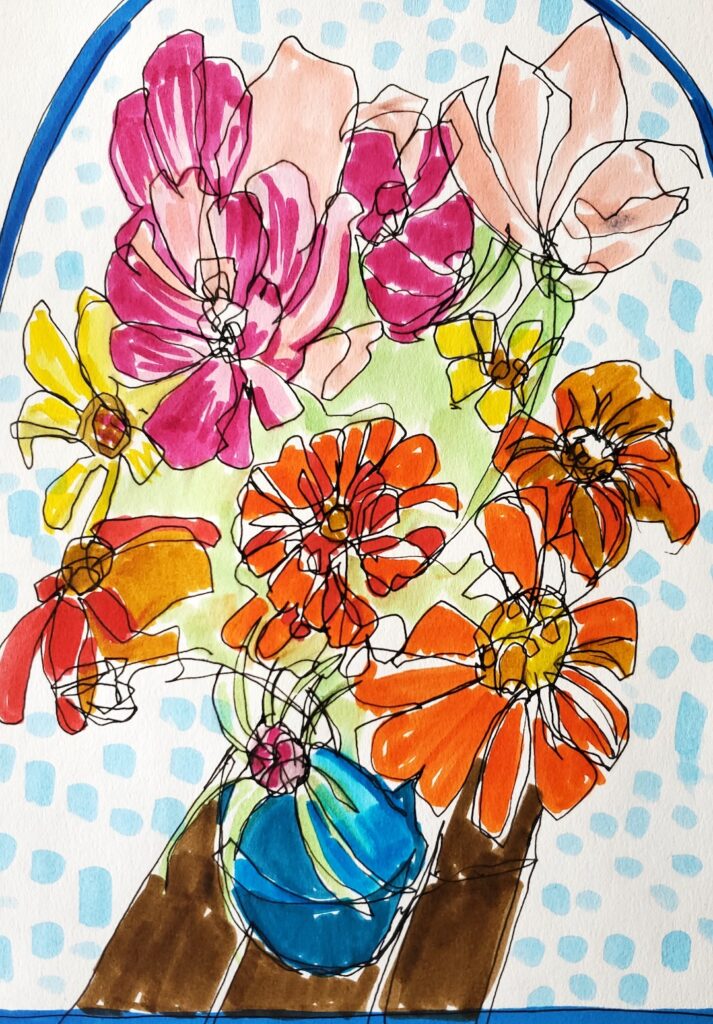
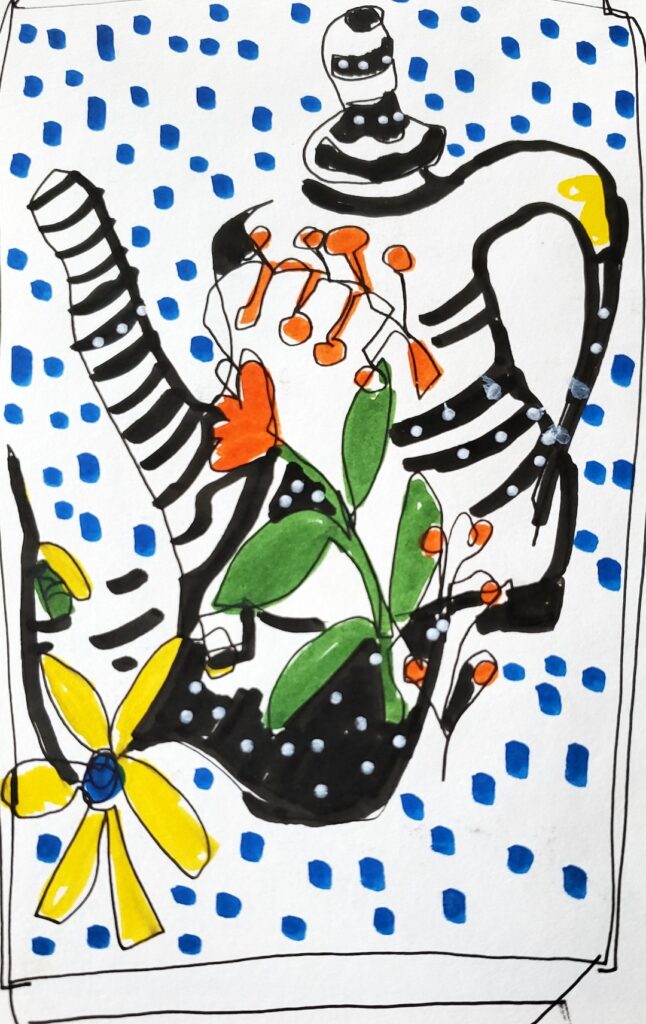
A couple of weeks ago, I did a blind contour drawing class led by Anne Leuck. She calls it Blind Contour breakthrough and she had us draw a plant, a couple lamps, flowers, even faces. And then after drawing the images – sometimes drawing the same image twice, one over the over, we had a chance to color.
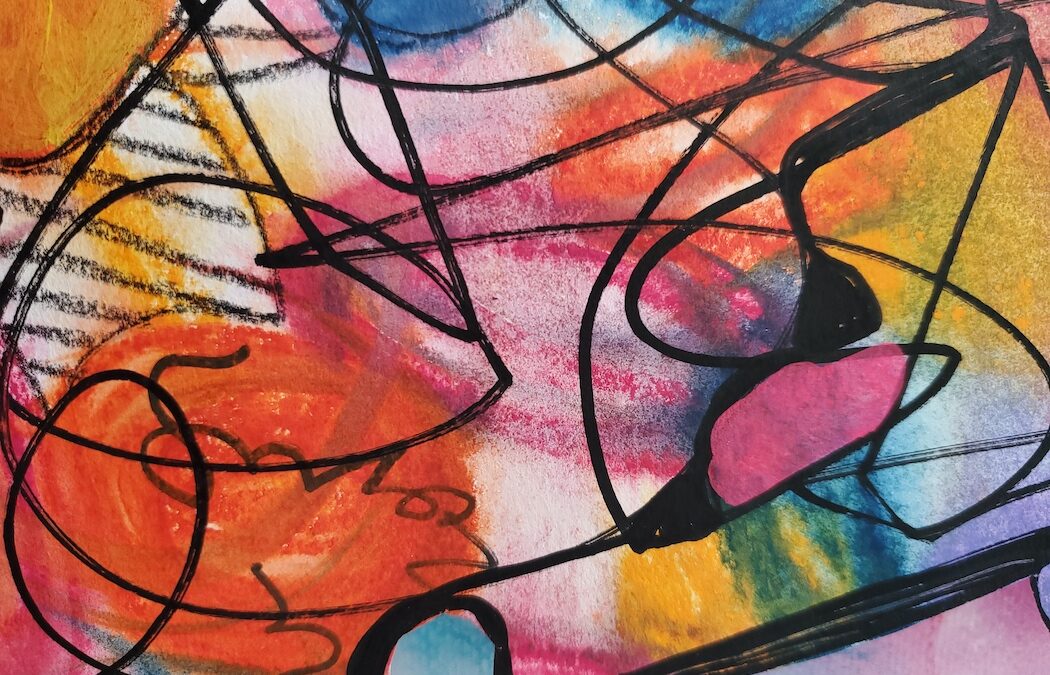
Coloring our blind contour drawings actually allowed us to play with line and pattern and abstraction, resulting in often delightful and surprising drawings.
The class provided a lovely way to have fun and get in touch with our own way of drawing and making lines.
We also did modified blind contour – which means you look a couple of times at the page while you draw.
Learning to use contour drawing, blind contour drawing and one line drawing in my drawing practice helped me to approach drawing, especially complex objects, with more curiosity and lightheartedness.
Anne says that blind contour drawing helps you develop a practice of trusting yourself — your eyes and your hand –without having inner critic, or left brain, judging us.
If you’re curious to see how other artists are using blind contour drawing, check out this video by Allison Kunath who did a series of blind contour portraits.
In this 4-week group workshop I give you the tools and space to write and explore what matters most to you. You’ll gain greater clarity, focus and confidence.
Know Your Values
We’ll do exercises to help you identify your needs and your core values. When you know your values, you’re better able to express what matters and make decisions that align with you are and want to be in the world.
Cultivate Your Voice
Journaling gives you a place to practice saying what you’re thinking, explore your curiosities, and honor your questions. Journaling helps you gain greater insight into what you want to say.
Craft Your Vision
What do you want to be different? In addition to journaling, we’ll use visualization and mindmapping to help you picture your future, express your dreams and craft your vision.
Workshop Details:
The workshop consists of four 1 hr. online group sessions and one session of 1 on 1 coaching for 30 minutes. $500/person.