How to Use Simple Mark Making to Relax Your Mind & Body
One of the things I love about mark making is that it takes me out of my head and connects me back to my body. There are no drawing skills required or needed.
For this exercise I recommend watercolor paints and brush but if you don’t have those – use whatever materials you have – pen, pencil, notepaper, or even your finger on a digital tablet. The benefits of this mindful mark making are the same.
Try this now:
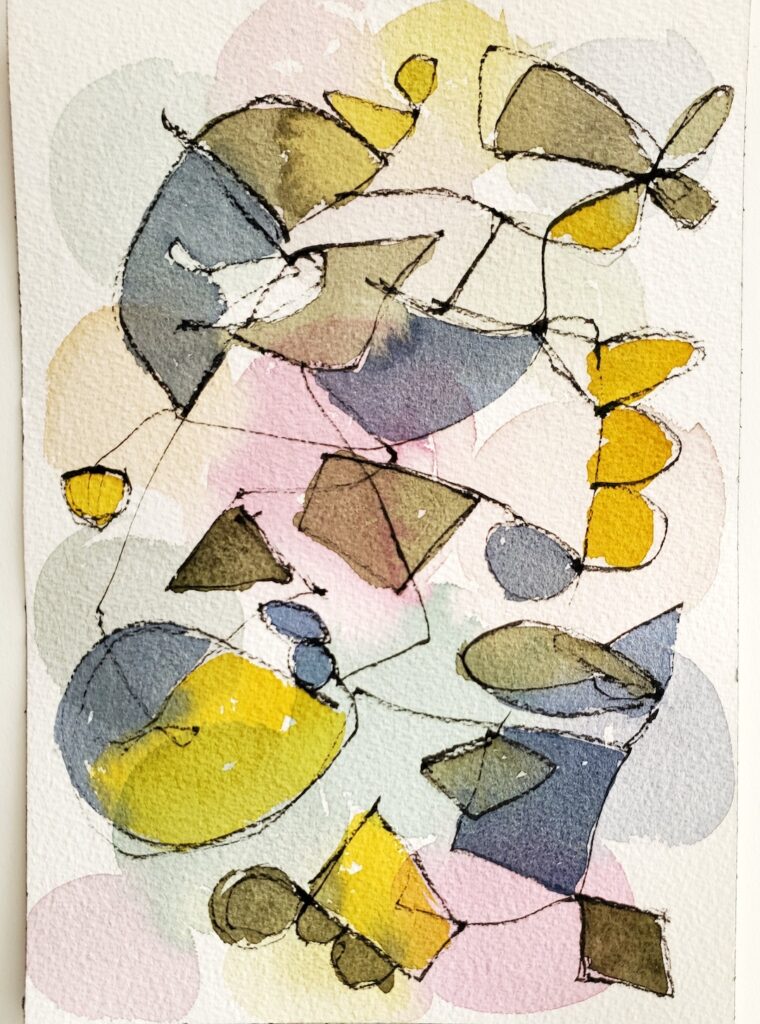
Fill your page with 50 lines – dotted lines, solid lines, angular lines, curvy lines.
Then on a new sheet of paper, make 50 circles – big ones, small ones, wobbly ones.
Now, on another sheet, try 50 squares and rectangles.
As you make these lines, shapes, marks, let them overlap – or keep them separate.
Breathe deeply as you move your brush or pen and just enjoy the marks that appear on the page. If you find yourself thinking about your day, it’s ok, just gently notice what’s arising and then move your attention to the paper and the paint.
If you’re using a pen, get curious about the space between your marks, turn the page and see where you want to make the next mark and how it relates to the ones already on the page.
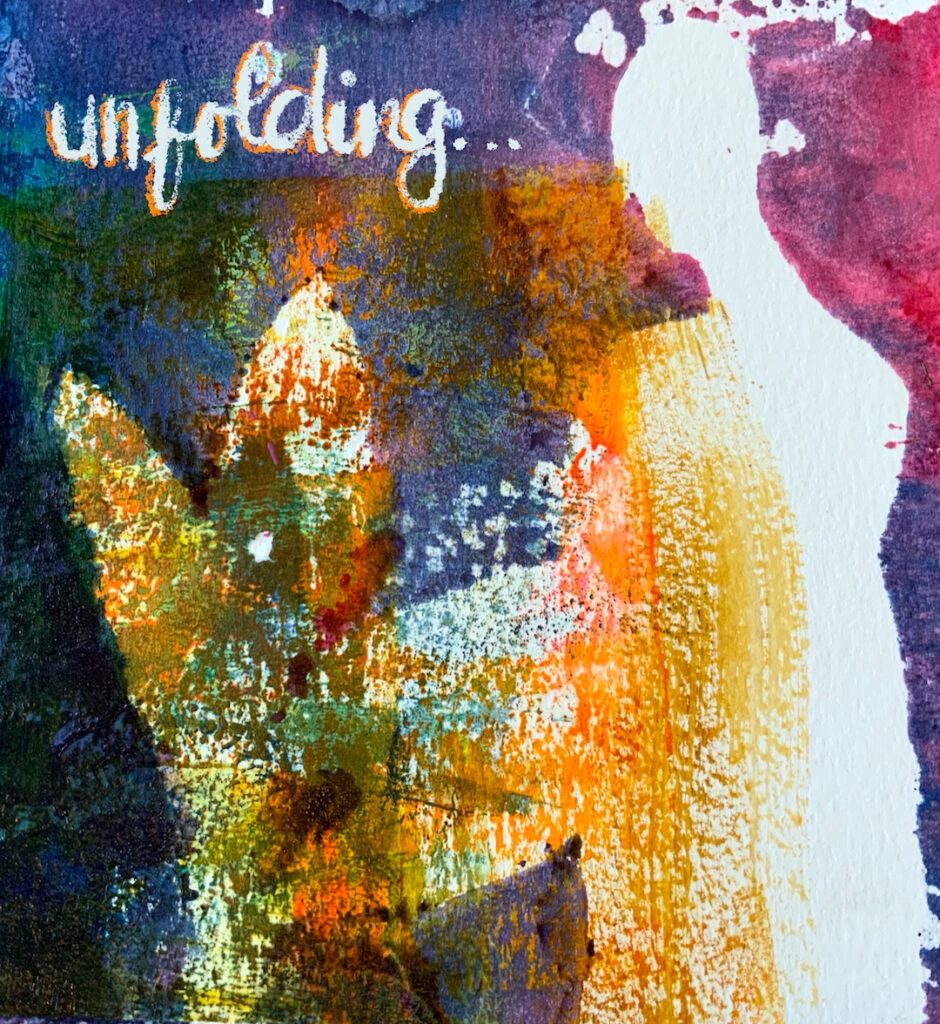
If you are painting, notice how the paint moves across the pages, and get curious about how the paper – whether it’s coarse paper, rough paper, smooth paper, responds to the paint. Does it absorb the paint quickly, or let the paint move out across it? There’s something so peaceful about the witnessing of the paint and its flow.
Just allowing the flow of the paint creates space in your mind so that questions can form, insights can arise.
When I’ve had a long day, yet I can’t seem to relax, to let go of the day, I find this process of simply making marks on the page while enjoying the colors of the paint, to be a window into both relaxation and creativity.
Are you wondering what to do with all of these doodle paintings? One thing I like to do is cut the pages up into squares or rectangles – 2 ½ inches by 3 inches, for example, and then use them as collage fodder or paste them on handmade cards.
But no practical use is required. This simple exercise is full of it’s own rewards. Take a few minutes for mark-making this week and try it out.
I heard myself sigh when I set the clock. Time to write. Time to freewrite. What’s so free about it? I’ve been barren of words. How is that even possible — after years of writing — when it feels like I must know all there is to know about generating words?
There’s some kind of curtain that crashes down when I cast my mind forward searching for meaning and sense. My mind returns and says, there’s nothing there.
I try to see in my mind’s eye where the words, not yet written, will go, and I find the end point wanting, and so I say, nope, nothing there.
But I know good and well that my mind’s eye doesn’t know – can’t know. Because it is the freewriting – the 15 minutes of being willing to enter the unknown and the uncertain that allows me to come out with writing at the end.
Writing things down without knowing where you’ll end up, allowing yourself to wander, uncertain, exploring what you have to say, is a way to strike gold – actually, a way to create gold, again and again.
I think that one of the tricky things about words is that they contain meaning and so I get caught up in laying down meaning and knowing. But words are also sound.
The day that I finally sat down, feeling barren of words, I started playing with the words – not as carriers of meaning, but as objects in and of themselves.
Instead of stringing the words together in sentences, I let each word hang out on a line, or maybe a couple words start playing together.
What emerged was a free association like….BE. Be. Buzz. ZZZZZZZZ, zipper. Zero. zounds. Zillow…..and I was off, starting to feel the curtain lifting and meaning emerging from the sounds and the letters cavorting in front of my eyes.
I re-remembered that freewriting isn’t just about setting a timer and writing for 15 minutes about what you’re thinking. Freewriting, also called automatic writing, is an invitation to play with sound, with letters, with phrases and let meaning slowly come into focus.
So I invite you to give it a try when you’re stuck and wanting to get some writing moving. Set a timer, pick up a dictionary, cast about in your mind for a favorite rhyme or phrase, write it and let the words call to each other.
Let me know how it goes. Also, freewriting is one of the tools I use in my group coaching workshop, you can find out more about that here: Journaling Your Values, Vision & Voice.
How might you bring awareness of your voice in your body?
In my workshop Journaling Your Values, Vision & Voice one of the exercises we do is make sounds and notice what our voice feels like in our bodies. Yes, it’s gets folks laughing, but it’s also quite fun and mind opening.
Try it now for yourself. Start with some vowel sounds – AAAHHH, EEEEE, IIIII, OOOOOO, UUUU and put your hand on your throat, your chest your belly to notice where the sounds resonate.
Then try sounding some consonants and notice how it feels to make the sounds:
Ha like breath and laughter – where do you feel the ha sound?
Woo like the winding and weaving wind, that’s higher in your throat.
SSSes are silky and sensual, a like soft shimmer moving through you.
PPP’s are percussive and powerful.
And the MMMMMMM sound, the sound you make intuitively when something is delicious, a sound expressing yumminess, a sound that is a hum that melts you from the inside out.
During the workshop, participants notice that feeling their voice in their body makes them more aware of the power of their voice, and how their voice influences and affects other people that they’re interacting with.
When you feel your voice in your body, it deepens your awareness of who you are and helps you connect with your own voice song – this song that is yours whether or not you embrace an identity as a “singer.”
What would it mean for you to be aware of your voice? How might you bring to your daily life that awareness of how your voice resonates within your body?
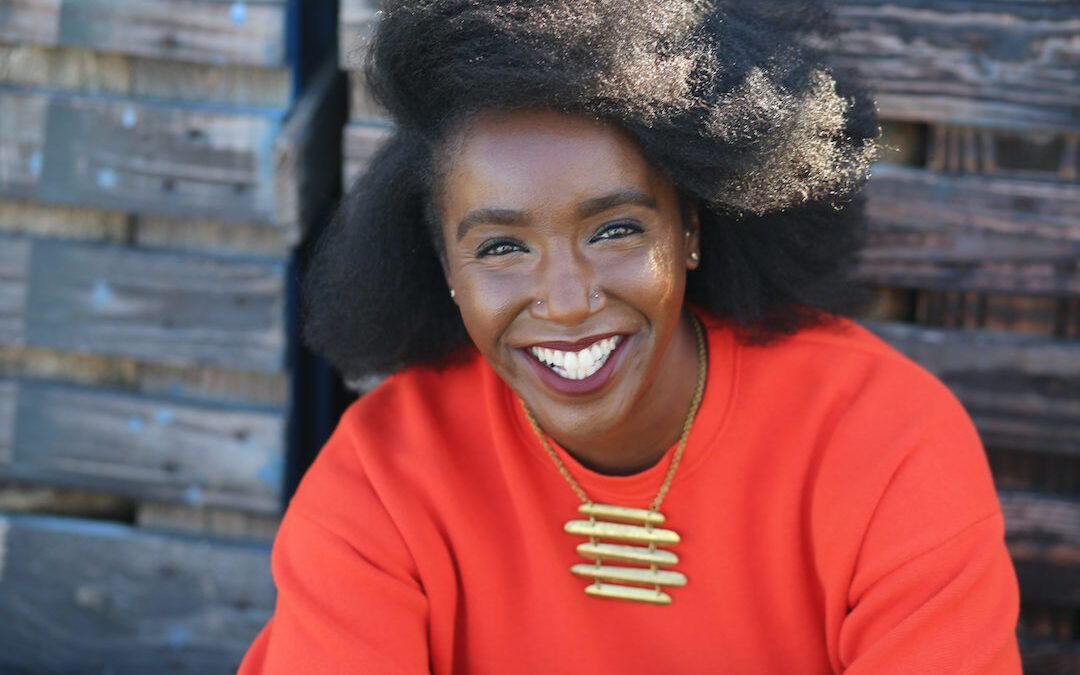
An Interview with Nwamaka Agbo, CEO of the Kataly Foundation & Managing Director of the Restorative Economies Fund
Kataly Foundation moves resources to support the economic, political, and cultural power of Black & Indigenous communities, and all communities of color.
Sande: What do you know now about leadership that you wished you had known when you started your role as a CEO?
Nwamaka Agobo: It has become abundantly clear to me that leadership is not about having all the answers.
Oftentimes, particularly when I was younger, leadership was presented as being ultimately responsible for what is happening in the organization, and being the one who is supposed to know everything.
Now I understand that leadership is modeling what it looks like to ask thoughtful and strategic questions.
Leadership means building a team of people who I help develop, trust, and train, who are the ones with the expertise needed so we have as many of the right answers as possible.
As CEO of the Foundation, I hold a bird’s eye view. I’m able to see all of the individual areas of work each person holds and how those pieces come together to make up the whole. I make sure there’s communication across those areas of expertise and that people are building relationships and connection with each other.
I also find that leadership means tending to the unspoken parts of the organization. I see that there are places and spaces where people need tending and care and there’s also places where people want separation. So being able to recognize and respect those boundaries is important.
Leadership is about moving away from “do as I say, not as I do” to actually “do as I do,” which requires me to hold myself accountable to being the type of colleague and leader I want my team to be.
In addition, being in a leadership role means you have responsibility for shining the light on each and every person doing their piece of the work.
Typically, we have a culture and a habit of putting the leader of an organization on a pedestal. But I believe we’re supposed to create lots of other pedestals and bring our colleagues and teammates along.
Leadership means being able to move with an awareness and level of humility where you can share the light and shine with amazing colleagues that are doing the work.
Sande: What does it mean to ask for help in your role? Who do you turn to?
Nwamaka: Who I turn to depends on what I’m asking for.
I’ve struggled with learning to delegate. Prior to this role, I was a consultant, so in that role I did everything myself. Now I am learning what it means to ask for help, particularly in delegating pieces of work and trusting that my team will let me know when they can’t take something on.
I also want to build a team that is willing to challenge me.
I don’t want a team of yes people. I don’t want a team that’s going to tell me what they think I want to hear.
When I’m asking for help, particularly when I’m asking to double check my own work or inquiring about how I’m moving in the world, I want a team that will say, “You know, this word or the way you framed this in your talk wasn’t helpful or wasn’t aligned with our values. Let’s unpack that.”
That is what it means for me to ask for help. To have honest, loving care, and accountability. It’s a team of people that bring not just critique and the analysis, but a team that can come with solutions, recommendations, and insights.
I also recognize that because we are a hierarchical organization and I am the person who’s technically at the “top” of that organization, there are times when it’s not appropriate for me to ask the team for help on certain things. There are some pieces that are really my responsibility to hold. And so then, I turn to my trusted advisors, mentors, colleagues, who are outside of the staff.
I have a “kitchen cabinet” with whom I can talk through strategy difficult engagements. They offer me insight and support. Having that trusted group of people that I turn to, who are all women of color, is also how I resource myself and have the ability to ask for help.
Sande: What allowed you to make the transition from not knowing how to, or not being used to asking for help, to doing it?
Nwamaka: A lot of humility. Learning to hold curiosity, learning to depersonalize things, and recognizing that when people ask questions, they’re not usually questioning me as a person, or my self-worth, or my value. Most of the time, the questions are coming from a really thoughtful place.
If I am committed to our mission, vision, and values as an organization, then what does it mean for me to not be the person who has all the answers, and to create space for others to have answers and solutions and then to acknowledge them and give them credit for their work?
I remember what it felt like early in my career to not be trusted, to not be engaged, to be silenced and sidelined and see people take credit for my work.
For better or for worse, navigating the world as a dark-skinned Black woman means that, unfortunately, I’m far too used to being discredited and made invisible, with people underestimating my capacities.
When I can hold a level of awareness and sensitivity to what that feels like, then I can bring my awareness to how I engage with my team.
I don’t want my team to ever feel like they or their work is not valued. I know that my role and my position is not threatened by them being excellent at their job. I want them to shine.
Sande: How does racial justice play into your leadership practices?
Nwamaka: Unfortunately, we are seeing that many diversity, equity, and inclusion (DEI) initiatives are not materializing the type of systemic racial justice change we need. And not just with racial justice – I would say with gender justice, career justice, and disability justice as well.
One of the reasons we’re not seeing change is because the racial justice work that is translated into DEI often ends up being only a theory of what it really means to be racially just or inclusive.
Therefore, it is crucially important to me that at Kataly we build a team that comes from a lived movement experience. These are people who have a track record, a demonstrated network and community, and experience of actually having done the work on the ground.
They know what it’s like to navigate and move through the world not only as people of color who experience racism, but as those who have pushed back and fought systems. And they know what it’s like to do this work from their intersectional identity – as people of color, as working class people, as queer, non-binary folks, and more.
We are building a team that is rooted in the praxis of diversity, equity, and inclusion. We are focused not just on racial justice but on demanding anti-racism in how we all move and operate.
Sande: What’s important about leading change in an organization and in the world?
Nwamaka: Leading change requires us to be able to navigate a world of shifting conditions.
My goal is to develop a team that can hold a learning stance.
A learning stance means we have the ability to acknowledge when there has been a mistake, or when we need to respond to a challenge that has shifted the landscape. We have the ability to critically assess what happened and to interrogate why things changed.
We also strive, both individually and collectively, to hold ourselves accountable and take on responsibility for the role we played in the mistake, and commit ourselves to improving the next time.
When leading change, it’s important to have a team that has the capacity to play in a dynamic landscape.
For example, think about what happens when you sit on a stability ball – you’re forced to adjust every time it rolls a different way, and constantly find your center. At first, you may fall off the ball when it shifts. But over time, the more you practice it, the more you can continue to find your center.
Leading change for me is about cultivating a team that can continue to find its center, individually and together.
This process requires the leader or leadership to have a deep amount of vulnerability. We have to be vulnerable enough to demonstrate to our team what it means to have a learning stance. When you, as the leader, fall off that stability ball, how do you get back on it?
And so when I make a mistake, I have to own it and I have to name it. I have to be able to identify what the mistake was, where I dropped the ball, what I could’ve done differently, and apologize to those that may have been impacted by my mistake.
And then I don’t just sit in the corner and lick my wounds, right? I have to come back and keep doing the work. We all have to learn how to show up in the work, show care and grace for each other, and understand how to communicate and facilitate a need for correction to our colleagues whenever it makes sense.
That may sound something like, “Wow, you know, that was really hard when you did that thing. It really hurt me, or it impacted me in this way. I appreciate you acknowledging it. Here is what I would like to see going forward.” We need to learn to make the agreements we need for repair.
I want us to have a culture where when someone makes a mistake, we don’t kick them out, but we actually see it as an opportunity to draw them in closer for a deeper connection in the hopes of stronger alignment going forward.
These are the type of skill sets that help a team move forward because mistakes and failures are natural. It’s part of the work. It’s part of how we get to deeper change. And yes, leading change also includes research and understanding what’s happening out in the world and the markets.
Ultimately, we have to remember that our ability to allow ourselves as individuals to be transformed through the work is also part of the change and the changing conditions that we’re trying to create.
We as individuals are a part of the systemic and institutional transformation. Systems are made up of people and designed by people and so we too have to change.
Sande: Thank you Nwamaka. It was such a joy to speak with you.
I recently did a workshop with the mixed media artist Eric Scott called What’s the Big Idea? This workshop was focused on finding the “big idea” behind the art we are making, but these same creative tools can be used as you explore and identify your values and clarify your vision.
Eric asked us to consider the question, what would you boil down your artwork to being about?
I started freewriting (where you write without stopping for 5 or 10 minutes) and noticed after I finished that I wrote about resistance. I wrote about the resistance that I see in myself when I want to make a change, but also the resistance that I notice in others, resistance like sticky sap that blocks progress and beats back against change for the common good.
As I worked on images – painting, drawing, and collaging – the notion of resonance emerged. I reflected on the ways the shapes and colors of my work are visual echoes of the connection that I feel with myself and with others.
Eric then gave us a process for looking at another artist whose work we admire and thinking about what draws us to their work and what themes show up.
I chose Sharon Virtue, whose recent exhibit State of Nature beautifully connects the human with nature. She uses pinks, browns, blacks, greens, golds with such delicious vibrancy.
In her statement about the exhibit, she says, “nature inspired me to broaden my scope of thinking, and the intersection of social justice and climate change became more clear, acknowledging the biggest challenge we are all facing as a species.”
What a beautiful example of honoring the big idea in one’s work.
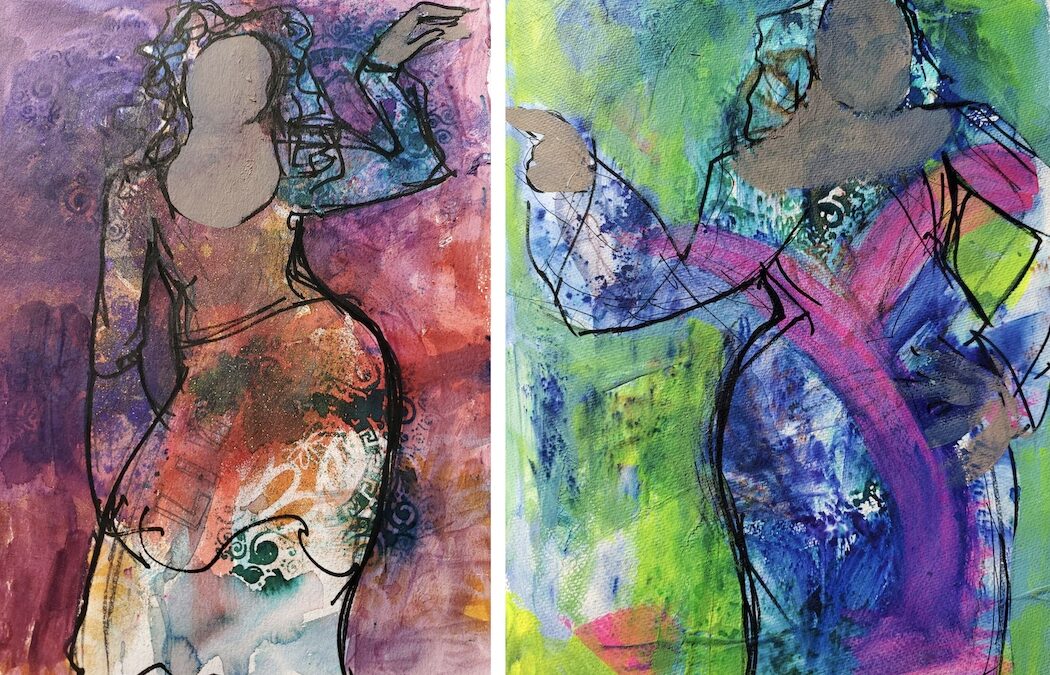
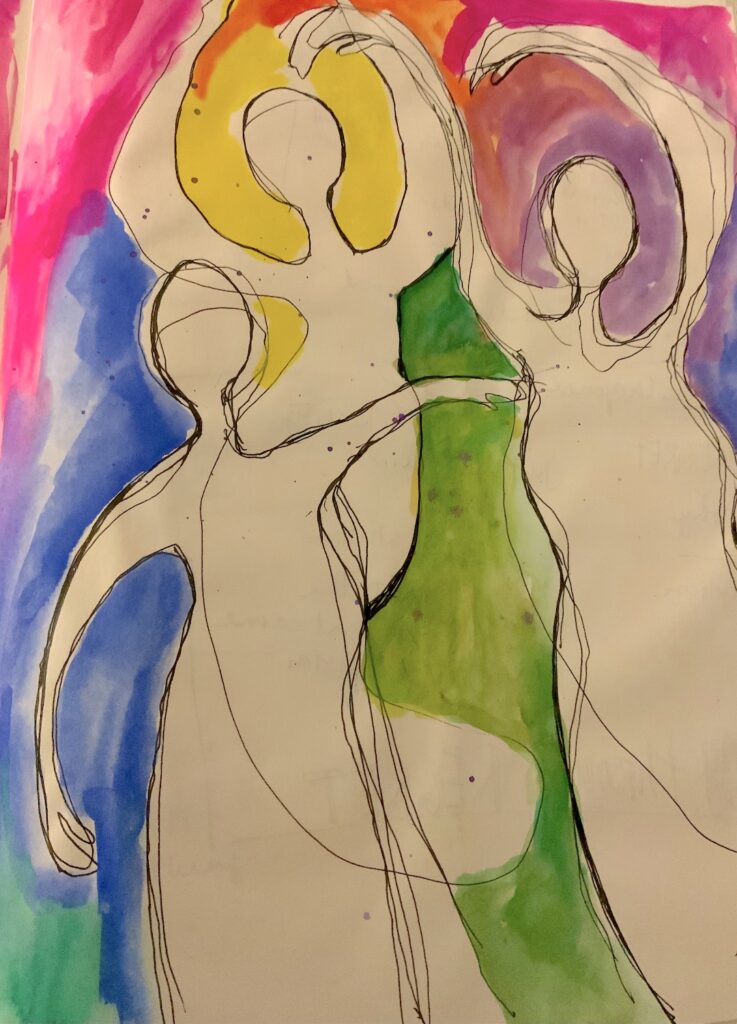
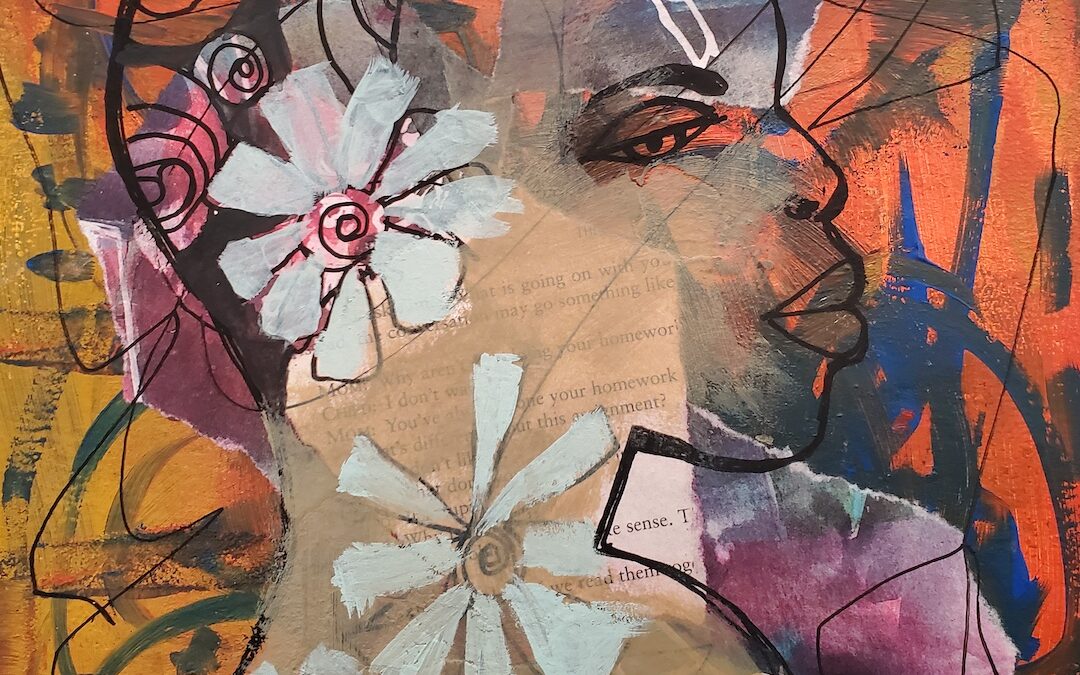
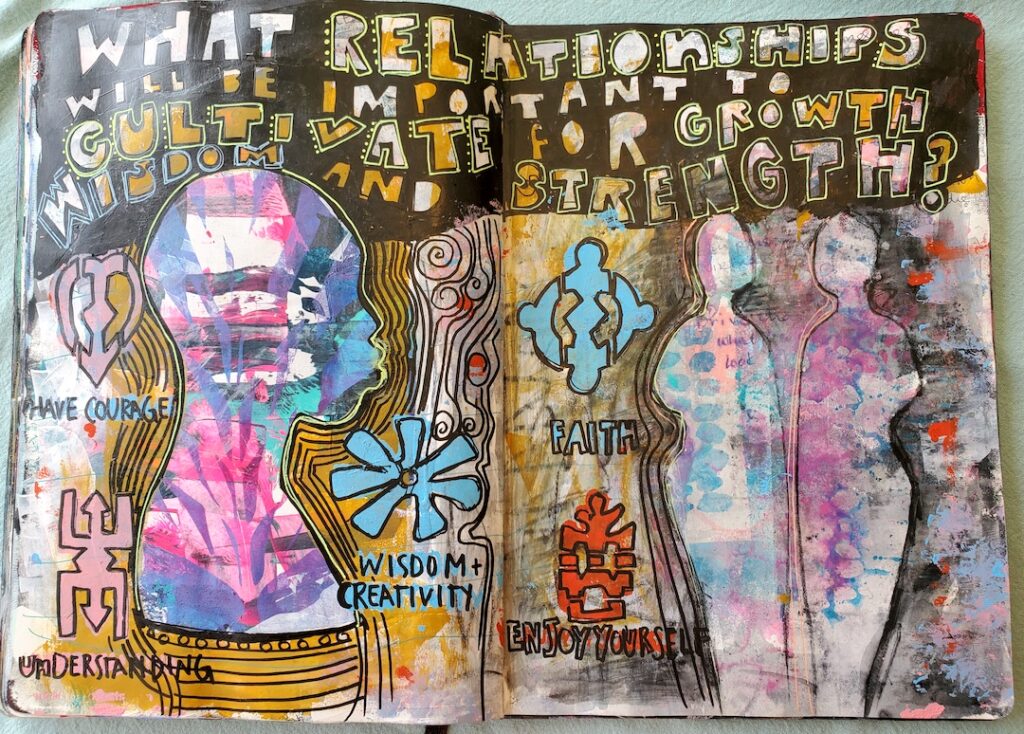
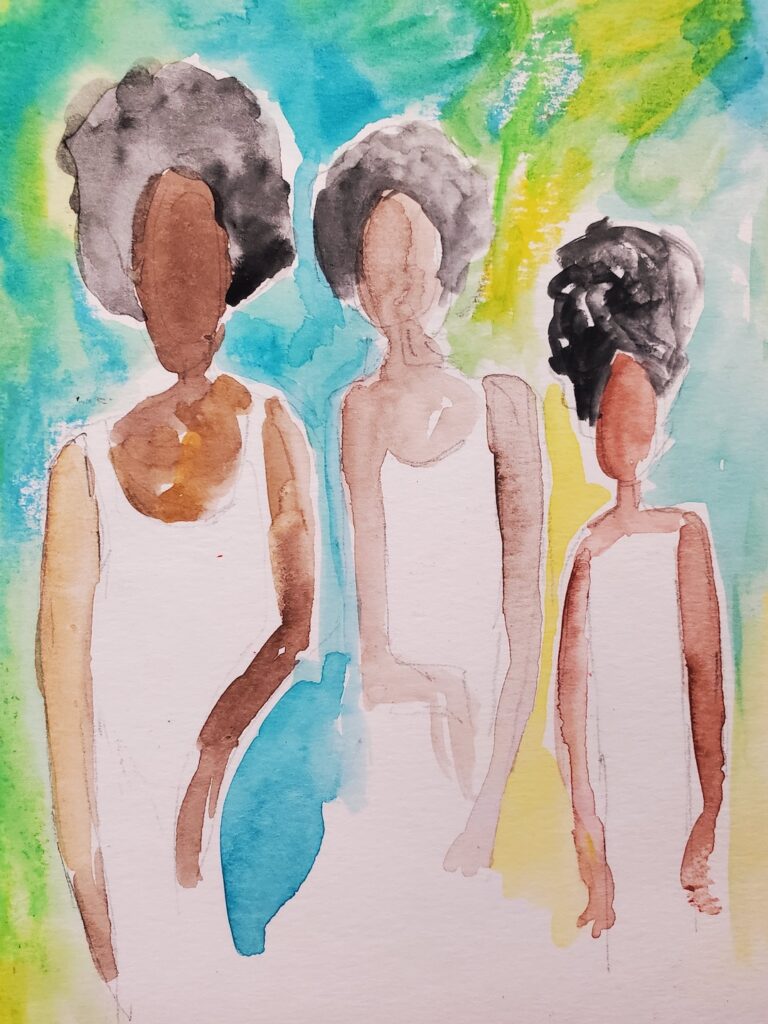
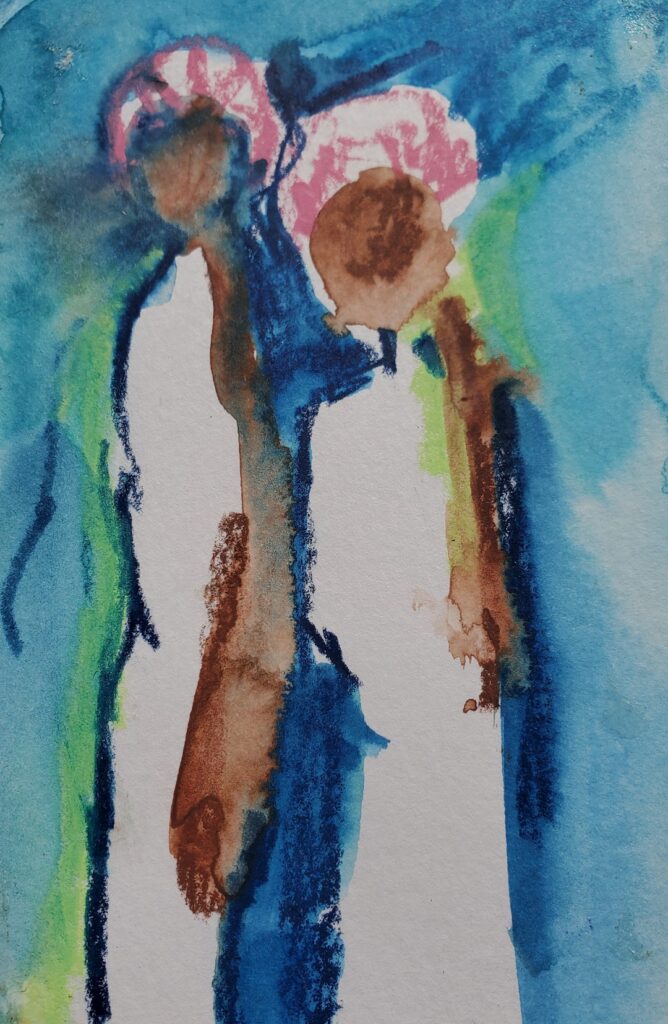
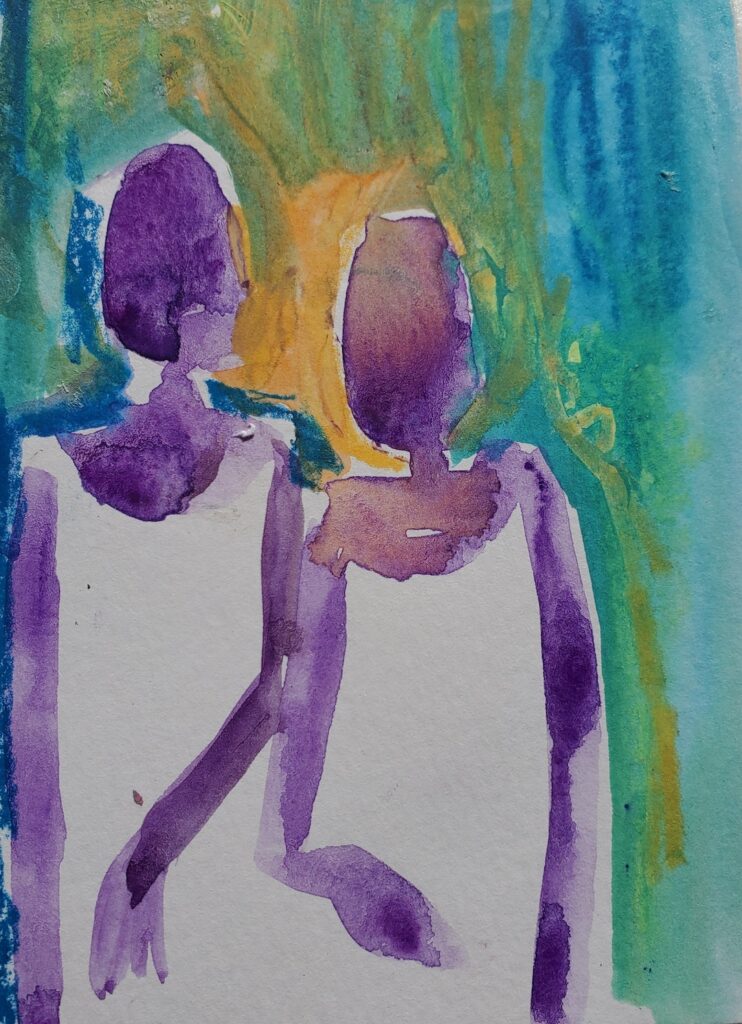
Inspired by her use of color and image, I painted and drew these faces and figures, embracing the browns, blacks, blues, flowing lines and shapes, feeling for the skeleton that forms the body of my work.