How to generate and capture transformative energy.
When I begin a coaching relationship, I encourage my clients to create a space for the work that they are about to do, which will help them to get the most out of coaching. When I say space, I’m talking about space in both the physical and the internal realms.
It is essential that you create a space for this powerful, precious work of exploring what is most important to you, why it matters, and how you will take empowered action for that work.
Physical means literally having a place to keep notes, to write or draw in between sessions, to track what you’ve said you’ll do and then note what happened as a result.
By doing this, you are creating a dedicated space – a container – be that a file folder, journal, binder, or digital file to:
Hold your thoughts, reflections, research, ideas, questions.
Capture the names of people you want to connect with or get support from.
Write down any promises you’ve made to yourself for actions that you’ll take between sessions.
The physical realm is also about putting the commitment you’re making on the calendar so that you’re creating a container with time – committing to the time needed for the coaching sessions as well as taking a few minutes in between sessions to:
Reflect on the conversation.
Note what emerged for you.
Notice connections from previous conversations.
Schedule time when you’ll follow up and do the activities that you’ve committed to.
Equally as important as creating space in the physical realm is creating space internally – creating space with your imagination.
That means taking a walk, or sitting somewhere you enjoy – by the water, or in a cafe, and letting your thoughts roam.
What are you hoping for as you enter coaching?
What will be different?
How will you know?
What would someone watching you see – how would they know by watching you or listening to you that something has shifted?
Giving yourself time to drift in your imagination is very important space creation. Also noticing your feelings as you imagine the work you want to do and its effect is important.
Do you notice sadness, excitement, fear, a blockage?
Breathe and allow the feelings to take up some space in you.
Jot down some of the feelings that you’re noticing, and ask them what they want you to know.
Years ago, when I first started working with a coach, I didn’t create a container for the work. Yes, I took notes during the sessions, and my coach would often send me follow-up materials to read that were relevant to what we’d discussed.
The work was powerful and contributed to me advancing in my career and work. But, because I’d taken notes in whatever notebook I had handy, rather than pulling them all together, I wasn’t able to go back and see the progress in my thinking or actions.
As a result, there was a loss of energy and momentum. I had not created a place, a cauldron, where disparate ideas could cook, side-by-side, becoming denser and more rich – a place I could return to for even more insight and power.
Whether you are working with a coach, in therapy or doing your own daily or weekly journal writing practice it is important to set aside this internal and external space for the work.
Creating this space for yourself will help you get the results you desire and exponentially increase the transformative energy of your efforts.
I recently began taking a workshop called The Seven Creative Powers, with the artist and entrepreneur Lisa Sonora. As part of the workshop we keep a sketchbook and do a variety of visual journaling exercises.
I’m making a delightful mess as I scrape paint on pages, make gelli prints, doodle, answer prompts, cut out letters from magazines, and transform a simple black sketchbook into a brightly colored, outrageously thick artifact documenting my troubles, blockages and hallelujah – insights.
I’m excited by this work! One of the creative powers we have been talking about that has set off a ripple effect in my thinking and behavior is the “power of observant thinking.”
What is observant thinking? It’s the practice of noticing your experience. This could be your experience of work, your relationships, how your day is going, or a project you are working on.
Observant thinking means noticing the things that you’re experiencing without judging them, instead staying curious and wondering.
After every exercise – whether that be writing or image making, we’re invited to answer the following questions:
What did you notice?
What feelings came up?
What thoughts were you aware of?
What was easy or challenging for you about this project?
And what take-aways or insights do you now have?
This practice of observant thinking – specifically noticing without judging – is not new to me. My coaching practice has helped me to hone observant thinking when I am sitting across from a client.
I assume my coach’s stance of curiosity and wonder so that I can listen without judgement, and ask empowering questions that help my client to see their experiences anew, gain fresh awareness and start moving toward their vision.
But how often do I apply that observant thinking to myself?
This practice of noticing my experience – be that how my day is going, my work, my relationships, my business ideas – without judging, and with a spirit of curiosity and openness?
One evening, as I answered the list of observant thinking questions that I’ve shared above, I realized that one of my colleagues often uses the practice of observation as a superpower that affects the ways in which we interact and hear each other.
During a meeting, this colleague will often say, “An observation that I made…,” or “Something that I observed…”
Using that particular phrasing brings a different quality to the conversation that we’re having, it signals a pause, calls forth a breath as well as an invitation to the rest of us to turn our attention to noticing, rather than leaping to judgement or even decision-making.
I have been doing this workshop for a few weeks now, studying the other powers of creativity, all the while strengthening my muscle of noticing my thoughts, feelings, reactions, yes and no’s, carefully plucking aha’s from my journal pages, patiently polishing and rewriting these seeds of power and possibility.
I like this quote by Cheryl Richardson that Lisa Sonora shared in the workshop:
“The beauty of awareness is that it interrupts a pattern. Bringing attention to our inner conversations – the things we say to ourselves, every single day, is a way of becoming present to the truth.”
What about you? How do you respond to these questions? Select an incident, something you worked on, or even a conversation and practice the power of observant thinking:
What did you notice?
What feelings came up?
What thoughts were you aware of?
What was easy or challenging?
What take-aways did you gain?
Write your responses. Then do it again tomorrow, and the next day, and the next . . . In a few days, reread what you wrote. And then start the cycle of questions again, reflecting on what you have written.
Stay curious, and see where your questions, and the creative power of observant thinking takes you.
What’s the smallest thing you can do that will help you move toward your goal?
One of the best tricks I know for dealing with that feeling of not having enough time is to reduce the task. Tell yourself that you’re just going to do a little bit.
For example, when stuck on a writing project, just set a timer and write for fifteen minutes. When the timer goes off, take a 15 minute walk around the block, or spend 15 minutes doing a puzzle, then come back to your desk, set the timer for another 15 minutes and go again.
Another way to approach breaking a project down into smaller chunks is to reduce the size of the product.
So in the case of artmaking, cut your paper into 2 inch by 2 inch size sheets and just make small drawings or paintings. I was so pleased to see the power of this strategy when I did Amy Maricle’s inchie challenge last month.
For 10 days, I made a little piece of art and found it helpful to think, well it’s just a little thing. I will just fill this little page. And then every day, I posted them on Instagram, joining with many others who were doing the challenge.
One of the things I like about this approach is that you can see how the small bits can add up to something more.
As you do the little bits, you see patterns. You can also arrange 2 or 3 bits, attach them to a background and you have a big bit! There is something very powerful about the symbolism of using art to prove to yourself that making little bits, taking small steps can build momentum and lead to something meaningful.
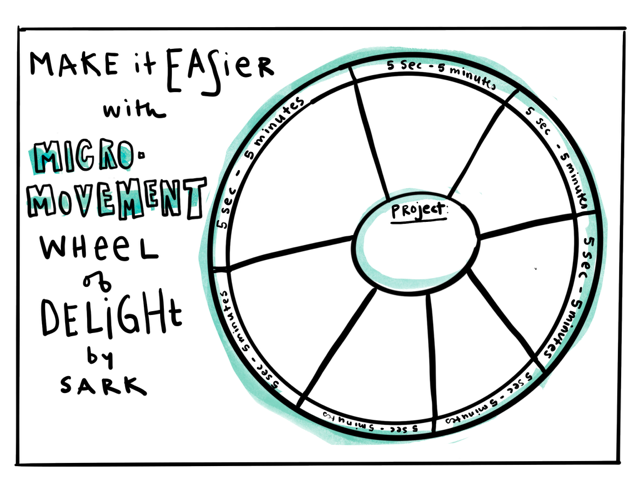
I have seen this idea of doing little bits show up in various ways throughout the years. The artist SARK invites you to outsmart resistance by doing what she calls micro-movements.
A micro-movement can consist of just sitting down at your computer – as a step toward picking up a project, or putting on your shoes when you are trying to reboot a walking habit.
SARK has created a template called a micromovement wheel that you can fill out with tasks that will just take 5 seconds to 5 minutes to do, all related to moving a goal forward.
So what about you? Is there something you are dreading, but really want to do to support your vision? How about making a list, a small one, of tiny steps you can take to move you in the direction you want to go?
And then ask yourself, What can I do to make the task needed even smaller, and more likely to accomplish?
The importance of naming your strengths and capacities.
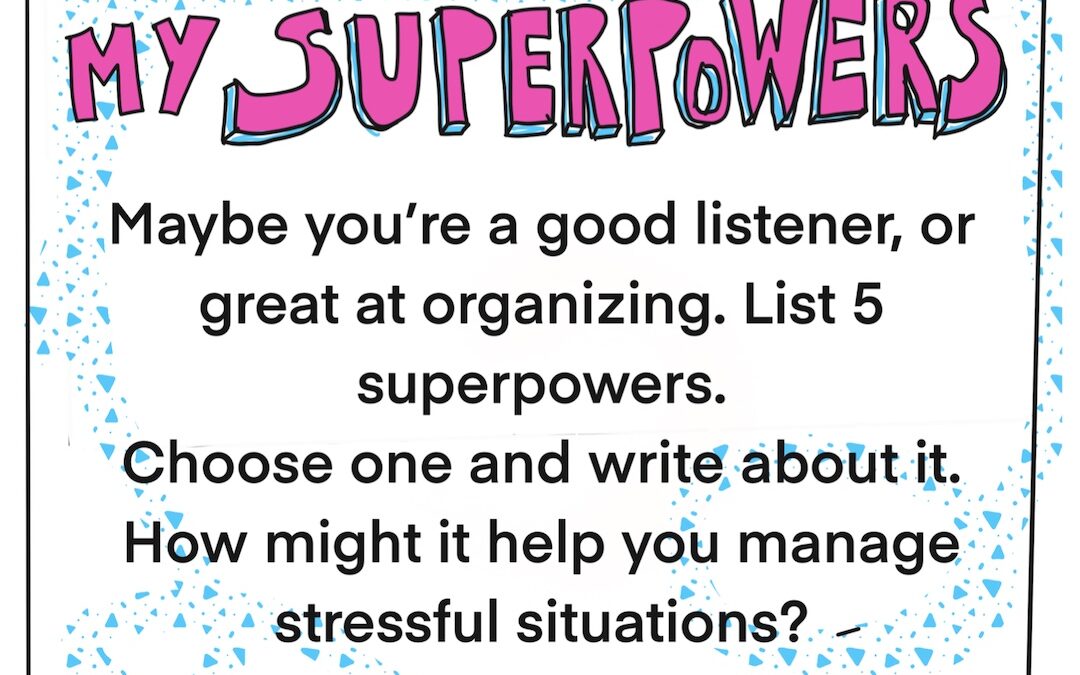
At a recent team meeting, we were invited to share our superpowers. Each of us spent 5 minutes using colored markers to write, draw, scribble words, phrases or an image that described one of our superpowers.
Fully engrossed in the activity, I selected The ReLuminator for myself – even throwing in a tagline: Helping you to light up your path and your brilliance. I noticed that I was smiling the whole time as I wrote and drew my superpower on the 8X14 inch paper.
Then we turned to the person next to us and shared our superpower, why we’d chosen it, and how we saw ourselves using this power. It was wonderful to hear my colleague describe her superpower and how she used it, then share with her ways that I saw her using that power.
After that, we each shared our superpower with the whole team, giving everyone the chance to listen, ask questions, and reflect back how they experienced our strengths and capacities. I felt energized as my colleagues affirmed, “Yes, indeed you are the one who helps us to find a path and blaze a trail.”
Yet this group conversation was about more than just affirming what we’d already seen and shared, it was also about getting us to expand our view of what our power was, literally naming and calling forth a power that we might not have recognized as such.
By the end, we were all laughing, radiant, our powers emanating from us, shimmering and visible to one another. The experience both compounded my appreciation of my teammates, and deepened our appreciation of each other.
There is something incredible and potentizing about naming each others’ strengths in the presence of each other.
In reflecting on the exercise, I realized that it’s a version of a skill I use in coaching called “Calling Out the Power” – which is a practice of deep listening, where I name and reflect back to my clients their unique strengths and capacities that they might be overlooking or forgetting to call on as they face a difficult challenge.
So what about you? What’s your superpower?
Calling out the power supports you as you step into your creativity, wholeness and sense of possibility.
And it is also a way to help you recognize how your yearnings, curiosities and emotions, as well as your strengths, are all sources of wisdom and power so that you can fully engage with the world.
Who might you tell, and then listen to, as they call forth even more powers in you than you recognized you hold?
I talked to a woman recently who was frustrated that she hadn’t been selected for a leadership position.
They didn’t see me as a candidate, she said. When we talked more, it became clear that she hadn’t explicitly asked to be considered for the role because she saw asking as risky. She didn’t want to leave the organization and she didn’t want the awkwardness of not being selected for the higher-level role.
I could relate because I have been in situations where I shared my professional ambitions and not gotten what I’ve asked for, which doesn’t feel good. And goodness knows that every situation is different and sharing one’s ambitions may not be wise.
And yet, do I regret sharing my ambitions? No, for three reasons:
I am committed to honoring my yearnings,
Because I can’t fulfill my ambitions alone – I need other people to know and support me in advancing, and
By making my desires visible, I am compelled to live into them, if not through one strategy, then another, if not in one space, then in another.
While reflecting on the words ambition and yearning, I began to wonder, what’s the distinction?
Ambition is defined as a strong desire to do or to achieve something, typically requiring determination and hard work. It comes from the Latin word ambitio – from amber – to go around (canvassing for votes). That definition leads me to picture a very externally focused expression of desire.
Yearning is defined as a feeling of intense longing for something, typically a feeling of longing for something that one has lost or been separated from. Yearning relates to wanting something that was in fact once yours, or even part of you. It comes from the german word, giernan, that meant eager.
Acknowledging the yearning is acknowledging a fuel source.
Going after professional positions involves doing the work, yes, as well as getting other folks to be able to imagine you in the role such that they help you to get there.
Sheryl Lee Ralph, who just won an Emmy for Best Supporting Actress in “Abbott Elementary”, is a great example of the intertwining importance of both ambition and yearning.
Since 1975, Ms. Ralph has been acting in starring roles and honing her craft. Now at 65, she is finally receiving widespread recognition for her powerful performances, recognition that is too often denied to talented Black women like herself.
“To anyone who has ever, ever had a dream, and thought your dream wouldn’t — couldn’t — come true. I’m here to tell you, this is what believing looks like.”
– Sheryl Lee Ralph in her Emmy award acceptance speech