
by Sande Smith | Apr 28, 2023 | leadership & racial justice
Can you give yourself the care you offer others?
Lately, inspired by a client, I’ve been pondering the conflict between self-care and care for others. I see this conflict often, predominately with women who are deeply committed to the well-being of others and working long hours in the workplace, in the community, and in the home. They express worry and fear that prioritizing themselves would inadvertently contribute to the suffering of others.
When you are committed to the work of making things better, it is easy to feel that you don’t have enough time to care for yourself; that to care for yourself is to take away from others.
These thoughts continued to percolate when I attended a conversation on Poetry as Community Care at the Association of Black Fundraising Executives annual conference.
One of the speakers, Damion Wilson, challenged the notion that caring for self must be at the expense of caring for others, when he said “You are part of the community, so give yourself the care you offer others.”
Another speaker, Sarah Byrne-Houser made a similar point, noting that, “we are conditioned to put our stakeholders first, rather than ourselves.”
All of this has me thinking about what would be learned if there were a 360 review process for the caregivers in our organizations and in our communities.
If you are a leader in an organization, you are accustomed to the process of 360 feedback, in which people who report to you, work with you – whether inside or outside the organization – give you anonymous feedback on how they experience you and your leadership.
What if we asked the beneficiaries of care how they experience the people who provide the care, and the quality of the care? Would they say, yes, I want you to be available 24/7 to me? And what if we asked what they want for the caregiver, and not just from the caregiver? Would we be surprised by their response?
How might someone accustomed to prioritizing the well-being of others over their own disrupt that behavior in a way that didn’t pit “self-care” against collective care, but rather defined the care of the self and the other as interconnected and dependent?
For the hard working person who’s developed a strong sense of self connected with giving, and supporting others, what does it mean to receive? To receive care? To receive help? To receive support?
Might the 360 process be a way for the caregiver to stop, be vulnerable and share her own needs and wants, then receive the support that they need and desire?
Might this be a way to enter into what author Diana Rowan calls “sacred reciprocity,” acknowledging that caring our ourselves is not something that we should do in isolation, but in relationship with those we care about and for, both giving and receiving, nurturing and being nurtured?
What if self care were somehow more radically considered inseparable from collective care, central to the growth and regeneration of us all? What a gift that would be.
by Sande Smith | Apr 27, 2023 | client challenges
How Poetry Can Help You Find Your Voice
April is one of my favorite months – and yes, one of the reasons is because it is my birthday month! Another reason is that it is National Poetry Month. I have been reading more poetry this month and savoring the way poetry makes art of language.
Poetry uses rhythm and rhyme, metaphor and imagery, storytelling and silence to get our attention, to make us notice what’s around us and inside us.
In the forward to John Fox’s book, Poetic Medicine, a down-to-earth guide to writing poetry, Dr. Rachel Remen says:
“Poetry is simply speaking truth. Each of us has a truth as unique as our own fingerprints….In the most profound way, speaking our truth allows us to know that our life matters, that our viewpoint has never existed before. That our suffering, our joy, our fears and our hopes are important and meaningful.”
Ah, just reading those words makes my breath deepen, my awareness expand. Dr. Remen’s words remind me of the value of turning to the art form of poetry to be inspired by the ways people use language to say what is difficult to say.
I am working with a client who is struggling to write ideas that are not typically expressed in her field. She is trying to speak a truth that is not yet named.
Poetry — both reading it and practicing it, can help give words to what she is yearning to express and not seeing in language around her.
This is what I love to do in my coaching and consulting – help people find their voice. We work together to surface what they care about and give language to it.
When you write about what you think and feel, you hear yourself and make tangible what you care about.
There are many ways to listen to yourself – reading poetry and finding what resonates with you provides a clue.
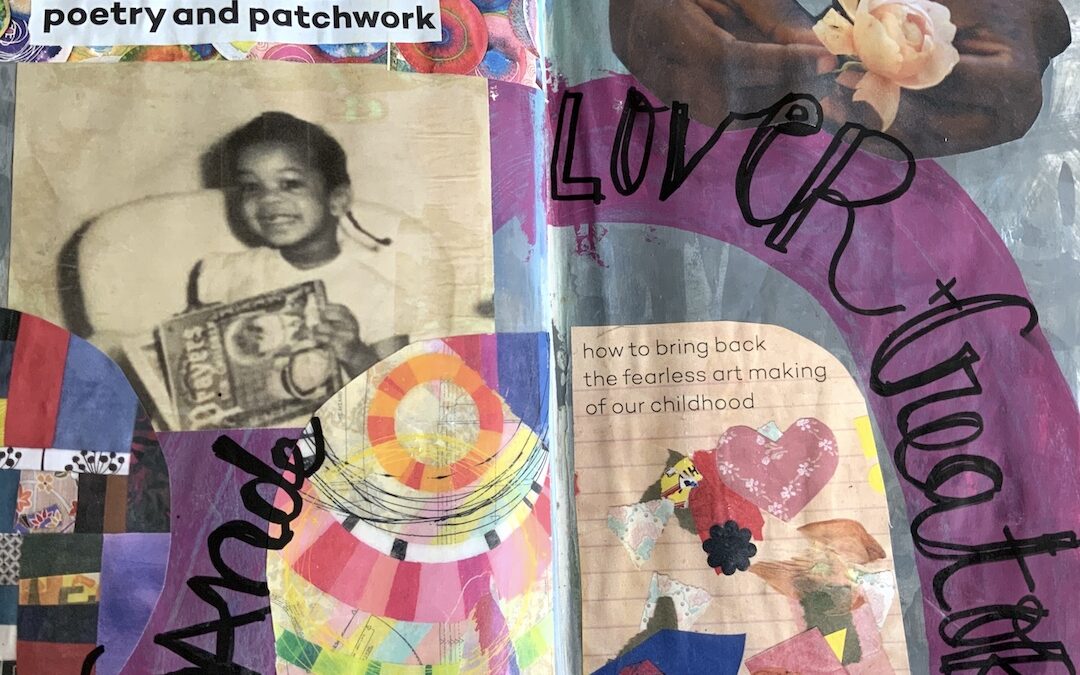
Another thing you can do is to cut out magazine images and put together a collage, or take a series of photos. Then, go back to see what you’ve cut out or captured. Notice the patterns – what can they tell you about what you are trying to express?
Freewriting is also a gold mine, leading to new insights. I offer a series of prompts and step-by-step guidance in my workbook Journaling Your Values, Vision & Voice.
Here are a few prompts for you now – take 10 or 15 minutes to write and respond to these questions:
What are you not saying? What do you see or notice that you never hear anyone else discuss? What wound is waiting for you to give it a name, so that you may enter and pass through?
by Sande Smith | Mar 27, 2023 | leadership & racial justice
Questions can be a tool for organizing, creating and designing new futures.
As a coach, I’m always thinking about questions.
I’m listening deeply and asking questions to help you pause and notice your thought patterns and beliefs. And some of these questions might challenge your beliefs so that you can start building a new way of thinking about what is possible for you and your life.
But I haven’t always loved questions. In fact, when I first saw the famous Rainer Maria Rilke passage that is often quoted, I was confused and annoyed by it.
“Be patient toward all that is unsolved in your heart and try to love the questions themselves . . . Do not now seek the answers, which cannot be given you because you would not be able to live them. . . . Live the questions now. . . “
I didn’t understand how living the questions could help me when I so deeply wanted answers about how to move from where I was, to where I wanted to be.
I recently finished reading Alicia Garza’s book, The Purpose of Power: How We Come Together When We Fall Apart.
Garza, a long-time organizer and co-founder of Black Lives Matter, talks about her upbringing, the influence of her parents, how the conservative right came to power, and gives examples of what it’s like to be an organizer listening to people’s challenges, needs and visions, while finding ways to help bring about improvements in their lives.
I was especially struck by how she talks about questions as a tool for bringing people together because it helps us to get under the assumptions that we hold about each other.
She gives the example of how Black and Latino people can hold misconceptions of each other, and not be sure how to engage in a conversation that respectfully unearths the misconceptions.
Rather than tell folks they shouldn’t hold the attitudes they do, she encourages a process of conversing and listening – dialoguing – that is rooted in respect.
“Asking questions is one of the most important tools we as organizers have at our disposal. Asking questions is how we get to know what’s underneath and in between our experiences in communities.
Knowing why something is happening can change behavior, in that it develops a practice in a person of doing the same – Asking why they see what they see – what’s behind what they see, and most important, if they are motivated not to experience it anymore, [determining] what can be done about it.” p. 94
Questions help us pull apart old beliefs and form new stories so we can see each other differently and imagine new possibilities.
Creativity strategist Natalie Nixon talk about how questions can be used within organizations to support the process of creating.
She defines creativity as “our ability to toggle between wonder and rigor to solve problems and produce novel value.” She points out that leaders have to be willing to be vulnerable because folks may be afraid of appearing foolish. She uses the term “question-shamed” to describe the sensation of having been made to feel foolish for asking questions.
Leaders show that they’re wondering – that they don’t know all the answers – when they model the process of thinking and questioning out loud.
Questions can be a powerful tool for organizing, creating and designing new futures. What else will I learn to love that once made me so uncomfortable? How about you? What makes you uncomfortable? What might it have to teach you?
by Sande Smith | Mar 27, 2023 | creativity & joy
How to work with your resistance.
Lately I’ve been thinking a lot about resistance. I had a client who wanted to write more so she could connect with her authentic voice. And yet, despite the desire, she found it hard to write 15 minutes a day, five days a week.
Another client disappeared halfway through our 8 sessions. She had told me the sessions were valuable and transformative, but she stopped scheduling appointments.
What’s going on? Why do we resist the change we desire? Why don’t we do the things that we long to do?
I’m no stranger to resistance. I love to write, and lately I have been writing daily in my journal. Yet, I wasn’t transcribing my writing and turning it into blog posts that I could share. Why not? Resistance.
What is this resistance?
Steven Pressfield, who has written many screenplays, talks about his many years of not writing, along with his learning and understanding of the resistance that stops us in his book, Do the Work,
Interestingly, Pressfield gives resistance a capital letter. He says,
“The first principle of Resistance is that there is an enemy. There is an intelligent, active, malign force working against us. Step one is to recognize this. This recognition alone is enormously powerful. It saved my life, and it will save yours.”
Where does resistance come from?
In principle 4, Pressfield says, “The Enemy Is Inside You, But It Is Not You.”
You are not to blame for the voices of Resistance you hear in your head. They are not your “fault”. You have done nothing “wrong”. If you’ve got a head, you’ve got a voice of Resistance inside it. You have resistance the same way you “have” a heartbeat. You are blameless. You retain free will and the capacity to act.”
Now clearly, Pressfield is VERY DRAMATIC. He does write screenplays with lots of action, after all. And yet, how helpful to realize that resistance accompanies us – but is not us.
Resistance shows up when we decide to step out of our habitual way of doing things.
How do we deal with resistance? One of my tactics is to write my resistance.
For example, I have told myself that I’m not going to just write in my journal, I’m going to type my thoughts too. But even though I told myself I was going to do this, I didn’t do it.
So how did I shift it? I I started typing about how resistance feels in my body, in my mind and what makes me angry about it. And in doing the typing, I felt the resistance shrivel up.
That is why I talk about taking small steps – here and here. Because when you do small steps it is harder for resistance to get activated.
If you try to do big steps, you’re giving resistance energy. Resistance feeds off your desire for BIG things to happen and change. As soon as you make an announcement – hmm, think new year’s day resolutions, you’ve sent an announcement to Resistance, and Resistance gets ready for you. Try not making a big announcement.
Instead of a resolution, set an intention.
And what’s the difference? An intention is soft. An intention is gentle. An intention uses your imagination by starting a process where you just see in your mind’s eye what you want, what could be different.
An intention can start with an image – something that you’d like to see or be. You’re not TELLING yourself you have to do something, or making a DEMAND of yourself. instead of pushing yourself, you’re creating an atmosphere of delight by creating an image of what you’d like. Inspired by the image, start taking tiny steps and watch Resistance cower.
by Sande Smith | Mar 27, 2023 | client challenges
One of the immediate benefits of group coaching is knowing that you are not alone.
I offer group coaching throughout the year on specific topics. These are facilitated discussions with reflection activities that take place over a few months. The benefits of group coaching are distinct and come with advantages that you are not able to receive in our 1×1 sessions.
The first big benefit of being in a group session is knowing that you are not alone. You connect with others dealing with similar challenges, who, like you want to create shifts and spark change in their lives.
Through these connections you realize that you are not alone in your doubts, your confusion, your creative blocks or leadership challenges. And you also experience that you are not alone in your passion, your curiosity, and your love of the particular topic that the group session is centered on.
I set the tone that creates a container for witnessing, learning, and listening to oneself and to others.
We design a set of agreements to support how we will be together.
We practice observant thinking, witnessing and noticing – rather than judging. We say, “Here’s what I noticed. Here’s what that has got me thinking about….” or, “How did you do that? Oh, wow, I appreciate the way you handled that. . . now I have another way of approaching this.”
Through building community, we learn from each other, we support each other. We watch, we hear, we are witnessed and heard.
What if I’m shy or nervous about being open in front of people I don’t know?
In group coaching and trainings, there are opportunities to step up and step back. If you’re shy, you can step back – and you can also rehearse stepping up. If you tend to be the one always first to speak, you can practice relaxing into just being still. You can try being and doing things that you wouldn’t normally do in the presence of others.
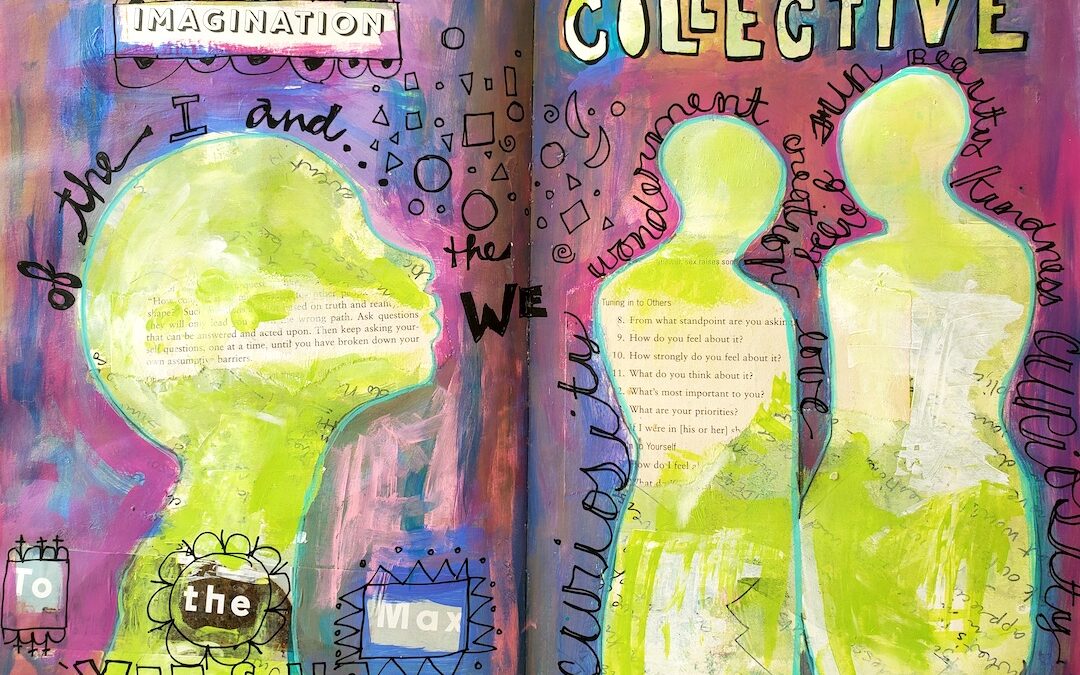
The group provides a container for experimentation, for connection, for mirroring and amplification.
This is not to say that group sessions will always be comfortable. It can be scary to be in front of people. To not know what they’re thinking when you speak, when you share. That is why we make our group agreements up front – and I hold the container with the group to support one another in witnessing and deep listening.
Group sessions provide a powerful facilitated community for growth through the process of supporting and being supported, witnessing and being witnessed, stepping up and stepping back. And it is deeply inspiring to see and be seen as you gain strength and grow in community.
