How to move from “I’ve just got to get through this!” to “How can I enjoy as much of this experience as possible?”
For the past few months, I’ve been practicing enjoying my work and high stakes moments even when I’m IN the moment. In other words, I have jettisoned a phrase that I tended to use quite often – “I’ll be glad when this is over.” Or another version of that idea – “I just have to get through this.”
And instead, I ask myself, “How can I enjoy as much of this experience as possible?”
I’ve had the chance to practice this quite a bit lately. For example, while teaching an online course with an international audience about visual journaling, facilitating and emc-ing a staff meeting of 40 people, and organizing and orchestrating a 200-person event.
So how have I moved from the mindset of ‘just get through it’ to ‘YEAH, this is FUN!!?’
And how can you? With these three things:
1. Set Your Intention
I set an intention that my values of creativity, love and fun shine forth in the experiences.
2. Ground yourself through meditation
Before the events I take the time to pause and meditate, reconnecting with my own source of energy, power and stillness.
3. Connect with your body
During the events, I relax and imagine myself in a state of flow while paying close attention to the information coming through my senses – the smells, sights, sounds.
As the events unfold, I notice what is happening and what is needed, then allow myself to respond with the right amount of effort.
The results are amazing – in addition to enjoying myself more, I radiate more joy and receive beautiful, positive messages of appreciation from the people participating in these experiences.
So what about you? Are there particular phrases that you perpetually say that stand in the way of your deep presence or full enjoyment as work or engage with others? What might you say to yourself instead?
Image has the power to remind you of your intention and connect you with what is important.
My sweetheart and I are decorating our new home together. We’ve decided to make our own version of Berber Baskets for our deck wall.
This was inspired by looking for ways to bring beauty into our space and we saw these beautiful baskets. My partner said, we have cardboard boxes. Let’s cut circles out and make our own patterns. So that is what we have been doing. In addition, we recently had friends over, and they painted “baskets” too.
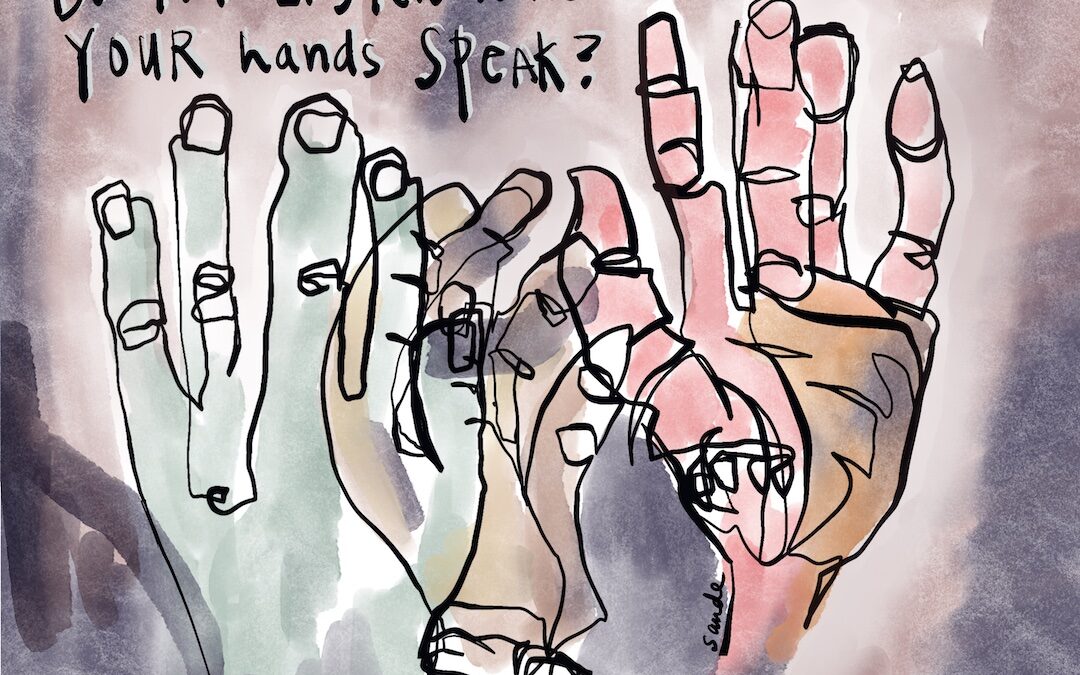
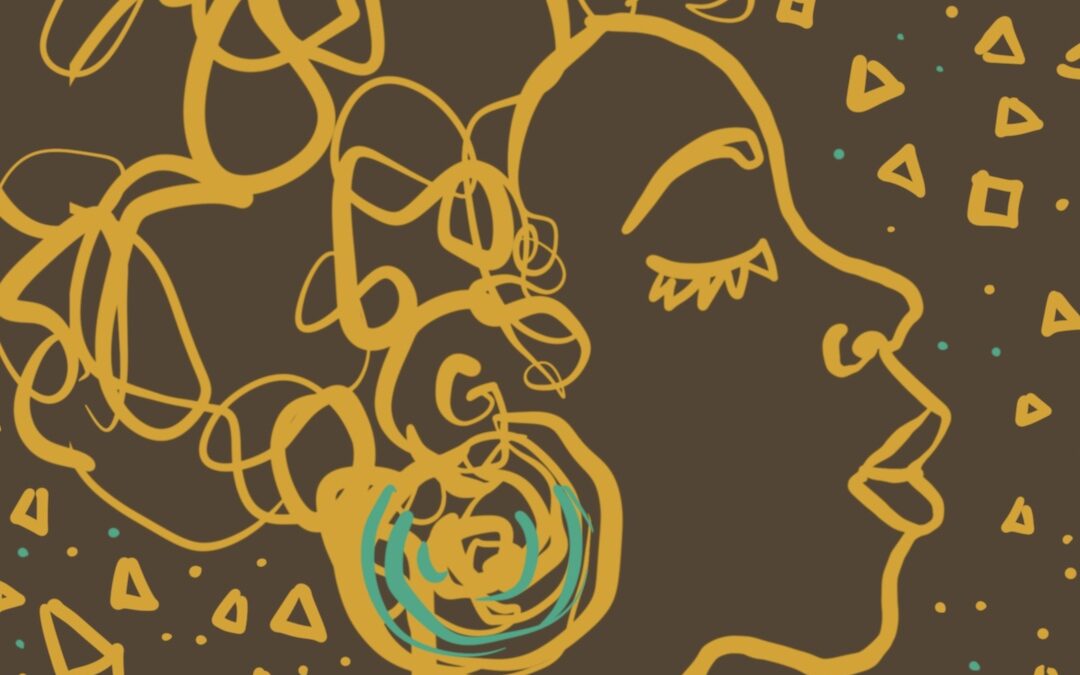
The “basket” that I created was a tracing of our two hands and it got me thinking about the power of our imagination to make visible what matters to us – specifically I was thinking about the hands that I drew and the patterns and their position on our wall.
I look at the hands and I am happy because they represent staying connected and in love through changing times and transition, holding each other and feeling each other’s touch through all of the shifts. The gold radiating out like a sun – the triangles that become diamonds.
The image has power that reminds me of my intention – from its position on the wall, it communicates to me.
Why is writing and drawing — literally putting something outside of yourself — so powerful? Because when the image is outside of you, it can talk to you.
The image becomes a transmitter, resending the message and the potent signals that remind you of who you want to be, and what you want to stand for.
Symbols outside ourselves matter because they help us know who we are, why we are and what we’re here to do.
The first is to soften, the second is to go gently and the third is to take time to ask, “What would be nourishing right now?”
When I am struggling, I slow down and listen. Over the past few months, I have been held by these three beautiful ideas that have taken root in me and helped me to move through this time of transition that I am in.
At work, I shared with folks that I was going to commit to bringing more ease and fun to my work – not sure what that would look like on the outside, but knowing that I would be doing meditation this time. I purchased Ingrid Bacci’s audio files and begin doing the meditation and body awareness tracks almost every day.
In her audio overview of The Art of Effortless Living, Ingrid Bacci says,
When you make your inner state, how you feel inside, more important than what you accomplish, how much you get done, how many people you impress…you end up performing at a higher level and you find much greater pleasure in what you do….Focusing on flow, on maintaining a balanced internal state creates success. This idea is not new. It has just been forgotten by our commercial, action-oriented culture.
To embrace this paradigm of effortless, I had to do two things:
Change My Mindset – I had to believe that cultivating an internal state of ease and effortlessness made sense. And it was hard. Because at first I didn’t believe that my internal state was something that I could manage, or that it had such a powerful effect on my external experience.
Build a New Habit – I had to commit to the daily practice of meditation which relaxes my body and focuses my attention on noticing my breath moving through me like a gentle caress.
Right away, I noticed that the meditation, which I do lying down, felt delicious. My body absolutely loved being invited to relax, to soften, to feel the breath, to slow down and stop. Doing the meditation has been important to show me the feeling of relaxation that I am going for.
Believing that being effortless is more important than having the right answer, saying the right thing and looking good has been challenging.
Intellectually, I already knew that pushing creates greater resistance – when I push on myself, I tighten. When I push others to get things done, they push back – maybe through words, a glance, their energy. . . connecting is harder, and so is achieving results.
I would notice that I’d be in a conversation with someone and I’d feel my body tense as I got ready to make a point, so I would pause and take a breath, notice my jaw, my neck. What if I don’t make the point right now, I’d say to myself, then I’d lean back a bit, soften my muscles. And maybe, I’d speak after that.
Seven months into this practice, I feel myself changing – my mindset and my behaviors. I am learning to soften when I want to push to get things done.
The second idea is to go gently, which beautifully accompanies this notion of effortlessness. Lisa Sonora recommends that when we feel overwhelmed, to go more gently.
When I think of gentle, I think of holding something fragile, like an egg, conscious of the way my hands are touching the egg, noticing the pressure of my fingers on the egg’s surface with such tenderness. So I turn that quality of tenderness toward myself and stop forcing, instead murmuring softly, it’s ok, it’s ok . . .
And the third idea, also from Lisa Sonora, is a question, What would be nourishing right now?
Over the years, I have often turned to food when I am stressed or pushing through a project. Food is soothing and grounding. But it is not always nourishing.
When I ask the question, what would be nourishing right now? I feel a sense of relief and softness toward myself – I take a deep breath and turn inward. What would be nourishing?
The answer sometimes is surprising – it might be to lie down on the floor, to go outside and touch a flower, to lie in my hammock, to get a cup of tea, to draw in my journal, to SLOW down and breathe, to meditate. Almost always it is some version of slowing down, pausing even, and just being.
In the course of moving house, which I talked about last time, I’ve noticed the challenges of wanting to push, push, push to get it done, to get into the next place, to be done. Moving is filled with task after task. It is a recipe for us to justify being stressed and tense.
Instead of giving into those feelings, I’ve reminded myself to soften, to go gently and to take time to ask, “What would be nourishing right now?” And in so doing, I create spaciousness for greater kindness and creativity while getting done what needs to get done.
How the process of letting go can help you be more of what you want.
My partner and I are on the tail end of a big move. We downsized from a house with a three-car garage that we used to store our stuff, into an apartment about half the size, with one room for storage. We’ve let go of a lot over the past month to fit into our new place, and it has been HARD.
For me, the big thing I let go of was BOOKS. Between the two of us, we have released at least 60 boxes of books. That’s about 1200 books. Now, don’t think that we don’t have any books left. Right now, I’m sitting in front of a bookshelf that’s holding about 250 books. And I have another 30 books in my office, and my partner has about 100 books in his office. So we still have books!
But letting go of so many books was a process that involved a few significant shifts in thinking:
1 – Releasing Shoulds
Many of the books that I had, represented things that I felt I SHOULD know, learn or do. Releasing those books meant acknowledging to myself that I’d probably read all that I was going to read in them. And even if the information held in those books had the potential to be amazing and life-changing, I didn’t have the time to read them all.
2- Accepting when a book was a past interest, not a present joyful desire.
At one time I may have wanted what was in the books, but now I wasn’t interested anymore. Accepting my shift of interest wasn’t an easy process.
3- Acknowledging that the way I learn now is DIFFERENT than it used to be.
When I was growing up as a working class girl in Philadelphia, books were the way I could access different viewpoints, lifestyles, and time periods. I didn’t have as much access to people from different walks of life and vantage points.
Decades later, I have built a life that allows me to connect to and speak with all kinds of people – and I love to talk to people, to learn from them directly. So while I still learn from books, I also prioritize learning from and interacting with people so that I can have more direct experiences relating to the things that I’m trying to learn.
4- Books can be dated.
Information moves quickly and ideas are constantly evolving. Books seem static to me in a way that they didn’t used to.
5- I’m a kinesthetic learner.
I learn by doing, by touching, by writing, by drawing, by visualizing. Just reading books doesn’t give me the full-on sensory experience that I need to feel connected to the topics/ideas and experiences that I’m trying to cultivate and absorb.
As an artist, I’m now cutting up books and magazines created by others and weaving the images, pages and words into my own books, creating works that help me to understand what matters to me. Creating artifacts that help me to EVOLVE.
Now that I have fewer books, I can really hone in on what the books I kept have to offer. I don’t feel as scattered. I feel as if the books are here to serve me, not me to serve them.
Books weren’t the only thing that I let go of. I let go of art supplies that I bought for classes, but realized that I didn’t really enjoy using. I let go of clothes that haven’t fit for years, releasing the idea that someday, I’ll wear them again.
I let go of notebooks from various jobs, artifacts and samples from work that I’ve done over the decades . . . constantly reminding myself that I don’t need these artifacts as proof of life, proof of my worth and what I have done. I know what I have done, I know what I can do, and I know that I am constantly evolving and changing.
One of the things that helped ease the process of releasing emerged through dialoguing with an image of a jeweled serpent in my visual journal. As I looked at the image, I asked the question, “What does the serpent know?” The response? “You must shed your skin to GROW, to expand, to realize your vision.”
Previously, I had been thinking of letting go as important to becoming smaller, more nimble. Now I could see that shedding was actually the key to growth and stepping into my power.
How to extract wisdom from your past and bring it into the present.
I’ve journaled over the years to acknowledge what I am going through, to calm and treat myself with care. I have journaled to tell myself that I matter, that I am here, present, and to not abandon myself.
The journaling that I have been doing over the years has been valuable because I’ve written to witness myself during challenging times – but I didn’t know that it has also been journaling to create wisdom.
The idea of extracting the wisdom from my journal is new to me, which is CRAzY because I have been journaling for decades! So what in the world have I been doing? Why has this idea of journaling to create wisdom escaped me?
I think there are a couple reasons:
1) I have hated the review process for as long as I can remember. Going back over something – whether that be a report that I wrote for school, or my journal became an exercise in seeing flaws, missteps and screw-ups. Measuring what I had created against what I should have created: some perfectionist ideal. I was never good at reviewing because I felt crappy about not getting things perfect the first time.
2) Reviewing a journal of just words, is well – kind of BORING. And visual journals are just more YUMMY to look at.
Reviewing my visual journal in a methodical way to reflect upon it, and extract, harvest, cultivate, see, notice, and appreciate is a valuable process I am just now undertaking.
When I review and APPRECIATE what I’ve created in my journal, the value of what’s in my journal increases.
I’ve noticed two things that relate to gaining greater appreciation, heightened value, and wisdom from my journals.
I picked up my visual journal and was paging through it, and there was quite a lot of work that I’d done writing and thinking about this topic of fear. I typed up what was in my journal and added it to the post. This process blew me away because I had forgotten that I’d done all that writing about fear already.
2) There’s another way that the wisdom from my journal is showing up. During one of our live journaling sessions, Lisa Sonora led us through a process of reviewing our pages, and then noticing which ones we found most satisfying and which ones we did not.
During that process, I went back and identified a page that was really bugging me because I hadn’t treated the words with the love that I wanted to show them. The page spread wasn’t beautiful to me. Looking at the page reminded me that I had just rushed through it, to get it done. You can see the first version below.
I covered up that version with black paint, and pearl paint so that I could go back and create something that did satisfy me. I collaged, I used typed words, and I took. My. Time. To really savor the poem, and the creation process.
In this second example (shown below) the wisdom that emerged had to do with learning to tune in to and respect what I found dissatisfying, asking myself questions about why that was so, and then taking my time to make a change that yielded a more satisfying page spread.
And so what is the wisdom? It’s realizing that the feeling of being satisfied is something to tune into – something to actively engage with.
I don’t think I understood how to practice being satisfied. This insight connects to a negative, destructive thought that I often find myself caught up in – which is the feeling of being deprived or denied. This exercise of noticing what is satisfying, or not satisfying, in my journal pages led me to the realization that feeling satisfied is an antidote to the feeling of being deprived. What does it take to be satisfied? Well, I am still learning.
So I’m seeing that extracting wisdom from my journal is taking place on two levels:
1) There is something that I wrote in my journal and maybe forgot I wrote. Going back to the journal gives me the information – I just transcribe it and work with it a bit. Voila. Thank you Journal!
and
2) This learning about who I am and what matters to me – this is much trickier. I don’t quite understand it. But definitely, I am learning about satisfaction and that I can consciously pause to notice – am I satisfied? Why or why not? I’m looking forward to seeing how this insight and awareness will show up in other areas of my life.