Tools to help you with five common leadership problems.
In my coaching practice there are certain themes that reoccur as clients navigate change and deal with organizational and personal challenges. These are the top five, along with links to blog posts I’ve written that offer strategies and resources to support you when you are dealing with these issues.
1. Balancing Self-Care and Responsiveness
One prevalent theme revolves around the internal struggle between self-care and being responsive to others. Taking care of oneself is seen as in conflict with taking care of and being responsive to others.
Clients express concern that making time to do projects for oneself is selfish and taking away from others. There is the fear that other people – whether loved ones in the family or people at work or in the community will wonder if you are committed to them. And there is the challenge of time in general, how to make time for the things that are important to you?
Many clients find themselves in well-paying jobs that, despite financial rewards, lack alignment with their values. Are you in a job that you thought you could tolerate because you were committed to the field or the mission but it is not the right fit?
Leadership challenges arise when attempting to bring others along who are resistant due to fear. Whether it’s fear of funding cuts or a scarcity mindset, influencing others to embrace bravery and take action can be an exhausting uphill battle.
Dealing with organizational change is a recurring issue. The dynamic nature of workplaces often requires adapting to shifts, and clients grapple with navigating these changes.
As I reflect on these recurring themes, I’m reminded of the profound questions surrounding transition. Who are you in the midst of change? What supports and challenges you? Where do you find yourself stuck, frustrated, or excited? And crucially, who do you turn to when standing on the edge of uncertainty?
Learn how to listen to yourself and trust your judgment.
Praise is not all it’s cracked up to be. Let’s talk about the unexpected downsides.
We can get so attached to wanting to hear how good we are and what a good job we’re doing, that when the acknowledgment doesn’t come, we wonder what’s wrong. We feel unappreciated, which hinders our ability to listen to ourselves and trust our own instincts and judgment.
For the last year, I have been making art in a praise-free zone and this has helped me to grow my curiosity and confidence in my own methods, interests and way of doing things.
What do I mean by no praise? This means no recommendations such as you should do this, or you should do that. And no critical feedback either. Instead, the learning and improving happens through a process of noticing what interests me in others’ work. I observe my reactions, feelings and thoughts, what attracts me and what challenges me. And most importantly, I keep drawing, painting writing — doing the work.
This experience has me thinking about how feedback — whether criticism or praise gets in the way of developing our creative and personal power.
I was first exposed to these studio agreements in Lisa Sonora’s visual journaling classes. I realized recently that there is also great resonance with the work of Tara Mohr, author of Playing Big, so I re-listened to a recording I have by her in which she talks about unhooking from praise and criticism.
Mohr talks about how we can become hooked on praise – giving and receiving it – and how fearing the lack of praise can get in the way of us being our full selves. She then provides tools for listening to and responding to feedback.
First she offers a huge reframe: feedback (both positive and negative) actually tells you more about the person giving it than it does about yourself.
She has you do the following: Instead of focusing on what the person is saying about you – ask yourself what the feedback tells you about the person who is giving it. What are their perspectives, priorities, and concerns?
Then, ask yourself if the feedback is relevant to your goals and what you’re seeking to accomplish. If the feedback is relevant, ask yourself how to make use of it, and how best to engage with the person.
Mohr emphasizes that the question of, “Is this feedback true about me or not?” should not get our attention. Instead, we should focus on whether the feedback is relevant to what we are trying to accomplish.
After listening to Mohr’s recording, I did the exercise using a piece of tough feedback that I’d received about a communications plan earlier in my career. What I learned was eye-opening.
I realized that I interpreted the numerous comments form my boss about the plan as evidence that I’d done something wrong. I became hyper-focused on incorporating everything my boss said into the plan so that it would be right.
What didn’t I do? Listen to my own professional voice, experience, and goals and then check into my boss’s priorities — which frankly were about speedy execution during a crisis, not perfection.
So what does that have to do with no praise zones? I missed the mark because I didn’t stay in touch with myself. I let the feedback be about me — and not what I was trying to accomplish, so I diminished my power and effectiveness.
Now, back to those studio agreements from Lisa Sonora:
1) No comments on others’ work or what they share: Don’t evaluate, give advice, coach, demonstrate, or point out what you like or dislike about what they’ve created. Do share about your own experience: what you are learning and how you feel. 2) Kindness matters: In online interactions, prioritize playing nice, recognizing that emotions might not always translate well through text.
I love these studio agreements because they reinforce the message that process is more important than product.
At first the no-praise agreement was challenging. This goes against how we typically behave with one another – especially when we are trying to be encouraging and make each other feel good.
Creating non-judgemental zones, free of praise and criticism actually creates a container that allows people to take risks and explore what they want to explore – to follow their own curiosity without worry about what comments they will receive.
Praise-free zones are a tremendous gift and key to building a practice of staying connected to your voice, your vision, your goals. And that pays off no matter what setting you’re in.
How to use collage and reflection to uncover new insights.
One of my favorite ways to get myself unstuck is to set a timer and make a collage. I start with a question to hold, and then I set a timer for 10 minutes and search through my stash of images.
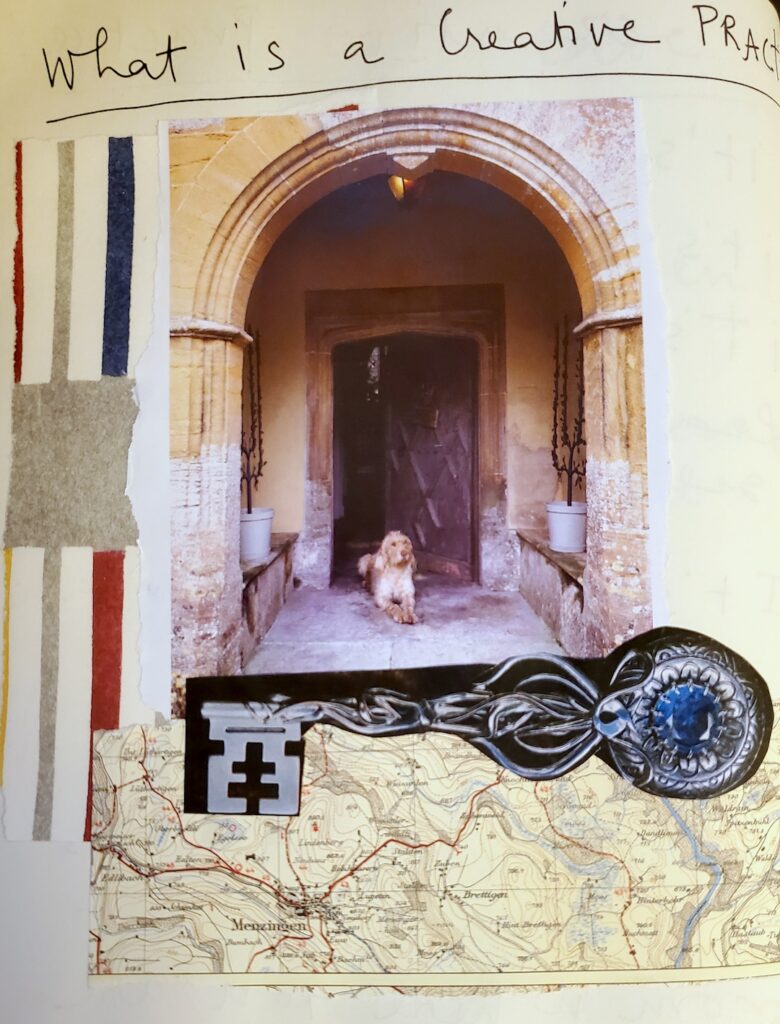
Here is an example – I started with the questions, “What is a Creative Practice?” And this is the collage I created in response:
When I reflected on the collage I created here, I wrote the following:
What is a Creative Practice?
it is a doorway
a map
a gentle sentinel, full of warmth and love, eagerly waiting for you to arrive and accompany you into yourself
it is a key, unlocking your own wisdom, previously hidden from you.
Using both collage and writing allows me to discover meaningful metaphors and connections that might not have surfaced through freewriting alone.
In this case. I was especially touched by the image of my creative practice as a dog, the gentle sentinel, waiting to accompany me as I journey into my unconscious self.
Try this for yourself the next time you are feeling stuck and needing fresh insights:
Grab a magazine, scissors, and glue.
State your main question.
Set a timer, collect images, and create your collage.
After you finish your collage, you want to take a few minutes to reflect on what you created. What connections do you see between the images you chose? Journal for a few minutes about your image and see what additional thoughts come.
I was asked during a job interview about the values I bring to the workplace. I shared that I believe in manifesting love. I believe in bringing care and lifting up the well-being of my colleagues by consciously speaking and behaving as if my colleagues are special.
Even as I shared this with my interviewers, I felt a little odd, because this wasn’t something that I heard people talk about.
How do we have a shared vision around bringing love into the workplace? What does that look like? Especially when love is typically seen as too personal, too squishy, for our professional spaces.
I was thrilled to have a chance to read bell hooks’ book, All About Love, during a book group in our workplace. First published in December 1999, All About Love: New Visions is described by hooks as “providing radical new ways to think about the art of loving, offering a hopeful, joyous vision of love’s transformative power.”
Personally, I wanted to hear from the rigorous intellect of bell hooks ways to consider whether or not I am behaving in a loving way – be that at work, or in other aspects of my life – and how I might measure that. I wanted to hear from her how she is growing her own capacity for love.
And I wanted to be in conversation with my colleagues about how these ideas might affect how we, in the social justice arena, do our work.
Well, I will tell you that the book group conversation was lively and enlivening. Hooks is committed to asking herself and others hard questions, challenging us to change how we behave based upon new information and new insight.
She challenges:
the belief that we can be in relationships where we treat each other harshly and call it love
stereotypical gender roles and behaviors
our habits, beliefs and practices about love
Early on in the book, hooks shares her concern that there isn’t a good definition of love. She does a lot of research and talking to folks about it. And she finally lands on a definition from M. Scott Peck’s book, The Road Less Traveled, first published in 1978, in which Peck describes love as “the will to extend one’s self for the purpose of nurturing one’s own or another’s spiritual growth.”
Hooks defines love as both an intention and an action. She writes,“To truly love we must learn to mix various ingredients — care, affection, recognition, respect, commitment, and trust, as well as honest and open communication.”
Hooks challenges us to think differently about what it means to tell lies (even so-called harmless lies to protect people’s feelings), to consider how we show love toward our children, and what it means to embrace a love ethic as the foundation for the work.
“Culturally, all spheres of American life – politics, religion, the workplace, domestic households, intimate relations – should and could have as their foundation a love ethic. Commitment to a love ethic transforms our lives by offering us a different set of values to live by.”
What ethics currently underlie our politics, religion, our workplace, domestic households, and intimate relations? Fear, materialism, domination, power and appearance are ones that come to mind, and hooks explores the role of fear and domination to thwart love in action and policy. Hooks encourages us to consider that,
“In large and small ways, we can make choices based on a belief that honesty, openness, and personal integrity need to be expressed in public and private decisions.”
After our workplace conversation, I was left with the question of how to turn insight into action. I believe it is through making a practice of the inquiry – how did I practice honesty today, how did I demonstrate openness today, how did I act in a way that matches the ideals that I hold?
By asking these questions of ourselves, and journaling our responses, even for a few minutes, we bring consciousness and awareness to a higher standard of loving.
The power of visual journaling to connect you to your inner wisdom.
I recently had a wonderful conversation with Lisa Sonora, one of my mentors in visual journaling. We talked about how visual journaling supports me in my life, touching upon topics such as:
The value of harvesting, which is the practice of going back and reviewing your journals, mining then for actionable insights and ideas, (16:03)
Drawing your letters and words so that meanings and connections are revealed (7:32), and
Upending perfectionism. (17:32) Through the process of making page spreads, I started noticing my drive to make the pages perfect, doing them over and over, pushing myself to meet some ideal. I also started noticing the feeling in my body of wanting to have something be perfect, which I had never noticed before. In an encounter at work, I noticed that same feeling in my body, which got my attention, and prompted me to decide to move through my work processes differently.
As I share in the video, I found the pages to be a rehearsal space for noticing deep patterns, emotions, and ways of being. The process of journaling and REFLECTING on the journaling allowed me to slow down enough to catch these patterns when they showed up in other realms.
Being able to see my patterns, gave me options for changing the entrenched habits.
In fact, all you have to do to start is cut out a few images from a magazine and glue them down or add splotches of color on the page. Then make a list about what’s on your mind, something you noticed that day, or a question that you’re exploring. You will be amazed to see how the combination of image and words sparks something new – something that you hadn’t known was there.