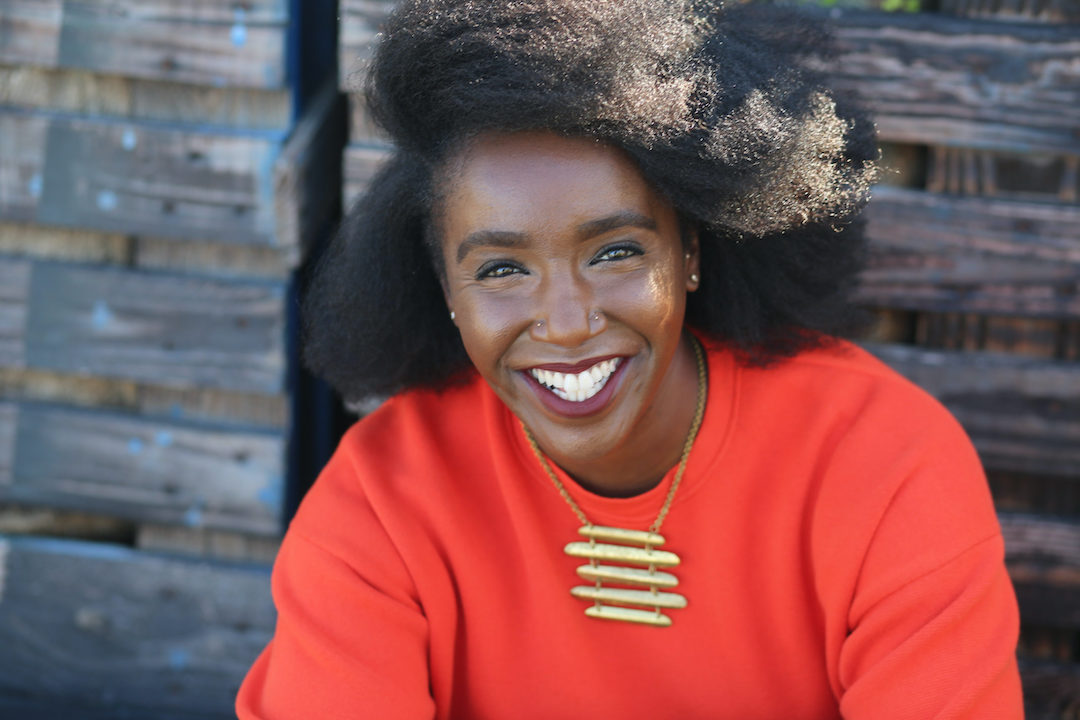
An Interview with Nwamaka Agbo, CEO of the Kataly Foundation & Managing Director of the Restorative Economies Fund
Kataly Foundation moves resources to support the economic, political, and cultural power of Black & Indigenous communities, and all communities of color.
Sande: What do you know now about leadership that you wished you had known when you started your role as a CEO?
Nwamaka Agobo: It has become abundantly clear to me that leadership is not about having all the answers.
Oftentimes, particularly when I was younger, leadership was presented as being ultimately responsible for what is happening in the organization, and being the one who is supposed to know everything.
Now I understand that leadership is modeling what it looks like to ask thoughtful and strategic questions.
Leadership means building a team of people who I help develop, trust, and train, who are the ones with the expertise needed so we have as many of the right answers as possible.
As CEO of the Foundation, I hold a bird’s eye view. I’m able to see all of the individual areas of work each person holds and how those pieces come together to make up the whole. I make sure there’s communication across those areas of expertise and that people are building relationships and connection with each other.
I also find that leadership means tending to the unspoken parts of the organization. I see that there are places and spaces where people need tending and care and there’s also places where people want separation. So being able to recognize and respect those boundaries is important.
Leadership is about moving away from “do as I say, not as I do” to actually “do as I do,” which requires me to hold myself accountable to being the type of colleague and leader I want my team to be.
In addition, being in a leadership role means you have responsibility for shining the light on each and every person doing their piece of the work.
Typically, we have a culture and a habit of putting the leader of an organization on a pedestal. But I believe we’re supposed to create lots of other pedestals and bring our colleagues and teammates along.
Leadership means being able to move with an awareness and level of humility where you can share the light and shine with amazing colleagues that are doing the work.
Sande: What does it mean to ask for help in your role? Who do you turn to?
Nwamaka: Who I turn to depends on what I’m asking for.
I’ve struggled with learning to delegate. Prior to this role, I was a consultant, so in that role I did everything myself. Now I am learning what it means to ask for help, particularly in delegating pieces of work and trusting that my team will let me know when they can’t take something on.
I also want to build a team that is willing to challenge me.
I don’t want a team of yes people. I don’t want a team that’s going to tell me what they think I want to hear.
When I’m asking for help, particularly when I’m asking to double check my own work or inquiring about how I’m moving in the world, I want a team that will say, “You know, this word or the way you framed this in your talk wasn’t helpful or wasn’t aligned with our values. Let’s unpack that.”
That is what it means for me to ask for help. To have honest, loving care, and accountability. It’s a team of people that bring not just critique and the analysis, but a team that can come with solutions, recommendations, and insights.
I also recognize that because we are a hierarchical organization and I am the person who’s technically at the “top” of that organization, there are times when it’s not appropriate for me to ask the team for help on certain things. There are some pieces that are really my responsibility to hold. And so then, I turn to my trusted advisors, mentors, colleagues, who are outside of the staff.
I have a “kitchen cabinet” with whom I can talk through strategy difficult engagements. They offer me insight and support. Having that trusted group of people that I turn to, who are all women of color, is also how I resource myself and have the ability to ask for help.
Sande: What allowed you to make the transition from not knowing how to, or not being used to asking for help, to doing it?
Nwamaka: A lot of humility. Learning to hold curiosity, learning to depersonalize things, and recognizing that when people ask questions, they’re not usually questioning me as a person, or my self-worth, or my value. Most of the time, the questions are coming from a really thoughtful place.
If I am committed to our mission, vision, and values as an organization, then what does it mean for me to not be the person who has all the answers, and to create space for others to have answers and solutions and then to acknowledge them and give them credit for their work?
I remember what it felt like early in my career to not be trusted, to not be engaged, to be silenced and sidelined and see people take credit for my work.
For better or for worse, navigating the world as a dark-skinned Black woman means that, unfortunately, I’m far too used to being discredited and made invisible, with people underestimating my capacities.
When I can hold a level of awareness and sensitivity to what that feels like, then I can bring my awareness to how I engage with my team.
I don’t want my team to ever feel like they or their work is not valued. I know that my role and my position is not threatened by them being excellent at their job. I want them to shine.
Sande: How does racial justice play into your leadership practices?
Nwamaka: Unfortunately, we are seeing that many diversity, equity, and inclusion (DEI) initiatives are not materializing the type of systemic racial justice change we need. And not just with racial justice – I would say with gender justice, career justice, and disability justice as well.
One of the reasons we’re not seeing change is because the racial justice work that is translated into DEI often ends up being only a theory of what it really means to be racially just or inclusive.
Therefore, it is crucially important to me that at Kataly we build a team that comes from a lived movement experience. These are people who have a track record, a demonstrated network and community, and experience of actually having done the work on the ground.
They know what it’s like to navigate and move through the world not only as people of color who experience racism, but as those who have pushed back and fought systems. And they know what it’s like to do this work from their intersectional identity – as people of color, as working class people, as queer, non-binary folks, and more.
We are building a team that is rooted in the praxis of diversity, equity, and inclusion. We are focused not just on racial justice but on demanding anti-racism in how we all move and operate.
Sande: What’s important about leading change in an organization and in the world?
Nwamaka: Leading change requires us to be able to navigate a world of shifting conditions.
My goal is to develop a team that can hold a learning stance.
A learning stance means we have the ability to acknowledge when there has been a mistake, or when we need to respond to a challenge that has shifted the landscape. We have the ability to critically assess what happened and to interrogate why things changed.
We also strive, both individually and collectively, to hold ourselves accountable and take on responsibility for the role we played in the mistake, and commit ourselves to improving the next time.
When leading change, it’s important to have a team that has the capacity to play in a dynamic landscape.
For example, think about what happens when you sit on a stability ball – you’re forced to adjust every time it rolls a different way, and constantly find your center. At first, you may fall off the ball when it shifts. But over time, the more you practice it, the more you can continue to find your center.
Leading change for me is about cultivating a team that can continue to find its center, individually and together.
This process requires the leader or leadership to have a deep amount of vulnerability. We have to be vulnerable enough to demonstrate to our team what it means to have a learning stance. When you, as the leader, fall off that stability ball, how do you get back on it?
And so when I make a mistake, I have to own it and I have to name it. I have to be able to identify what the mistake was, where I dropped the ball, what I could’ve done differently, and apologize to those that may have been impacted by my mistake.
And then I don’t just sit in the corner and lick my wounds, right? I have to come back and keep doing the work. We all have to learn how to show up in the work, show care and grace for each other, and understand how to communicate and facilitate a need for correction to our colleagues whenever it makes sense.
That may sound something like, “Wow, you know, that was really hard when you did that thing. It really hurt me, or it impacted me in this way. I appreciate you acknowledging it. Here is what I would like to see going forward.” We need to learn to make the agreements we need for repair.
I want us to have a culture where when someone makes a mistake, we don’t kick them out, but we actually see it as an opportunity to draw them in closer for a deeper connection in the hopes of stronger alignment going forward.
These are the type of skill sets that help a team move forward because mistakes and failures are natural. It’s part of the work. It’s part of how we get to deeper change. And yes, leading change also includes research and understanding what’s happening out in the world and the markets.
Ultimately, we have to remember that our ability to allow ourselves as individuals to be transformed through the work is also part of the change and the changing conditions that we’re trying to create.
We as individuals are a part of the systemic and institutional transformation. Systems are made up of people and designed by people and so we too have to change.
Sande: Thank you Nwamaka. It was such a joy to speak with you.
This interview is part of my Defining Leadership: Conversations with Women Leaders series.