One of the powerful practices we do in coaching is to create and articulate a future vision.
Why are you interested in being coached? Because you want to change something that isn’t working. You have a vision for yourself and the contribution you want to make to your life, your loved ones, and the world. But something’s getting in the way. What is it? And what’s at stake if you don’t change this situation? What will the world lose if you do not step fully into your vision?
Vision work is grounded in storytelling. For example, think about a story of a peak experience in which you felt joyful and powerful. Take a few minutes to jot it down, and then notice what it tells you about what matters most to you, and the values that you hold. What are those values? And now, consider what emerges from this story that helps you embrace the future you want? When you think of where you want to be 10 years from now, who is there? What surrounds you?
In this ideal future, what strengths and capabilities have you developed? Note too, that you already have capabilities and strengths. Which of these will you use more of in this future? And what contribution to you want to make? What makes this contribution unique? What is the visionary story of your life?
Now, what if your vision were 1,000 times bigger? What if your vision were 1,000 times deeper? Then what? What could come into being then?
Williams, an author, musician and spiritual teacher, calls upon us to stop thinking of fighting racism as a lifelong fight that will last for generations, but instead, one that can be fought in one generation. OUR generation.
He says, “But before we can begin to look at how to end racism—both systemic and internalized—I think it’s important that we understand what makes racism persist. Because once you’ve been stuck in a condition—once you’ve been working on the same recurring problem over and over to no end—it becomes important to shift the question from, “What is the problem?’ to, ‘Why does the problem continue to persist in the first place?’
Ah, yes, that is similar to one of the coaching questions we ask. What gets in the way of realizing your vision? To that question, we bring an attitude of curiosity and deep interest as we investigate the obstacles that get in the way.
Williams points to five beliefs shared by so many of us who are working to fight racism:
Racism is unavoidable.
Race matters.
“Those people” will never change.
Real change takes a long time.
We don’t know how to end it.
One by one, he challenges each of these shared beliefs that stymie our imagination and thwart our actions, and shows that:
1)Racism can be avoided because it is learned, not automatic.
2) While racism matters, race is imaginary, a social construct set up to uphold power and reinforce divisions.
3)People can change – the trick is figuring out how, and then use those reason for change to “create a model for racial healing where those conditions can be met, and met quickly.”
4)Some of the greatest changes in human history have occurred in less than 25 years. For example, the time from the Wright Brothers first flight to the use of commercial air travel was 17 years. The time from the first phone call on a handheld cell phone to widespread use of the cell phone was 22 years. He has plenty of other examples to bring home the speed of change that is possible.
5) Thanks to tremendous work from anti-racist scholars and researchers, we have models, systems and structures describing exactly what is needed to do to end racism.
In coaching, once you’re clear on your vision, then you have to get clear that you are willing to take the steps needed to move toward that vision. As you take action, you seek the resources you need to accomplish the goal. You plan for the resistance and obstacles that may arise. You set up accountability structures that both inspire and encourage. You determine who you may enlist to support you along the way. You acknowledge and celebrate the milestones as you reach them.
I accept the challenge to take actions to realize the future I envision – to end racism and unleash the power, beauty and brilliance possible in a world where every single one of us is nurtured and encouraged to realize the fullness of who we are.
What future do you envision, and how will you bring it to life?
Coaching is a powerful tool that can help you get from where you are to where you want to be.
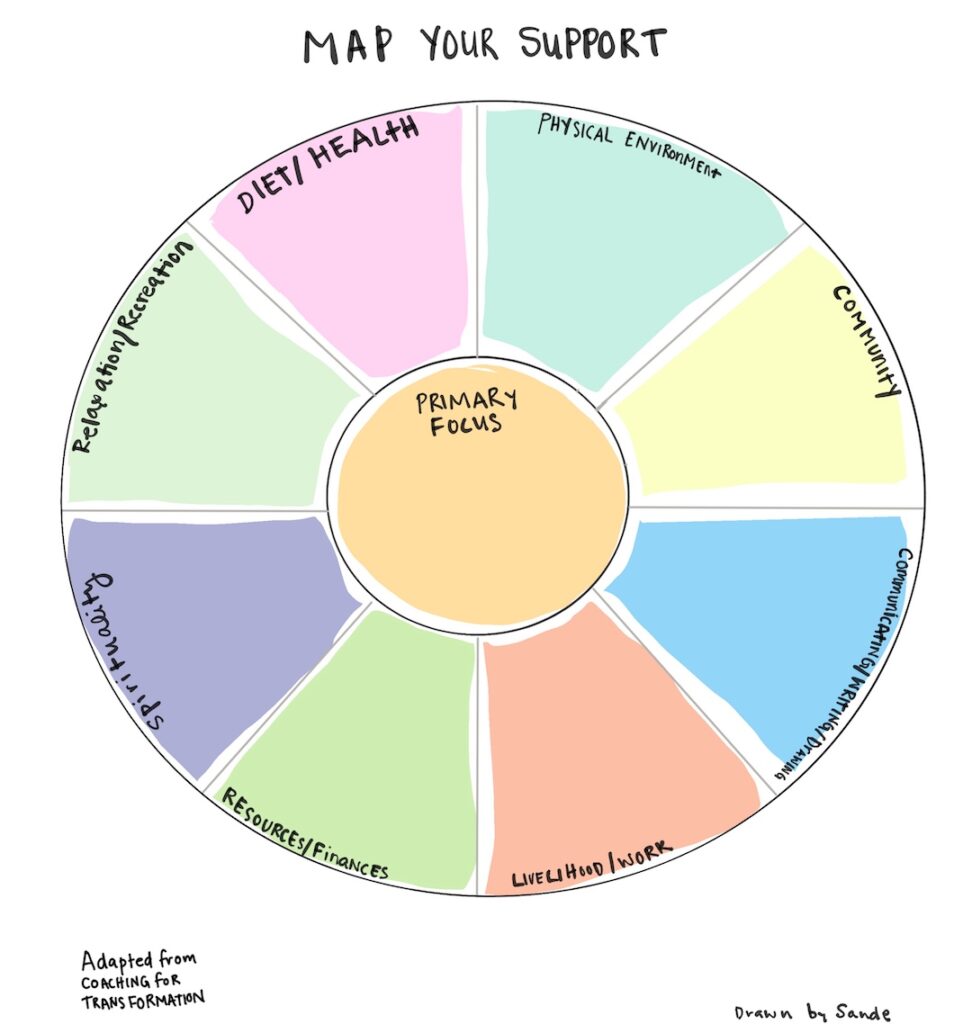
But you’re still the one doing the work and you have to take care of yourself on the journey. It can be exhausting and scary. How will you support yourself along the way? Mapping out the support you need can be very helpful.
I’ve provided a template for you to work with:
In the map, you’ll see your primary focus in the middle, and then various areas of your life. First, jot down how those areas are already supporting you, and then note what more might be possible.
What resources do you have? Think about the knowledge and expertise you have in other areas of your life. Who is in your community – friends, family and acquaintances? Who can you talk to – both living and ancestral? What about other areas of your life – your work, your physical environment, your spirituality?
How do those areas support you now, and how might you call upon them for greater support to move you in this area you are working on?
Let go of self-doubt and judging. Become a master of observation and curiosity.
Here’s what I mean by becoming a master of observation. Imagine you’re making a drawing of a face. When drawing you can look at what you’re doing and say to yourself “what is that? Do you think that’s a nose? Ugh, that’s horrible, and look at her eyes, they’re too big. Why did you think you could draw this face anyway? It’s too hard.” Ah, the self-doubt emerges and then the belief that you can draw ebbs away.
Or you can look at the drawing and say, “hmm, yes, I see her nose is a little lower on the face than her nose is in the photo. Ah there, her eyes need to be a little bit farther from each other. Oh this is interesting, what is the difference in size between her left eye and her right eye?” Now curiosity is managing the process.
As you navigate the drawing process you can be curious and notice the difference between what you are drawing and what you see in front of you. You can be curious about the distinctions, and then choose how to respond. You can choose when and where to make changes in your drawing.
Notice the difference in how those two perspectives feel? In the first example, the judging quickly turns to self-doubt. The body notices the difference in these perspectives.
When you are observing what’s in front of you, you’re engaging in a process that can energize you, rather than drain you. Judging tends to drain us, while observing with curiosity fuels us and creates spaciousness.
This week, how might you play with the distinction between judging and observing? How does it affect your feelings of self-doubt and influence your sense of confidence?
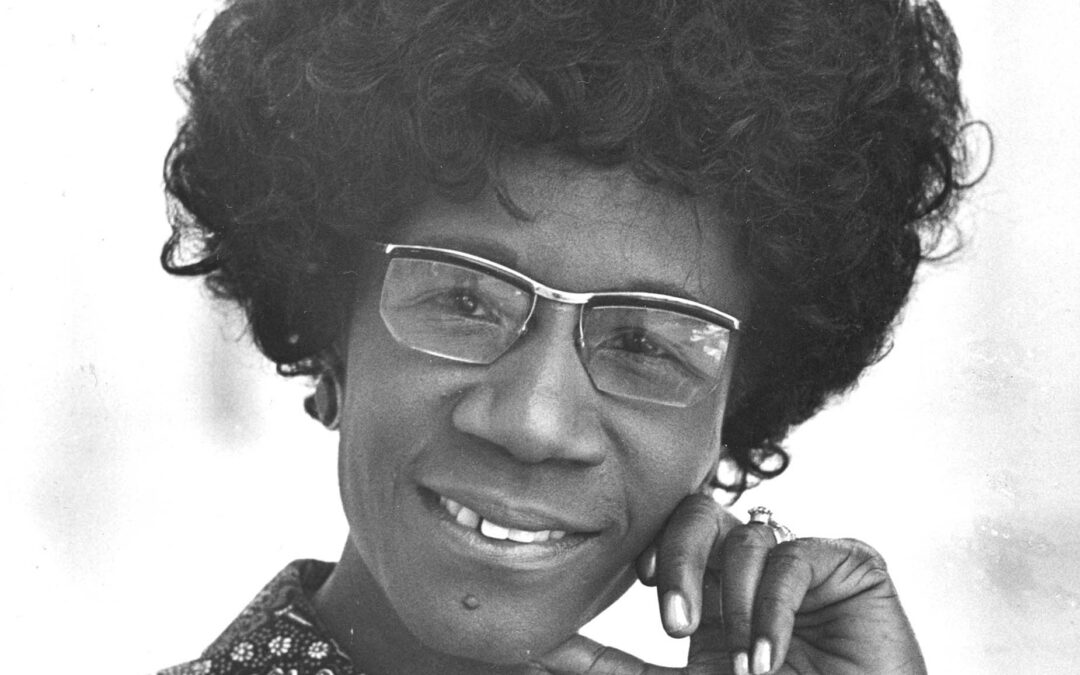
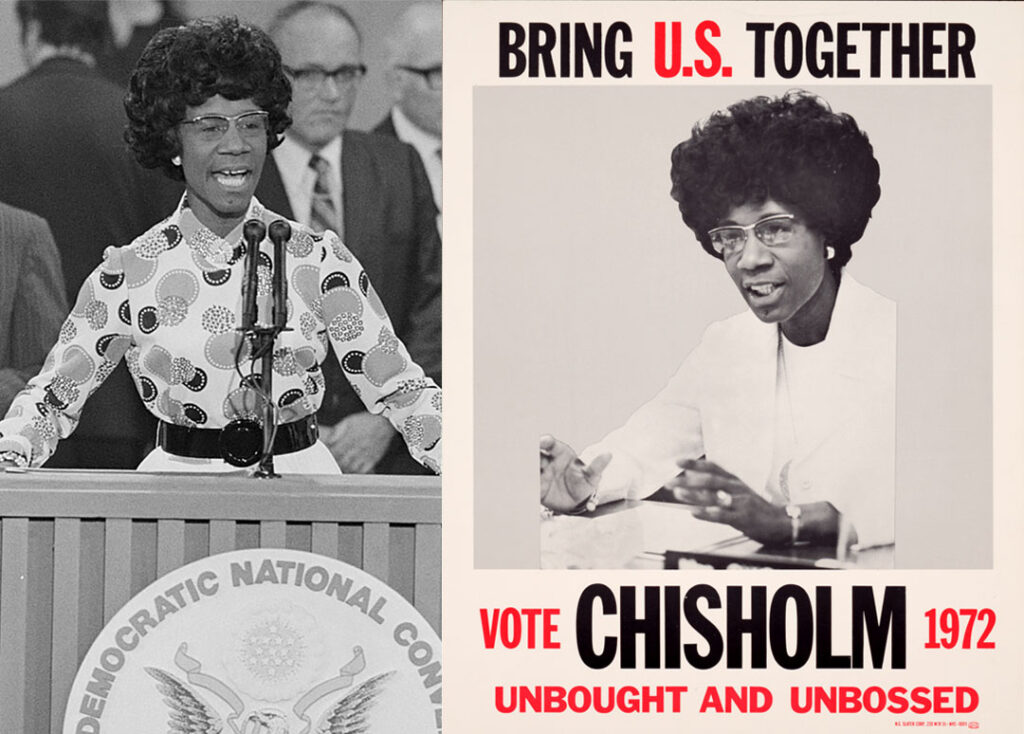
When I was growing up, I knew about Shirley Chisholm, the Black Congresswoman who ran for President in 1972 – the first Black woman to do so.
My mom had a copy of her autobiography, Unbought and Unbossed, and clearly admired her. But who was Shirley Chisholm and what really happened? When I learned that the African American Museum of the Diaspora was holding a virtual film club featuring a film called Shirley Chisholm ’72, Unbought and Unbossed, I jumped at the chance to watch the film and join the conversation. (You can watch the film for free on Kanopy, if you have a library card, or on Amazon Prime video.)
Director Shola Lynch says that she wanted to tell Shirley’s story while she was still alive, but it was hard because “nobody knew where she was.” It took persistence and synchronicity – “I met a guy in a bar whose mother lived next door to her – in Florida,” that led to Shola finally being able to meet up and carry out interview with Shirley. She tells a beautiful, compelling story that contains Shirley’s reflections on the campaign, as well as footage of Shirley giving speeches and telling it like it is. As someone who loves color, I was also delighted to see Shirley’s sense of style – she wore beautiful and colorful suits while traveling the campaign trail.
During the opening scene, we see Shirley Chisholm addressing a crowded room at the Concord Baptist Church in Brooklyn, New York. And she says the following:
I stand before you today as a candidate for the Democratic nomination for the presidency of the United states of America. I am not the candidate of black America although I am Black and proud. I am not the candidate of the women’s movement of this country although I am a woman and I’m equally proud of that. I am the candidate of the people of America and my presence before you now symbolizes a new era in American political history.
Americans all over are demanding a new sensibility, a new philosophy of government of Washington.
We can create a new America in 1972, one where there’s freedom from violence and war, at home and abroad, where’s there’s freedom from poverty and discrimination where there is at least a feeling that we’re making progress in ensuring for everyone medical care, employment and decent housing.
Those of you who can now vote for the first time, those of you who agree with me that the institutions of this country belong to all of the people who inhabit it, those of you who have been neglected, left out, ignored, forgotten or shunned aside for whatever reason – give me your help in this hour, join me in an effort to reshape our society and regain control of our destiny as we go down the freedom trail for 1972.
You’ll learn a lot about leadership from this film.
It was hard for Shirley. She battled both racism and sexism, and lack of support from the mainstream women’s movement and the Black caucus was a bitter disappointment. Having paid the expenses for the campaign out of her savings (a schoolteacher’s salary), she ended the campaign in debt. But true to her intent, she inspired millions.
To see and hear Shirley Chisholm, in her own words, is food for the soul. And when you’ve watched the film, be sure to check out Shola Lynch talking to Cornelius Moore as she shares the behind the scenes story about making the film.
Lately, I’ve been getting into painting with gouache, a water soluble paint – similar to watercolor, but more opaque.
You can paint with gouache using very little water, so the consistency of the paint is thick like heavy cream. And when it’s that thick, the paint goes on deliciously creamy and dries to a velvety matte finish. There’s something sensual and delightful about gouache.
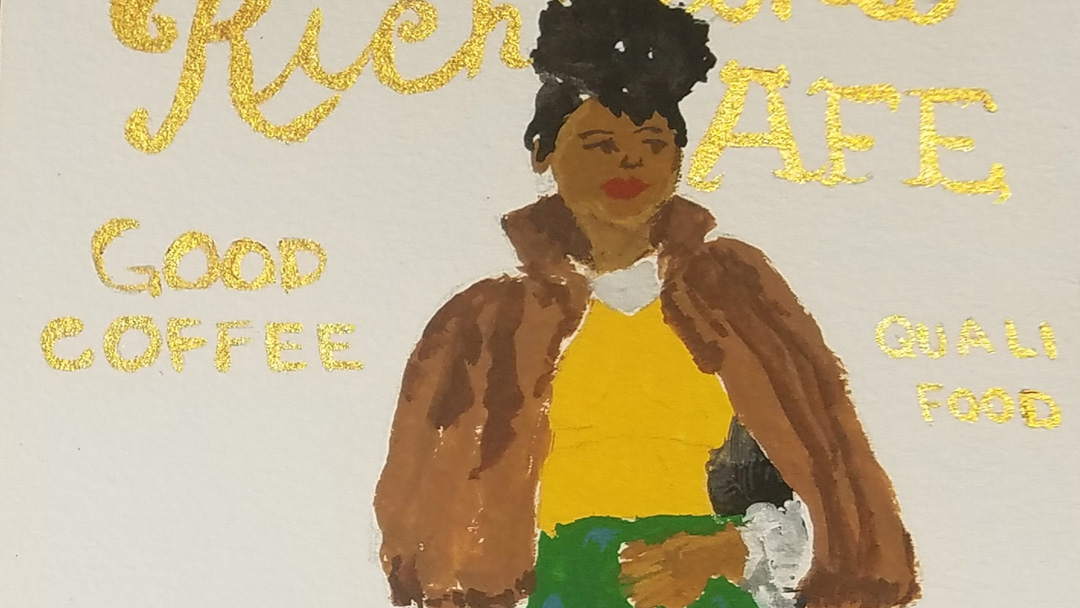
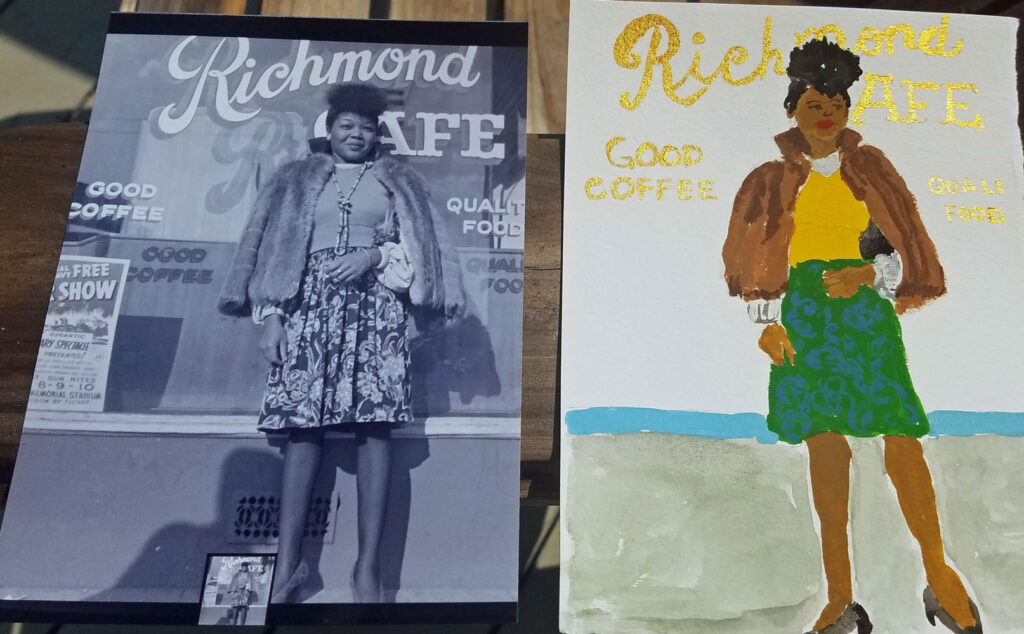
One of my favorite artists who works with gouache is August Wren. She paints whimsical and colorful butterflies, flowers, coffee cups and tea cups. And she also paints portraits. Recently, I did an online class with her where she showed how she looks at black and white photos and turns them into lovely, colorful gouache portraits.
I painted from a black and white photo taken by Dorothea Lange. I found it especially enjoyable because Dorothea Lange’s photos take me back to the 40’s and 50’s of Oakland and Richmond, California life. I get to see what the streets looked like and begin to understand a bit more about what life was like for people during those times.
Because the photos are black and white, I exercise my imagination as I illustrate the photos in color. Whether or not you want to paint them, be sure to check out the Oakland Museum’s online collection of Dorothea Lange’s photos. And here are some resources for you to check out if you want to learn more about gouache and give it a try: