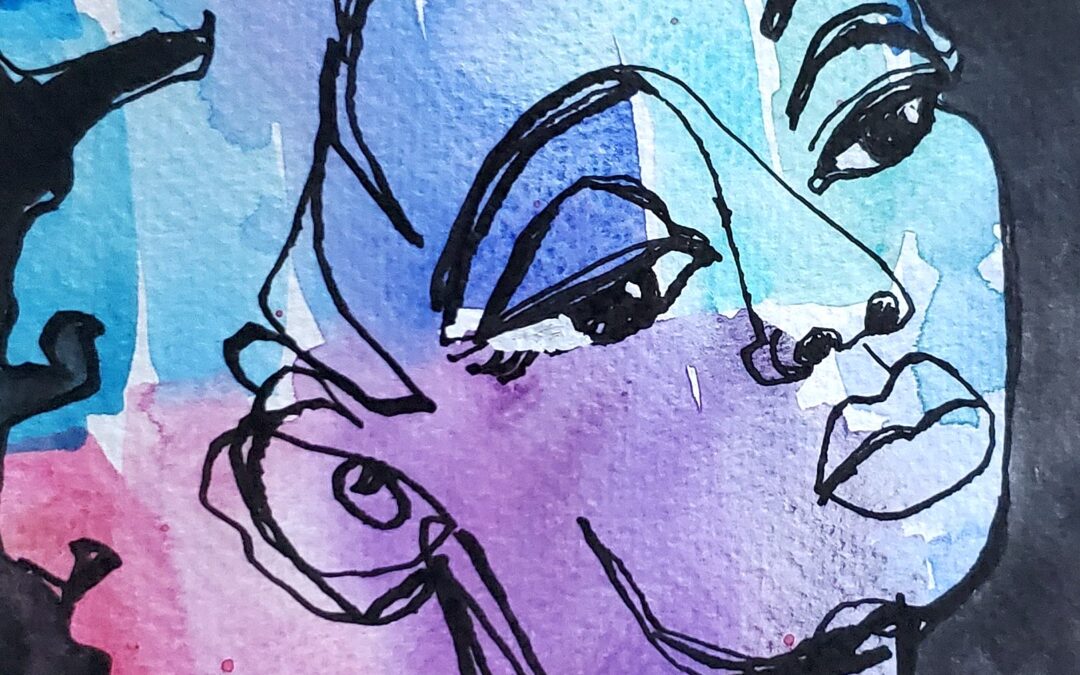
by Sande Smith | Mar 27, 2025 | leadership & racial justice
Uproot toxic word legacies and embrace your full self.
Did you grow up as I did, with the expression, “Sticks and stones may break my bones but words will never hurt me?”
At first, this refrain seems to make good sense. If their words are having an effect, then it must be our fault for letting the harmless words affect us.
Well, 50 years later, I can say that words do matter – and that what is said to us, or about us, has a tremendous impact. Especially when we are young.
I remember when I was in the 1st grade and the other girls teased me. They said that my short Afro made me look like a boy, they said I was too tall and “talked white.”
I felt terrible when I heard the words those girls said. These words went into my skin, affected my eyes, my mind, and changed how I saw myself. Now I could only see myself as NOT pretty. I became ashamed of being smart, tall and powerful.
When I came home and told my mom what the other girls said, she replied, “Sticks and stones may break your bones, but words will never hurt you.”
I do not remember her saying words that would have healed, like, “My dear you are beautiful and I love the way you speak.”
Yes, my mom taught me to enunciate, to speak clearly, study hard and get straight A’s. She told me that I should not care what those girls thought.
But I did. I knew that the words were searing into my mind, my body, affecting and poisoning my sight, my mind, and that my mother did not know the antidote. In fact, she continued to poison me, as I grew to be 5’8″ to her 5’3″.
When we went shopping for shoes, my mom used to get frustrated. She would say, “Your feet are so big.” She told me my hands were too big and not ladylike.
I wanted to believe that, “Sticks and stones may break my bones but words will never hurt me.” And yet, these words did hurt.
The poet, civil rights activist and memoirist Maya Angelou said that
“Words are things.
You must be careful,
careful about calling people out of their names, using racial pejoratives
and sexual pejoratives and all that ignorance,
don’t do that.
Someday we’ll be able to measure the power of words.
I think they are things
I think they get on the walls
they get in your wallpaper
they get in your rugs
in your upholstery
in your clothes
and finally Into you.”
When I listen to Maya Angelou speak about words being things, I believe that she knew what my mother did not know, that words shape us.
Words helped me to dismember myself. To break myself down.
Those words from my childhood took root, and made an easy resting place for adulthood insecurities, like imposter syndrome, to flourish and impede my development.
Maya says that someday we’ll be able to measure the power of words. I think that we already can measure their power in the ways that we repeat phrases to ourselves like,
Who do you think you are?
No one wants to hear that.
That’ll never work.
Critiques like this soak into our skin, our bones, our skulls and re-emerge when we face new challenges, raise our children, and strive to reach our potential.
Now, decades later, I understand the paradox – how much my mom loved me, how much she wanted me to succeed, to go further than she ever dreamed, and yet, she also used words that diminished me. It is hard to accept these contradictions.
But what happens when I face it? When I stop wanting my mom to be the one that showed me how marvelous I am?
What happens when I allow Maya Angelou to be one of the people who reminds me how MUCH I am, who allows me to embrace the largeness of myself and accept that I may be too much for some people, but I have the right, the responsibility, the pleasure, the blessing to be my full self.
I am as much a part of Maya Angelou’s lineage as I am my mother’s. When I read Maya’s work so many years ago, she was giving me permission and inspiration to write and love my story, my journey, my poetry, myself.
What does it feel like to embrace the polarities of who you are without self-hatred, but rather deep compassion?
I looked up the origins of the sticks and stones phrase and the first account was in 1862, in the Christian Recorder, an African American publication. No doubt, it was meant to be a talisman, a protection against racist speech.
And yet, this “spell” is ineffective.
How can we detoxify ourselves from the poison of words that have taken root in our bodies? I have a teacher who says we are wounded in community and we must be healed in community.
I believe this to be true. I have had many moving experiences in which friends, clients, and others mirror back to me the beauty and joy of what they see when I live and embody my full self. Their words are a healing and transforming force.
Words are things and words shape us.
Nourishing words from my trusted community help to heal me, rebirth me, and deeply inhabit the value of my unique and quirky perspectives. Slowly, I release the compulsion to fit in, and accept my powerful distinctness.
Who do you turn to for that mirroring? What words will put you back together? What words help you reconnect with yourself?
What can emerge in the spaciousness of accepting that words are things and words shape us? I am deeply committed to being a word sorcerer, to spelling my future, and healing the community as the community has been healing me. Join me.
If you need support to uproot toxic word legacies, reach out for a free coaching consultation.

by Sande Smith | Feb 27, 2025 | leadership & racial justice
The Importance of Interdependence
As a coach, I notice that my clients are missing an important piece of the work. This is something I’ve struggled with as well. We’re missing each other. We don’t know how to ask for help, or receive it.
Learning to ask for, and receive help is essential to our well-being, and to realizing our goals and visions.
In The 7 Habits of Highly Effective People, Stephen Covey describes a maturity hierarchy:
- Dependence: Relying on others to meet our needs.
- Independence: Meeting our needs on our own.
- Interdependence: Combining efforts with others to achieve greater success.
Interdependence speaks to the ways in which our lives touch and are touched by others, the ways in which our actions affect and are affected by others.
We are not alone. Not ever. We benefit from and benefit others. We hurt and are hurt by others.
What shifts when we acknowledge that interdependence?
Learning to ask for and receive help can be a challenge when we’re used to leading, when the role of caretaker is more familiar and comfortable, or when we are just used to doing things on our own.
Use these questions to reflect on ways you could shift into more interdependence:
1 – Redefine Your Relationship with Help
Many of us struggle to ask for what we need. Please reflect on what’s blocking you.
• What stories do you tell yourself about asking for help?
• What story about receiving help could you release or reshape?
• What if you believed guides and mentors were available to you, waiting for you to ask?
2 – Identify Your Support Network
• Who is your hero, your mentor, your collaborator, your accomplice? (Thanks to Journal Fodder 365 for these terms.)
• Who guides you? Who do you turn to for help?
• Are you open to receiving support? Why or why not?
3 – Qualify the Help You Need
Not all help is the same. Some help solves simple problems (fixing a shower), while other help requires complicated expertise (legal or financial advice.)
Then there are the complex life questions with no simple solutions – these require a combination of helpers who can listen, provide expertise, share loving connection, and engage in longer conversations.
• What do you need help with?
• What kind of help do you need?
• Who can you ask to help you with this?
4 – Balance Giving and Receiving
For so many of us, giving is easy, receiving is hard. The reality is, you can’t just give, you’ll burn out. You have to learn to receive. Picture an infinity symbol. Giving and receiving are intertwined. True interdependence requires both.
Start talking to folks about what you need, what you’re imagining and wanting to make happen in your life, at work or on a specific project. See how they can help and be open to receive.

by Sande Smith | Feb 5, 2025 | leadership & racial justice
Offerings to Support You
How do we resource ourselves during difficult times? How do we sustain ourselves and our loved ones? How do we cultivate our aliveness when the world is threatening our safety and breaking our hearts? These questions have been on my mind as we face four years of a Trump presidency.
Here are some resources to help you navigate these hard times. One is a post that I wrote when I was feeling discouraged. The other two are from folks whom I respect.
All three are offerings to support you in developing strategies to take care of yourself in the days to come.
1.
What takes our power? And what charges us? I realized I can listen to news and absorb what’s being said in a way that drains my power, or I can take what’s being said, and use it as fuel.
I Will Not Give Up shows how I created a mantra to support my aliveness. I invite you to take a few minutes to gather images and create a collage that helps you visualize what will help you stay true to yourself.
2.
Kelsey Blackwell, a wonderful somatic coach whom I’ve worked with, is offering a 4-week program called Inner Compass: Developing Your Somatic and Ancestral Personal Practice. The program will support you in nurturing your resilience and fostering a sense of hope for the future. Learn more and register here.
3.
Jungian psychotherapist Satya Doyle Brock recently wrote a thoughtful piece called Archetypes of Resistance, reflecting on the ancient roles that go into what she calls the enduring work of transformation, peace, equality and freedom.
The explanatory list of 20 archetypes include the Observer, the Neighbor, the Healer, the Keeper of Law, the Soul-Tender. I invite you to take a look and feel into which archetypes are beckoning to you.
As we face these uncertain times, let’s remember that together, we can create spaces for hope, resilience, and transformation.

by Sande Smith | Jan 10, 2025 | client challenges
How Slowing Down Can Help You Reconnect
In November 2022, I fractured my foot. I was walking quickly, excitedly talking about a recent trip, and not noticing the uneven ground. Whoompf. I fell. The pain was intense, and an X-ray revealed a fractured small toe.
I took the break as a message from my body to slow down.
Slowing down wasn’t easy for me. I had a full time job, a budding coaching practice and multiple other personal and professional commitments. Everything was important, there were lists of things that needed to get done. Too often, I was in survival mode, not pausing long enough to reflect and notice what worked, what I loved, what I loathed, what I learned.
When I’m constantly rushing to the next thing, I get depleted. Rushing is a mode that pushes and forces and constricts and fights self and other to get things done. A way of being that doesn’t leave room for savoring, for enjoying as much of an experience as possible.
So I’ve coached myself to s-l-o-w down.
And what do I do when I’m slowing down? Breathe. And notice. Look around. Pause. Listen.
To slow down and go within. What is the value of that?
Right now, with Trump’s second presidency win, I know that I feel deeply discouraged. Angry, outraged, betrayed, sad, and afraid. I am wondering, where do we go from here?
I remind myself not to surrender my soul in advance. As Timothy Snyder writes in On Tyranny, “Don’t obey in advance.”
To that, I add: Don’t surrender your aliveness in advance. Don’t let fear and despair overcome you. Search for the internal process that will allow you to strengthen yourself, to be centered, to still have pleasures and even thrive while facing what is, and what is to come.
There is a symbiotic relationship between inner and outer work that is essential for creating the change and shifts we desire to make. We’re in a season where it makes sense to slow down. We’re in winter, the time of short days and longer darkness.
Lean into the dark as a place of power, of wisdom, of rest, of stillness.
Lean into the dark as the place where we all began – the womb as the place of deep growth and incubation. When we fear the dark, without questioning that fear, then we lose the chance to find the power in the dark, the power in ourselves.
Instead of rushing to the next thing, SLOW down and let yourself be like taffy, slow and elastic. Let the time move like thick, syrupy, nurturing time.
Allowing yourself to slow down means you can breathe more, you can enjoy your experiences more. Then you can move forward and respond to what’s happening from a deeper place of awareness.

by Sande Smith | Oct 29, 2024 | client challenges
How your beliefs shape your interactions with others
As a leadership coach, clients often share with me their frustration with board members or staff. They describe situations where people don’t follow through on commitments, or take responsibility for what needs to get done. Oftentimes, attempts to address the challenges have failed.
Having sat on boards and managed staff, I relate to their frustration. Working with people brings us face-to-face with our beliefs about them. Do we think they can change?
In my personal experience and working with clients, I see how our assumptions and beliefs contribute to the challenges we experience. Our thoughts about people and the situation can keep us frustrated and trapped in the same old loop, working in the same way and having the same results.
We embody our beliefs when we interact with people.
The actions we take, the requests we make, the tone we adopt, all are subtle – or not so subtle – indicators of our beliefs and expectations that the other person responds to. All affect the results we receive.
What about you?
Consider a current situation you are dealing with at work or in your personal life. This could be a challenging project that requires group buy-in, a difficult relationship, or a team member who isn’t meeting expectations. Take some time to journal and reflect on this series of questions.
- What is happening?
- Who is involved?
- What is frustrating you?
- What do you believe about the situation and the people involved?
- Do you believe that the situation can change?
- Do you believe that the people can change?
- How does believing someone can or can not change influence the way you behave toward them?
- What would you like to have happen?
- What story are you telling yourself about why what you want to have happen WILL NOT or CANNOT happen?
Stories We Tell Ourselves
As I think about the questions that I am asking you, I ask myself – why do I tell stories about people? And I notice that one of the reasons I tell myself a story about other people is to protect myself from disappointment.
I am protecting myself when I look at you and say, hmm, I know how you will be. I know what you will do. I know that you will not follow through because you NEVER follow through.
Do I tell you this though? Do I say, “I can’t trust you.”? Or do I just treat you as if I don’t trust you based on the belief that I have about you, the story that I have crafted about you.
Do I do what my clients often do – stay quiet to protect your feelings, or avoid bringing emotions into it, or to stay nice?
Rewriting the Story
Take the situation that you were reflecting on earlier and try rewriting the story.
But first, make sure you’ve made visible the current story you’re telling. Write the person’s name, and then detail what you’re currently saying. Write your thoughts, your feelings, your beliefs, your actions. Make it juicy, don’t hold back.
And then challenge yourself to write a different story.
Unlock the power of your imagination to craft a new story and create a new relationship/reality. Ask yourself, what story could I tell that demonstrates that I BELIEVE in that person, that I believe they have good intentions?
Will writing a new story really change anything?
Well, here’s what I’ve noticed – when I write a new story, it changes me. And I see this process change my clients — they notice that they feel less frustrated, less angry. They have more spaciousness inside themselves and so they have better, more honest conversations with their board and staff. While it doesn’t always look the way they thought it would, they often find they receive more support.
So will you try this experiment? There’s no guarantee that other people will change, but YOU will change. You will notice an opening in yourself, feel less trapped and see new possibilities.
