by Sande Smith | Sep 22, 2025 | leadership & racial justice
Keep Creating
Why do I go on and on about the importance of having a creative practice? Because I have seen time and again for myself and for my clients that filling a page with paint, doodles, magazine cutouts, lists, scribbles, journal entries – whatever comes out – builds a lifeline, a way to emerge from confusion, anger and despair into a place of possibility.
A creative practice is a way to reconnect with yourself and what matters most to you.
I recently watched a Ted Talk with Amie McNee. She talks about how necessary it is to make art when the world is on fire. Why? Because a creative practice teaches you about making something out of nothing.
Speaking in an animated way, Amie wears a vivid orange floor length coat – her feet are bare. Ah, this woman is strange, you can’t help but think. She is daring to be herself.
She says that the creative practice of MAKING something gives us agency, which is all the more important when we’re living in a world with problems so huge that we feel small, inconsequential and helpless.
The way we feel most of the time becomes the way that we feel all of the time. Small, inconsequential, helpless – there’s no point, we say. Before we know it, it has become a practice, this way of thinking, then feeling — small, helpless, not helpful, inconsequential.
We need art BECAUSE the world is on fire, she says, because we have to learn to have agency.
What a Creative Practice Gives You
Her words remind me that humans are master extrapolators. Capable of extending the application of what we learn in one situation to another situation.
That is, we can learn something in one situation and then find a way to apply that learning to another situation. And at first, it may not seem as if there is a practice that is relevant and applicable. But if we are patient and curious, noticing what we are learning, then we can see how to apply that learning to another situation.
The container of a creative practice allows you to experiment with thoughts, feelings and observations in a contained way, which then helps you to go outside the practice container and be different, act differently. In the container, you can explore and reflect on how you are:
Practicing appreciation,
Practicing curiosity,
Practicing willingness to make a mistake,
Practicing getting support, asking questions, being humble,
Practicing receiving.
If you are willing, anything can be an entry point for creating.
Being willing to not know what you will create generates a field of possibility.
Try it:
- Grab crayons, markers, paint. Whatever you have.
- Look around you and write down three things you see.
- Look inside you (maybe close your eyes) to notice your feelings. Then write down three sensations or emotions.
- Then turn to the page and doodle, paint color, write words inspired by your observations.
- It doesn’t have to make sense. Just allow.
Create your own container of possibility. Create because the world is on fire and we need you.

by Sande Smith | Sep 22, 2025 | client challenges
The importance of learning to receive
I grew up with the expression that it is better to give than receive. I don’t agree. While it is important to be a giver, to have a practice of giving, one of the things we are missing and needing is a daily practice of receiving.
To replenish yourself when you are feeling drained, you have to be able receive.
Receiving is what allows the giving. How can someone give to you if you don’t receive? There is an energy flow that is interrupted when the receiver does not allow the gift to land in their body, mind, spirit.
To receive is to allow oneself to be part of the flow that comes from someone else. This can feel like losing control, which is scary and one of the reasons we don’t celebrate and revel in receiving. We are in another’s hands when we are receiving. We have to trust.
But do not think receiving is passive. It requires our willingness to ask for what we need, our presence in the flow.
The smallest things can be gifts.
I’ve been feeling drained and depleted. I went to the salon for a manicure and pedicure. I received the kind touch of women massaging my hands and my feet.
The end product was less important—the well-groomed hands and ready-for-sandals toes. I felt replenished with the receiving, allowing myself to soften with the touch, to open to the flow of the giving. I am vulnerable in that moment, susceptible to injury, no longer on guard, no longer defending.
When, in the small container of receiving a face massage, a manicure, or the sight of red roofs, I soften, then I am practicing the reciprocity that creates better, more generous givers, that creates more kindness, more love.
When you are feeling drained, when you are questioning how to keep going, how to refill your empty source, replenish yourself with receiving. Allow yourself to be held, to be touched and to be supported. To feel the hands of a friend massaging your shoulders or face slowly.
To replenish, to fill up what has been drained, allow yourself to receive.
What do you need? What can you ask for? What can you receive?
by Sande Smith | Jul 30, 2025 | leadership & racial justice
What stories are shaping your life?
Who we are and who we are becoming is directly connected to the stories we tell ourselves and the stories we take in—whether through news, movies, books, or conversations shared with friends over coffee.
I am currently smitten with Survival of the Thickest, a TV series based on Michelle Buteau’s memoir.
The main character, Mavis Beaumont, is a 2X-sized Black woman living and working in New York. She’s a stylist with two best friends, Khalil and Marley, who she can talk to about anything and share any problem with.
Survival of the Thickest is storytelling medicine.
In one of my favorite episodes, Mavis designs an alternative prom for kids who get dissed and dismissed in their high schools. Mavis has a vision to make sure “plus-size baddies”—male, female, trans—are respected, treated like treasures by high fashion, able to delight in the clothing they wear so they feel absolutely, delectably beautiful.
Where was Mavis when I was 14?
Redefining who is beautiful, who gets to wear beautiful clothes, who gets to believe they are beautiful—that’s a story that goes right to the core of my 14-year-old self standing in Sears and Roebuck dressing rooms, trying on pants. My strong, curvy thighs and backside were always too big for the limited available sizes, which 40-plus years ago didn’t come in curve-positive variety.
Survival of the Thickest reveres and celebrates the many shades of Blackness, as well as many aspects of fatness. And it challenges the harmful stories we tell ourselves, like when Mavis catches her live-in boyfriend cheating and starts blaming herself: “If only I weren’t so big…”
A story is a curse when it’s full of shoulds.
After a recent leg injury, I berated myself with shoulds, rage burning my stomach as I repeated, “I shouldn’t have taken that walk. I should have been paying more attention. I should have been exercising more, building muscle so I could have caught myself.”
Nor were my shoulds limited to my flawed body. My barrage continued: “That physical therapist should have done an MRI right away, not just an ultrasound. They should have known the injury might require surgery . . .”
Stories based in shoulds keep us stuck in a losing narrative, trapped in a web of blame and shame.
When I shared my story with a bodyworker friend of mine, she took my story and turned it around.
“What an amazing body you have,” she said, “to have never needed a surgery. You and I are the same age, and I have had 5 major surgeries. Two of them hip replacements.” As she provided unflinching detail of her surgeries, she shrugged saying, “yes, it was scary, it was intense, but I’m glad I did it, otherwise I would not be able to walk.”
Blame is a trap, she said. The question is not what should I have done, the question is what do I do now? What are my options now?
As her words soaked into me, the burn cooled. I could feel new options, new possibilities.
I remember another “what do I do now” story.
When I was 12, I heard Rubin “Hurricane” Carter interviewed after spending almost 20 years of his life wrongfully imprisoned. After years of battling the wrongful conviction, he was finally free. When asked if he was bitter, he replied, “Bitterness corrodes the vessel that holds it.”
Hearing his words showed me that we Black people, so mistreated, maligned, and murdered, have the power of alchemy. To take what has happened to us and turn it into something life-giving.
Glory Edim, creator of the Well-Read Black Girl community has written a memoir called Gather Me. She tells stories of how the books she’s read since childhood helped her understand how to do more than just survive difficult situations. Stories helped her interrogate and navigate troubling times so as to find joy and self-ownership.
Stories shape us, give us reference points and help us make new meanings that challenge the ones we inherited.
What stories are you telling yourself right now? Are they medicine or poison? Are they lifting you up or keeping you stuck in cycles of self-doubt and “should have” shame spirals?
Stories have the power to transform us.
Stories can help us see new possibilities for who we might become, or they can trap us in old patterns that no longer serve us.
When you catch yourself in a “should” story—when you hear that inner critic saying you’re not enough, not ready, not qualified—remember that you have the power to choose a different narrative.
What stories do you want to invite into your life and which ones do you need to release?
by Sande Smith | Jun 29, 2025 | leadership & racial justice
When we don’t have answers, it’s enough to start with the questions.
As I struggle to absorb the enormity of the US President’s human rights violations and cruelty, I find myself tightening my jaw, my neck, my stomach. My mind folds in on itself. Anger, sorrow, despair cascade throughout my mind and body.
But there is not enough space within my nervous system, my stomach, my head, my heart to contain my reactions to what’s happening.
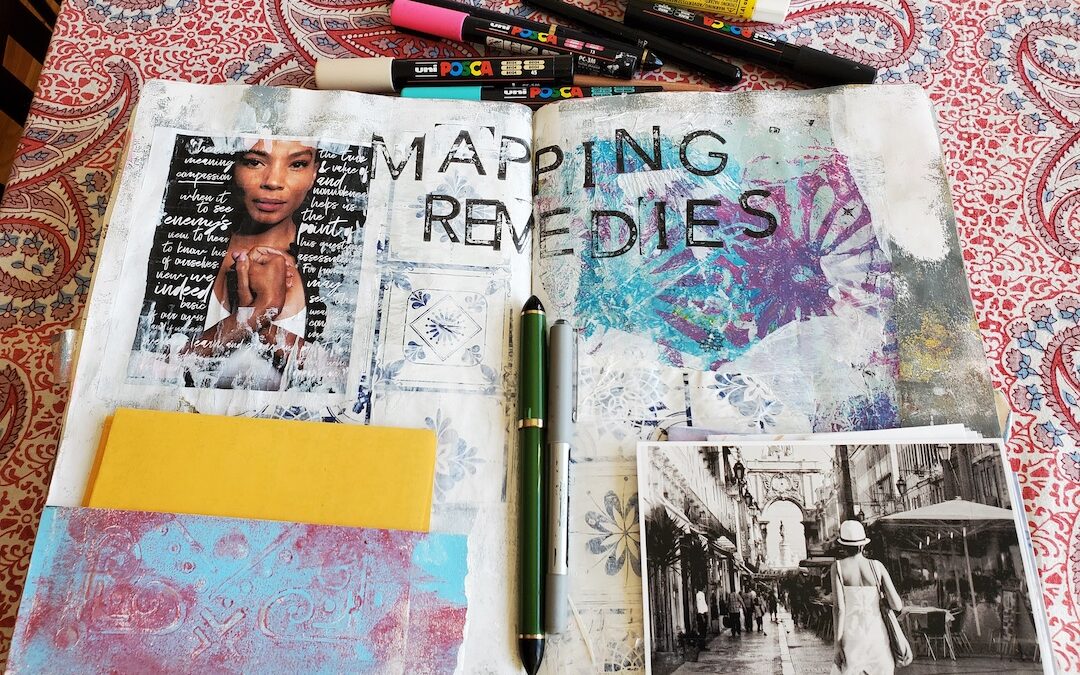
So I turn to my creative practice of visual journaling where I write my thoughts, questions, take notes, draw what I see, make marks, glue down images – ugly and beautiful, and then I reflect on what the combination of images and words reveal.
The journals I make are not a luxury – they are a necessity.
They extend my capacity to grapple with contradictions between what we we believe and what we do, what goes on in our families and ourselves, and what goes on in our cities and in the world.
Visual journals serve as containers where we may spill, rant, weep, and ultimately help us to see connections, be curious, ask new questions, and see new possibilities.
In these tumultuous times, I want to encourage you to embrace a 15 minute daily visual journaling practice to support you.
If that seems impossible with your schedule, do it once a week. Pick a day and set aside some time to write, scribble, draw and/or glue down images, even phrases from news articles.
We want answers, we want to know how to fix the problems we are facing. But when we don’t have answers, it’s enough to start with questions. Journal your questions.
Make an external space to explore what doesn’t make sense.
Being able to work with contradictions requires creativity, imagination and a space to make visible, manipulate and handle the harsh acidic happenings that burn too hot to hold inside our bodies and minds.
Now more than ever, we must condition ourselves to be able to see, name, talk about, and be CURIOUS about the contradictions between us and within us.
Through a reciprocal process of creating and reflecting in a visual journal, you can expand your capacity to do what poet John Keats described as negative capability, that is the capability of “being in uncertainties, mysteries, doubts, without any irritable reaching after fact and reason.”
It’s not about finding immediate answers or fixes but about allowing the questions and contradictions to coexist.
You’ll find that your journal pages will have a message for you, offering insights you hadn’t thought of or acknowledged, supporting actions aligned with the work you are here to do.
Here are a couple blog posts to prompt your thinking and your creating:
by Sande Smith | Apr 28, 2025 | creativity & joy
Poems can shift our perspectives, spark new thoughts and open pathways for healing.
April is national poetry month and almost every day, I have been reading a poem.
The power of poetry is often overlooked because it arranges words in ways that are unlike our everyday speech. This unfamiliarity can be off-putting. But that very unfamiliarity invites us to slow down, to listen differently, and to feel deeply.
Poetry reaches past the surface, touching emotions and truths we may struggle to articulate in ordinary language.
My mother’s love for Psalms, and Joyce Kilmer’s poem Trees, introduced me to the power of poetry early on.
I grew up hearing her recite her favorite psalms and poems in a manner that was incantatory, spell casting, magical. She showed me how poetry could be a friend, a companion in struggle. I experienced poetry as a way to shift my state of mind and connect with something deeper.
We can say things with poetry that are hard to say, hard to say because we can’t find the words to capture the range, the contradictions inside us.
Poetry to the rescue! Poetry wields imagery, metaphor, alliteration, rhyme and rhythm to create a language world we can inhabit and that can inhabit us.
Years ago, I studied poetry, and spent an especially marvelous week in Tahoe studying with tremendous poets, Lucille Clifton, Sharon Olds, Yusef Kumanyakaa, Galway Kinell and Li-Young Lee.
Every day, both the attendees and the teaching poets, wrote a new poem Every day, I felt the confusion of oh no, what am I going to write about?, felt the click of oh yes, I know, and then sat down at my keyboard, savoring the flow of laying down words, changing them, reading them out loud, then writing and rewriting my daily poem.
When I came back home after that magical week, I let drop the so-called hammer of reality – “Oh Sande”, I told myself, “What are you going to do with all that poetry stuff.” You need a job, a real job, a practical job, a job that helps people.
I put away my love of poetry.
Recently I took an online class called Poetry as Healing with Joy Roulier Sawyer. Joy spiced up the class with her red glasses and Frida Kahlo earrings, her dark black hair piled up in a rowdy bun, her face lively with emotions as she spoke – curiosity, enthusiasm, encouragement, reflectiveness.
Through the class I learned about the fields of poetry therapy and bibliotherapy that use words and poetry and texts to help people acknowledge and move through emotional pain and navigate challenging transitions.
What makes poetry a tool for healing is that our “feeling-response” is more important than an intellectual interpretation of the poem’s meaning.
I love this because it moves us away from believing that we’re not “getting” a poem. When poetry feels like a puzzle we can’t solve, then we feel locked out and frustrated.
During the class we would read the poems using the 4 stages of the bibliotherapy model:
- Recognize an emotional connection to the poem.
- Examine the poem deeply, exploring its relevance to your life.
- Juxtapose your response with others’ perspectives, noting similarities and differences.
- Integrate your experience of the poem by writing your reflections and considering any actions you might take informed by your reading and reflections.
This approach liberates us from the need to “get” the poem. Instead, we focus on connection—to ourselves, to others, and to the text.
One of the poems we read was Derek Walcott’s poem: Love After Love. Each time I read this poem an emotional resonance goes through my body, what Joy Roulier Sawyer described as the “feeling-sense,” a feeling of yes, and understanding.
Here are a few lines:
“You will love again the stranger who was your self.
Give wine. Give bread, Give back your heart
to itself, to the stranger who has loved you”
When I repeat out loud these phrases, I feel deep compassion toward myself and forgiveness for the ways I have misunderstood what was most important to my spirit and my aliveness.
Through these words, Derek Walcott expresses what it is to be estranged from himself. And he shows that there can also be a homecoming. In this poem, he invites me to come home to myself, to heal my own relationship with myself.
Poetry can be transformative. Reading poems can shift our perspectives, spark new thoughts and open pathways for healing.
Instead of being stopped by language that perplexes, we can read a poem for that feeling sense, we can savor the words that resonate with us, nourish us, and let go what doesn’t.
What is your relationship to poetry? Has it spoken to or nurtured you over the years? If you feel distanced from poetry, consider these prompts:
- If I were not afraid of poetry, I would ___________.
- Poetry reminds me ___________, which leads me to ___________.
- If I thought of poetry as healing, I would ___________.
- The poem or text that helped me recognize I was not alone is ___________.
- Healing, to me, means ___________.
- Beauty in language means ___________.
- When I hear healing language, it feels like ___________.
Poetry invites us to feel deeply and connect with ourselves and others. It’s not about decoding a puzzle but about feeling and being nourished by the essence of the words and what they mean to us. Let poetry be a companion on your journey, guiding you toward self-discovery and healing.
